The best vet tech degrees online are associate programs accredited by the AVMA Committee on Veterinary Technician Education and Activities (CVTEA), because most state boards require that accreditation before you can sit for the Veterinary Technician National Examination (VTNE). Penn Foster suits self-paced learners who want a set structure. Purdue suits people already working in a clinic. Platt College suits anyone who wants the shortest advertised timeline. SUNY Delhi suits readers who want a public college program. Dallas College suits students near campus who want in-person labs.
You can study the coursework from home, but you cannot skip the hands-on training. Accredited programs require you to practice essential skills with live animals, so expect supervised clinical work at a veterinary practice. If you are already a credentialed technician and want a bachelor’s degree, completion programs like the one at the University of Missouri exist, but this list covers paths to your first license.
Search results for online vet tech programs bury the details that matter: length, format, how clinical hours work, and what the whole degree costs. The five programs below are compared on those points. Clinical placements and licensing run through US states, so if you live abroad, ask each school whether you can enroll before you apply.
1. Penn Foster online associate degree
Penn Foster’s Veterinary Technician Associate Degree is an AVMA-accredited online program built around a clear, fixed structure. It is the easiest of the five to plan around because the credit count and clinical requirements are published up front.
Length, format, and cost
The program runs 4 semesters and 66 credits, and it includes two externships. Here is the profile at a glance:
- Credential: associate degree
- Length: 4 semesters
- Credits: 66
- Hands-on training: 2 externships
- Format: online coursework plus in-person externship work
Who it suits and what to check
This program suits self-directed learners who want a defined path and do not need a campus. Before you enroll, ask how externship sites are arranged and whether you must find the clinic yourself.
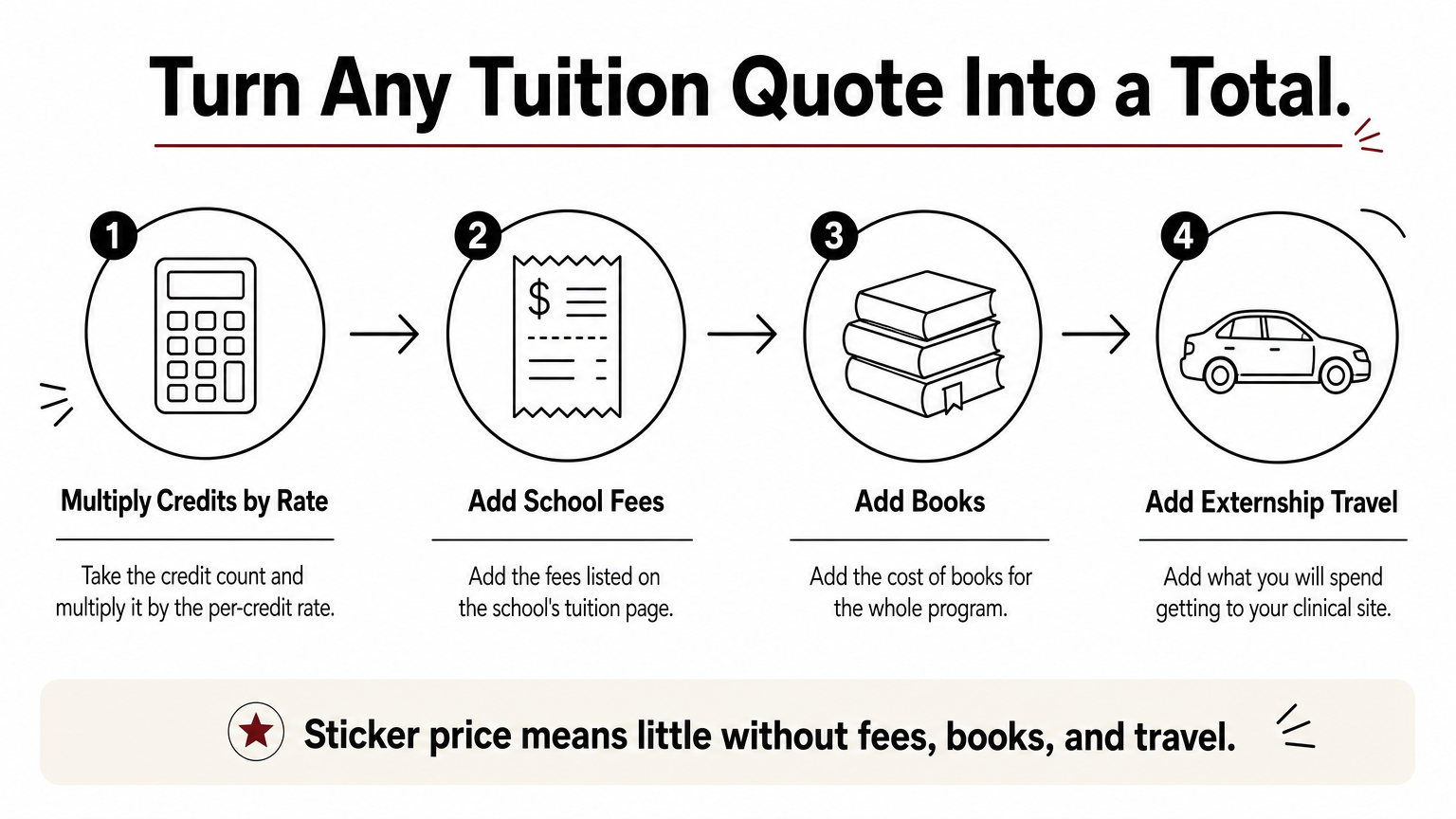
To compare cost across schools, turn every quote into a total. Multiply credits by the rate, then add fees, books, and externship travel. An illustrative rate of $250 per credit would put 66 credits at $16,500 before extras. Use that formula with the figure from the school’s tuition page.
A program’s sticker price means little until you add fees, books, and clinical travel.
2. Purdue distance learning program
Purdue’s Veterinary Technology Distance Learning Program is a flexible online route designed to fit around a busy schedule. It comes from a university veterinary college, which gives it strong name recognition with employers.

Length, format, and cost
Purdue delivers coursework through distance learning, and you complete clinical training in a practice setting. Its profile:
- Credential: veterinary technology degree through distance learning
- Format: online coursework with supervised clinical work
- Pace: built to fit around a work schedule
- Length and tuition: confirm on Purdue’s program page, since rates vary by residency
Who it suits and what to check
Purdue fits people already working in a veterinary clinic, because you can apply what you learn on the job. A flexible schedule matters most when you cannot cut your work hours.
Ask whether your current clinic can host your clinical work, and what supervision it must provide. That single answer can decide whether the program is practical for you. Also confirm the admission requirements before you budget your time.
If your employer cannot host your clinical hours, a flexible schedule will not save the plan.
3. Platt College online associate degree
Platt College offers an online associate degree in veterinary technology that it says you can finish in as little as 19 months. That makes it the quickest advertised option on this list.
Length, format, and cost
The school delivers the program through distance education with convenient class schedules. A quick look:
- Credential: associate degree
- Length: as little as 19 months
- Format: distance education
- Tuition: see the school’s program page for current rates
Who it suits and what to check
This path suits career changers who want to be licensed fast. Speed has a cost, though. A 19-month finish means a heavier weekly workload than a program that stretches over three years.
Treat "as little as" as a best case. Ask what pace gets you to 19 months, how many clinical hours fall into that window, and whether you can hold a full-time job. Then confirm the program’s accreditation on the AVMA list and compare the total cost with the others here.
The shortest timeline only helps if your weekly schedule can carry the pace behind it.
4. SUNY Delhi veterinary science technology
SUNY Delhi’s Veterinary Science Technology (AAS) online program lets you study remotely and work toward becoming a Licensed Veterinary Technician. It is new, and that shapes how carefully you should vet it.
Length, format, and cost
SUNY Delhi describes the program as fully remote for coursework. Its profile:
- Credential: Associate in Applied Science (AAS)
- Format: online study, with clinical skills still practiced in person
- Licensing goal: Licensed Veterinary Technician
- Length and tuition: check the SUNY Delhi program page, including out-of-state rates
Who it suits and what to check
It suits students who want a public college credential and live in New York or plan to be licensed there. A newer program also has a shorter track record to judge.
Check its status on the AVMA accredited-programs list before you pay a deposit, and look for VTNE pass rates, which a brand-new cohort may not have yet. If you plan to work outside New York, confirm that state’s board accepts the degree.
With a new program, verify accreditation and pass rates before you commit.
5. Dallas College veterinary technology
Dallas College runs an AVMA-accredited Veterinary Technology program that combines online classes with hands-on training. It is a hybrid, not a fully remote degree, so it works best if you live within reach of campus.

Length, format, and cost
The online classes cover theory, and the in-person portion covers skills. Quick facts:
- Credential: degrees and certificates in veterinary technology
- Accreditation: AVMA
- Format: online classes plus hands-on labs
- Tuition: ask about resident and non-resident rates
Who it suits and what to check
This program suits students near Dallas who learn better with live lab time and a faculty team nearby. Community college pricing can also lower the total, but only if you qualify for the local rate.
Ask exactly which courses meet in person, how often, and at what times. A hybrid schedule that clashes with your job is a real barrier, so get the lab calendar before you apply.
A hybrid program saves money only if you can reliably get to its labs.
How to pick and move forward
Start with accreditation, because it decides whether you can sit for the VTNE and earn a license. Then match the program to your life: Penn Foster for structure, Purdue if you already work in a clinic, Platt for speed, SUNY Delhi for a public college path, and Dallas College for in-person labs.
Before you apply, get three answers in writing: how clinical hours are arranged, what the total cost is after fees, and what the program’s VTNE pass rate has been. If you want more side-by-side breakdowns of online degrees and certificates, explore more comparisons at Study Abroad Nations.