The best associate’s degree online accredited by a recognized agency usually comes from a public community college, because it pairs regional accreditation with low tuition and credits that transfer. Pick Cerro Coso, Northeast Community College or Great Basin College if price comes first. Pick Barton County, Sinclair or California Coast University if you need flexible pacing or a faster finish. Pick Georgia State Perimeter College or Miami Dade College Online if you want a large public name. Pick Southern New Hampshire University or Purdue Global if you want a private university with many majors.
The hard part is not finding programs. Hundreds of schools advertise online associate degrees, and many "top" lists are really paid placements. Some schools are accredited by agencies that other colleges do not respect, and that can cost you transfer credits or a path to a bachelor’s degree. Others look cheap until you notice that the price only applies to residents of one state.
This article gives you ten schools that publish an accreditor and a tuition figure, so you can compare them on the same terms. A short section on accreditation comes first, so you know how to verify any school yourself. After the ten picks, you get a cost table, a worked example, and a realistic answer on one-year associate degrees. At Study Abroad Nations we compare online degrees and courses for students who are cost-conscious, so price and credibility drive every pick. Every school here is based in the United States.
What accreditation means for an online associate degree
Accreditation is a peer review by an outside agency that confirms a college meets academic standards, and it controls two things you care about: federal aid and credit transfer. Only students at schools accredited by an agency the U.S. Department of Education recognizes can use federal aid such as Pell Grants and federal loans. Most colleges also accept transfer credits only from accredited schools.
Regional and national accreditors
Regional accreditation is the older and more widely accepted type, and it is what most people mean by regionally accredited online associate degree programs. Regional accreditors cover broad areas of the country and review mostly nonprofit and public colleges. The Department of Education stopped formally separating regional and national accreditors in 2020. In practice, though, many registrars still treat credits from regionally accredited schools as the easiest to transfer.
National accreditors such as the Distance Education Accrediting Commission (DEAC) are legitimate, and they accredit many career-focused and distance schools. The risk is narrower: a regionally accredited college may refuse your credits. Here is how the ten schools below are accredited.
| Accreditor | Type | Schools in this list |
|---|---|---|
| Accrediting Commission for Community and Junior Colleges (ACCJC) | Regional | Cerro Coso |
| Higher Learning Commission (HLC) | Regional | Northeast, Sinclair, Barton County, Purdue Global |
| Northwest Commission on Colleges and Universities (NWCCU) | Regional | Great Basin |
| Southern Association of Colleges and Schools Commission on Colleges (SACSCOC) | Regional | Georgia State Perimeter, Miami Dade |
| New England Commission of Higher Education (NECHE) | Regional | Southern New Hampshire University |
| Distance Education Accrediting Commission (DEAC) | National | California Coast University |
Regional accreditation is the safest default if there is any chance you will transfer into a bachelor’s program later.
How to check a school before you apply
Do not rely on a school’s marketing page alone. Verification takes about five minutes, and you can repeat it for any program you find.
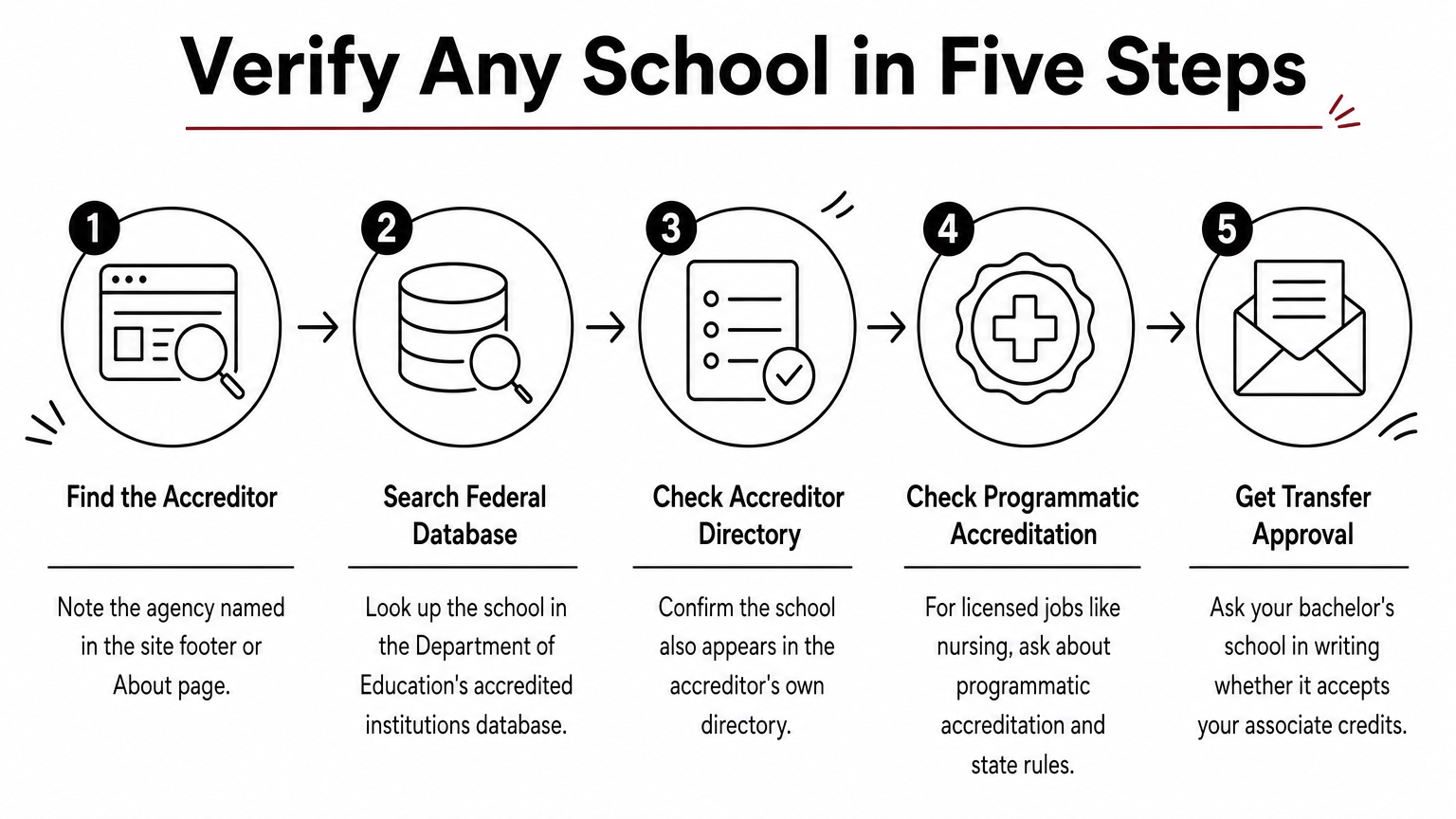
- Find the accreditation statement on the school’s website, usually in the footer or on an "About" page, and write down the agency’s name.
- Search for the school in the Department of Education’s Database of Accredited Postsecondary Institutions and Programs.
- Confirm the school appears in the accreditor’s own directory.
- If your goal is a licensed job such as nursing, ask whether the specific program has programmatic accreditation and meets your state’s rules.
- If you plan to transfer, ask the bachelor’s school in writing whether it accepts credits from your associate program.
1. Cerro Coso Community College
Accreditation and cost
Cerro Coso is a public California community college accredited by ACCJC, a regional accreditor, and it has the lowest tuition in this list at $1,380 per year for in-state students. Over two years that is about $2,760 in tuition, before fees and books.
- Accreditor: ACCJC (regional)
- In-state tuition: $1,380 per year
- Out-of-state tuition: $11,460 per year
- Typical length: 2 years
Format and who it suits
Online students can choose AA-T and AS-T degrees built for transfer, or workforce credentials in cyber security, cloud computing, Linux and data analytics. With more than 2,500 online students, the college keeps online sections running on a regular schedule. That matters when you need one specific course to graduate on time.
Cerro Coso is best for California residents who want a cheap, transfer-friendly start. The catch is the price gap, because the out-of-state rate is more than eight times higher. Students also report that learning Moodle takes effort and that reaching instructors by email or message board can be slow. If you live outside California, compare it with the next pick first.
The cheapest sticker price only helps you if you qualify for it.
2. Northeast Community College
Accreditation and cost
Northeast Community College is a public college accredited by HLC, and its out-of-state rate is one of the lowest in this list at $4,590 per year. In-state students pay $3,300. The gap between the two rates is only about $1,300, so residency barely changes your bill.
- Accreditor: HLC (regional)
- In-state tuition: $3,300 per year
- Out-of-state tuition: $4,590 per year
- Typical length: 2 years
Format and who it suits
The college lets you build toward an associate degree in smaller steps. You can finish a short credential with standalone job value, then stack it into the full degree or stop and use what you earned. Its reported first-year retention is 71%, a decent sign that students who start tend to keep going. About 1,265 undergraduates study online.
This school suits you if you are unsure about committing to two years, or if you live outside the college’s state and want a low flat-ish rate. One reviewer says classes can be hard to fit around full-time work, though tutoring is available. Plan for that before you pile on a heavy course load.
For students outside a college’s home state, the out-of-state rate is the only price that counts.
3. Great Basin College
Accreditation and cost
Great Basin College, a rural Nevada public college, is accredited by NWCCU and charges $3,810 per year in-state and $5,715 out-of-state. A two-year total therefore runs about $7,620 in-state or $11,430 out-of-state, tuition only.
- Accreditor: NWCCU (regional)
- In-state tuition: $3,810 per year
- Out-of-state tuition: $5,715 per year
- Typical length: 2 years
Format and who it suits
Great Basin enrolls about 3,000 undergraduates online, which is large for a school its size. Its programs are tied to workforce needs in rural Nevada, and reviewers describe approachable instructors, small classes and hands-on career support. Its reported graduation rate is 52%, higher than several schools in this list.
You may notice the reported median graduate earnings of $91,344. Treat that number carefully. It reflects local industries and a small group of graduates, so it is not a promise for every major. Great Basin is a good fit if you want personal attention and a program matched to real local jobs. It fits less well if you want a broad menu of majors from a large university.
Treat one standout earnings figure as a reason to ask questions, not as a forecast.
4. Sinclair Community College
Accreditation and cost
Sinclair is a public college accredited by HLC. It charges a flat $4,530 per year no matter where you live, which makes budgeting simple. Two years of tuition comes to about $9,060.
- Accreditor: HLC (regional)
- Tuition: $4,530 per year, same for in-state and out-of-state
- Typical length: 2 years
- Online undergraduates: about 7,200
Format and who it suits
Sinclair offers four delivery styles: fully online, scheduled online, blended and FlexPace. FlexPace is competency-based, so you move faster by proving you already know the material. That is the closest thing to a legitimate fast track at a public college. Sinclair also reports 100% first-year retention, which suggests its support systems work.
Student feedback is mixed, and you should know it going in. Some reviewers praise advisors and the IT faculty. Others say general education instructors answer email slowly and some course content is outdated. Its reported graduation rate is 32%. Sinclair suits self-directed students who want an out-of-state-friendly price and may already have skills to test out of coursework.
Competency-based pacing turns an associate degree from a time commitment into a test of what you know.
5. Barton County Community College
Accreditation and cost

Barton County Community College is accredited by HLC and charges a flat $4,950 per year, whether you live in the state or not. A two-year total is about $9,900 in tuition.
- Accreditor: HLC (regional)
- Tuition: $4,950 per year, same for everyone
- Typical length: 2 years
- Online undergraduates: about 2,900
Format and who it suits
Barton starts courses frequently, with rolling start dates and several term lengths, including short sessions and intersessions. You rarely wait months for the next term, which helps if your schedule changes. It also offers fully online technical programs in areas such as hazardous materials management, occupational safety and network security. Those fields are often partly in-person elsewhere.
The college has a long record with military students. One reviewer finished his degree online after studying while serving in the Army. Barton fits adults who need to start soon and finish on an irregular schedule. It also fits students in safety or security fields who want a fully online route. The review base is small, so ask an advisor about support before you commit.
Frequent start dates save more time than most students expect, because waiting for a term is lost momentum.
6. Georgia State University Perimeter College
Accreditation and cost
Perimeter College is part of Georgia State University, which is accredited by SACSCOC, a regional accreditor. The school offers online A.A. and A.S. degrees that you can complete 100% online. Tuition depends on your residency status, so check the college’s tuition page for the rate that applies to you.
- Accreditor: SACSCOC (regional)
- Degrees: online A.A. and A.S.
- Format: 100% online
- Tuition: varies by residency, confirm on the school’s site
Format and who it suits
The A.A. and A.S. are general education degrees aimed at transfer into a bachelor’s program. An A.A. leans toward liberal arts and social science with more electives. An A.S. adds more math and science for technical majors. Because the degree sits inside a large research university system, it appeals to students who already want a four-year degree there.
Do not assume a transfer is guaranteed. Ask the admissions office how your credits map to your target major. Perimeter suits students who want a recognized university name on their transcript and a clear route into a bachelor’s degree. It suits you less if you want a job-specific degree you can use right after graduation.
Choose A.A. or A.S. by the bachelor’s degree you want, not by which one sounds easier.
7. Miami Dade College Online
Accreditation and cost
Miami Dade College is a large public college accredited by SACSCOC. Its online division lists popular associate’s degree programs in flexible formats, so you can browse majors in one place. Tuition at public colleges depends on residency, so confirm your rate on the college’s tuition page.
- Accreditor: SACSCOC (regional)
- Format: online associate’s degrees
- Tuition: varies by residency, confirm on the school’s site
- Best check: whether your specific major is fully online
Format and who it suits
Miami Dade is a good place to compare several majors at once, since it publishes a program list rather than a single flagship degree. Before you commit to any major, confirm it can be completed without campus visits. Some programs include labs, clinicals or proctored exams that require you to be on site.
This school suits students who want a wide choice of fields from a large public institution. It also suits those who may later move into a state university system. We do not have a published graduation rate or median earnings figure for it, so ask the admissions office for completion and transfer data. Those two numbers say more about quality than any marketing page.
A major listed online is not always a major you can finish online.
8. Southern New Hampshire University
Accreditation and cost
Southern New Hampshire University (SNHU) is a private nonprofit university accredited by NECHE, the regional accreditor for New England. Tuition is a flat $10,260 per year for everyone, so two years come to about $20,520.
- Accreditor: NECHE (regional)
- Tuition: $10,260 per year, same for everyone
- Typical length: 2 years
- Sample online degrees: AS in Business Administration, Criminal Justice and Information Technologies
Format and who it suits
SNHU says its online degrees carry the same accreditation and value as its campus degrees. The school also markets a generous credit transfer policy and military-friendly terms. For adults with earlier college credits, that policy can shorten the path more than a cheaper school with stricter transfer rules.
Alumni data shows a reported median salary of $58,894 and a 62% recommendation rate from reviewers. SNHU costs about twice as much as the cheapest public options here. It suits working adults who want a polished online system, a wide choice of majors and a realistic chance of transferring in earlier credits. If you start from zero credits and watch every dollar, a public college will serve you better.
A higher price at a private university only pays off if the credit transfer terms save you real coursework.
9. Purdue Global
Accreditation and cost
Purdue Global is accredited by HLC, a regional accreditor, and it offers both associate of science (AS) and associate of applied science (AAS) degrees online. Tuition is a flat $11,130 per year, which makes a two-year total of about $22,260.
- Accreditor: HLC (regional)
- Tuition: $11,130 per year, same for everyone
- Degree types: AS and AAS
- Typical length: 2 years
Format and who it suits
The AS versus AAS choice matters here. An AS is built for transfer into a bachelor’s program. An AAS is built to prepare you for a specific job, and its credits may not transfer fully. Purdue Global’s reported recommendation rate is 76%, and the university describes itself as built for working adults.
Purdue Global is the most expensive school in this list, so use the price as a test. Ask what you get for the extra money, such as credit for prior learning, advising and the degree options. It fits adults who want an established private online system and know what job or degree comes next. It fits poorly if you want the lowest possible cost and have no transfer credits.
An AAS prepares you for a job, while an AS prepares you for a transfer, so decide before you enroll.
10. California Coast University
Accreditation and cost
California Coast University (CCU) is accredited by DEAC, a national accreditor, and charges a flat $5,100 per year. Two years of tuition come to about $10,200. The school also offers interest-free monthly payment plans, and 92% of reviewers recommend it.
- Accreditor: DEAC (national)
- Tuition: $5,100 per year, same for everyone
- Pacing: self-paced, 60-credit associate program
- Payment: interest-free monthly plans
Format and who it suits
CCU removes the schedule entirely. There are no semesters, start dates or pacing expectations, so you can move through a 60-credit associate program as fast as you can finish the coursework. Reviewers call the work demanding, with serious writing and open-book finals, and say staff respond quickly.
The trade-offs are real. Reviewers note limited credit transfer and licensure acceptance in some fields because of national accreditation, and the school withholds diplomas until balances are paid. CCU suits self-motivated working adults who want speed and a payment plan, and who do not plan to transfer to a regionally accredited college. If you might transfer, check with the target school first.
Self-paced study is only a good deal if your degree is accepted where you plan to use it.
How to compare cost, speed and degree fields
Tuition side by side
A two-year associate degree costs between about $2,760 and $22,920 in tuition across these schools, depending on the school and your residency. For context, the National Center for Education Statistics reports average 2022-23 tuition and fees at two-year institutions of about $4,000 at public schools, $16,300 at private for-profit schools and $19,500 at private nonprofit schools. These figures assume full-time study of roughly 60 credits and exclude fees and books. Georgia State Perimeter and Miami Dade are left out because the sources I used do not give a comparable published rate, so check their tuition pages.
| School | Annual in-state | Annual out-of-state | Two years in-state | Two years out-of-state |
|---|---|---|---|---|
| Cerro Coso | $1,380 | $11,460 | $2,760 | $22,920 |
| Northeast | $3,300 | $4,590 | $6,600 | $9,180 |
| Great Basin | $3,810 | $5,715 | $7,620 | $11,430 |
| Sinclair | $4,530 | $4,530 | $9,060 | $9,060 |
| Barton County | $4,950 | $4,950 | $9,900 | $9,900 |
| California Coast | $5,100 | $5,100 | $10,200 | $10,200 |
| SNHU | $10,260 | $10,260 | $20,520 | $20,520 |
| Purdue Global | $11,130 | $11,130 | $22,260 | $22,260 |
Here is a worked example for a student who does not live in California. Two years at Cerro Coso would cost $22,920, while two years at Northeast would cost $9,180. That is $13,740 less, for a regionally accredited degree in both cases. Against SNHU’s $20,520, Northeast still saves $11,340. Residents of California reverse the comparison, because Cerro Coso’s $2,760 is the cheapest total in the list.
Compare two-year totals for your own residency, because the lowest annual rate on a list is rarely yours.
One-year and fast routes
A one-year accredited associate degree is realistic only if you start with credits. Most associate degrees need about 60 credits, so finishing in 12 months means bringing in roughly 30 or more and completing the rest at full speed. Starting from zero, expect closer to two years. A full-time year at a flat-rate school like Barton, about $4,950, covers roughly half the degree.
Three routes can shorten the timeline:
- Transfer credits: earlier college courses, AP or similar credit can cover general education requirements.
- Competency-based pacing: Sinclair’s FlexPace and CCU’s self-paced model let you advance when you prove mastery.
- Rolling starts: Barton’s frequent start dates and short terms let you stack more courses per year.
Be careful with any school that promises a degree in six months with no prior credit. Ask for the accreditor’s name, then run the check from the first section.
Choosing a field, and a note for international students
Business, information technology and criminal justice are the most common fully online associate fields, and general studies degrees in the A.A. style are the most flexible. Nobody can honestly name the "easiest" degree, because difficulty depends on you. The highest-paying two-year fields, such as nursing, radiologic technology and dental hygiene, require clinical hours, so few of them can be completed fully online. IT and healthcare administration are better bets for a fully online route.
If you live outside the United States, check visa rules before you enroll. Students on an F-1 student visa generally cannot satisfy their status through fully online study, so ask the school’s international office what your visa allows. If you study from your home country, also confirm that your own country’s employers or universities will recognize the degree.
Pick the school, then verify it
The strongest choice for most people is a regionally accredited public college with a price that fits their residency. Cerro Coso wins for California residents. Northeast and Great Basin win for out-of-state students. Sinclair and Barton win on flexibility. Georgia State Perimeter and Miami Dade suit readers who want a large public name. SNHU and Purdue Global cost more but may reward you if you bring existing credits. California Coast University is the fast, self-paced option, with the transfer risk that comes with national accreditation.
Whichever school you shortlist, confirm the accreditor in the Department of Education database, ask about credit transfer in writing, and compare two-year totals for your own residency. To keep comparing, explore more online degrees, courses and scholarship guides on Study Abroad Nations.