The best online degrees doctorate option depends on what you want the title to do for you. Choose a DBA if you lead in business, an EdD if you work in education, a DNP if you are a nurse heading toward clinical leadership, and a DHSc if you work in health administration or public health. Choose a PhD if you want to research or teach at a university, and an executive JD if you want legal knowledge without practicing law. Whatever you pick, accreditation decides whether the degree holds its value.
The hard part is that most search results are school brochures. They tell you each program is flexible and career-ready, but they rarely tell you how many hours a week a program takes, which accreditor stands behind it, or which degree type fits your goal. That is how people end up in a 25-hour-a-week program while working full time, or in a degree their employer does not recognize.
This article sorts online doctorates by degree type, then gives each one the same three checks: who it suits, how the format works, and which accreditation to confirm. At Study Abroad Nations we compile and compare online degrees and programs for readers who want practical detail before they apply, and the same approach applies here. You will also find a verification routine and a side-by-side time table at the end.
1. Doctor of Business Administration (DBA)
A DBA is an applied research doctorate for people who already work in business and want to solve organizational problems with evidence. It is the most common online doctorate for managers, consultants, and executives who do not plan to become full-time professors.

Who it suits
The DBA fits mid-career and senior professionals in accounting, finance, marketing, management, and similar fields. Liberty University describes professional doctorates as degrees that still teach advanced research methods but aim them at practical challenges, while a PhD builds theory. That difference should guide you. If you want a faculty career at a research university, a PhD is the safer route. If you want a seat at the executive table, a DBA is usually the better match.
Pick a DBA when you want to apply research to business problems, and a PhD when you want to produce theory.
Format and time to finish
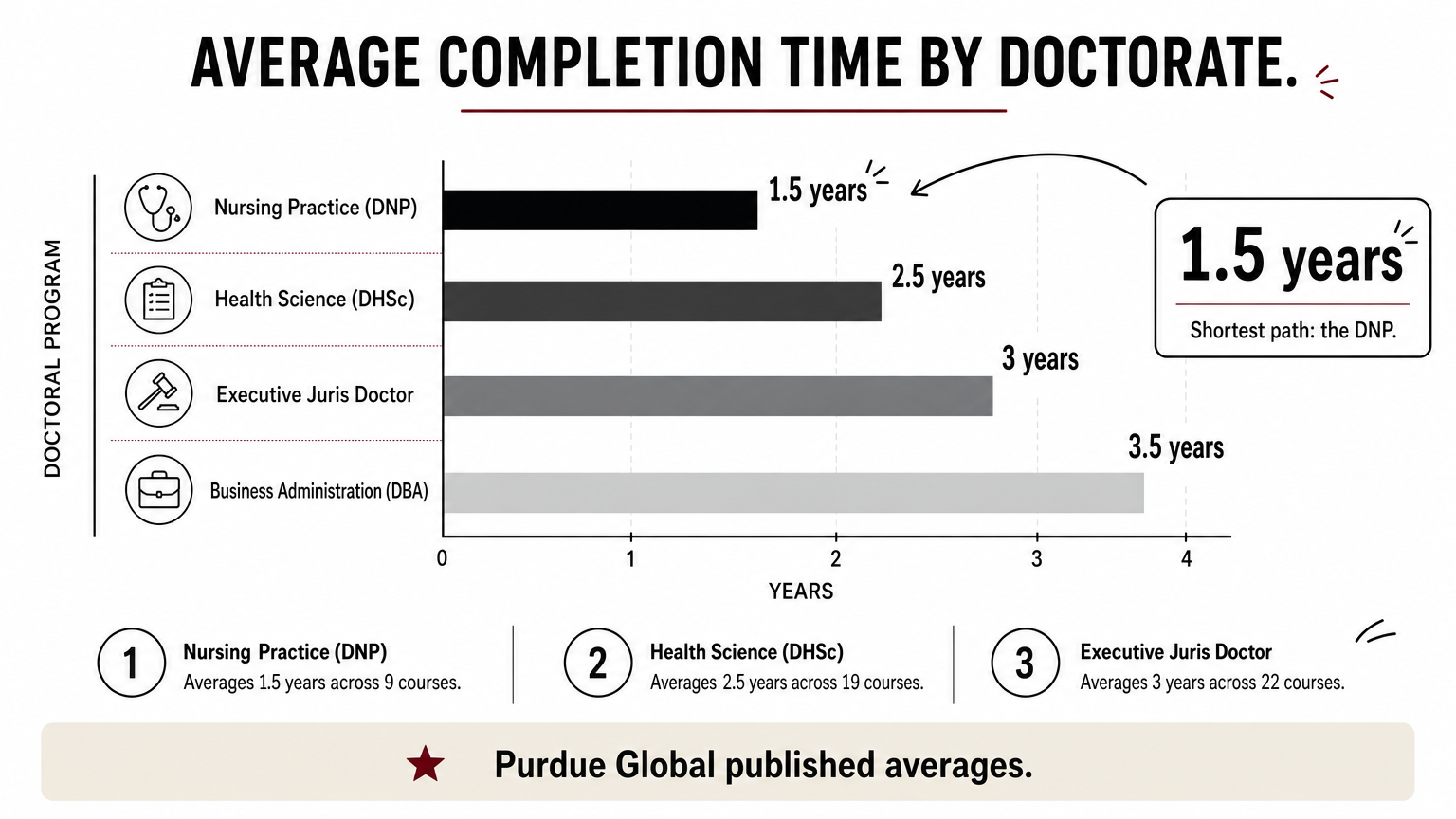
Purdue Global’s online DBA lists 23 courses of 10 weeks each, with 20 to 25 hours of work per week and concentrations in accounting, finance, marketing, management, or a custom option. Its stated average completion time is 3.5 years on a full-time schedule. Do the math before you commit: 20 to 25 hours across 10 weeks is 200 to 250 hours per course. If you work 45 hours a week, that load is real.
Liberty offers DBA tracks in more than a dozen specializations, including supply chain, healthcare management, and project management. Compare specializations, not just school names.
Accreditation to confirm
Start with institutional accreditation, such as HLC or SACSCOC, which are regional accreditors. Then look for a business accreditor. Liberty lists ACBSP accreditation for many of its business programs, and AACSB is another widely known standard. Ask whether the accreditation covers the specific DBA and not only the undergraduate business school.
2. Doctor of Education (EdD)
An EdD is a professional doctorate for educators who want to lead schools, districts, colleges, or training organizations. It focuses on applying research to practice rather than preparing you for a research career.
Who it suits
This degree suits principals, curriculum directors, instructional designers, higher education administrators, and special education leaders. Purdue Global’s Doctor of Education in Leadership and Innovation covers instruction and education policy. Liberty’s EdD catalog is much broader, with tracks in curriculum and instruction, higher education administration, instructional design and technology, special education, and educational leadership.
The choice of track matters more than the school brand. A track in higher education administration leads to different jobs than one in K-12 leadership.
Format and time to finish
Purdue Global’s EdD lists 12 courses of 10 weeks each, at 20 to 25 hours per week. That is the shortest course count among its business and education doctorates, but the weekly load is the same as the DBA. One EdD directory counts 441 online EdD programs, and says more than half of the 25 it ranks are fully online. Plenty of options exist, so you can afford to be picky about format.
With hundreds of online EdD programs available, choose on track, schedule, and accreditation rather than on whichever school advertises most.
Accreditation to confirm
Check institutional accreditation first. If the program leads to a principal or superintendent license, confirm approval with your state education agency, because licensure rules differ by state and institutional accreditation alone does not guarantee a license. Liberty notes that its initial and advanced licensure programs hold CAEP accreditation, which is the type of programmatic accreditation to look for in licensure tracks.
3. Doctor of Nursing Practice (DNP)
A DNP is the terminal practice degree for nurses who want clinical leadership, advanced practice, or health system roles. It tends to be the fastest of the professional doctorates, which also makes it the best answer if you want the quickest doctorate to finish.

Who it suits
The DNP suits registered nurses and advanced practice nurses who want to move into leadership, policy, or advanced clinical roles. Entry requirements vary. Liberty offers post-MSN options, and also post-BSN tracks in Family Nurse Practitioner and Psychiatric Mental Health Nurse Practitioner that accept applicants with only a bachelor’s degree. Most other doctorates require a master’s first, so this is an unusual path.
The DNP is usually the shortest route to a doctorate, but only if the entry track matches the degree you already hold.
Format and time to finish
Purdue Global’s online DNP lists just 9 courses of 10 weeks each, at 15 to 18 hours per week, with an average completion time of 1.5 years. Multiply it out: 15 to 18 hours across 9 courses is 1,350 to 1,620 hours of coursework. Post-BSN tracks run longer, and Liberty describes its Family Nurse Practitioner DNP as one of its longer doctorates.
Ask every school how clinical or practicum placement works. Some programs expect you to arrange your own site, which can add months.
Accreditation to confirm
Look for CCNE accreditation of the DNP itself. Liberty states that its Doctor of Nursing Practice program is accredited by the Commission on Collegiate Nursing Education. Also confirm that graduates qualify for the certification exam and your state board of nursing requirements for the role you want.
4. Doctor of Health Science (DHSc)
A DHSc is a professional doctorate for health professionals who work around patient care rather than in a licensed clinical role. It covers health administration, public health, education, and policy.
Who it suits
Pick this if you are a health administrator, allied health professional, public health worker, or health educator who wants leadership credentials. Purdue Global describes its Doctor of Health Science as focused on professional practice, with open electives so you can tailor it to your goals. Liberty offers a DHSc in Leadership and Policy, plus a PhD in Health Sciences with tracks in exercise and sport science, healthcare leadership, and trauma-informed care.
Format and time to finish
Purdue Global’s DHSc runs 19 courses of 10 weeks each, at 15 to 18 hours per week, with an average of 2.5 years. That sits between the DNP and the DBA in length. The lighter weekly load, compared with the 20 to 25 hours of the business and education doctorates, makes it one of the more manageable options for people with full-time jobs.
Because the degree is broad, check how much of the curriculum you choose. Open electives can make it fit your career exactly, or leave you with a degree that is hard to explain to an employer.
A DHSc rewards you when your goal is leadership around healthcare, not a clinical license.
Accreditation to confirm
Institutional accreditation is the baseline. Programmatic accreditation matters less for a DHSc than for a DNP, since no license depends on it. Still, ask for faculty credentials and whether the school lets you contact graduates working in your target field.
5. Online PhD
An online PhD is the research doctorate, built for people who want to produce original scholarship and often to teach at universities. It is the right choice when your goal is academic, and the wrong one when you want a faster professional credential.
Who it suits
A PhD suits future professors, researchers, and policy analysts. Liberty describes PhDs as research-focused, theory-based degrees for academic roles, and offers them in fields including education, psychology, criminal justice, history, English, communication, and aviation. It also lists 150+ doctoral and postgraduate degrees in total, the widest catalog in this group. Many programs are built for working adults, so being 35 or older is not a barrier. Time is the real cost.
Format and time to finish
Liberty teaches primarily in 8-week courses with 8 start dates a year and no set login times. Most programs are fully online, but some require on-campus intensives in Lynchburg, Virginia. Liberty also says you may transfer in up to 50% of a graduate or doctoral degree, which can shorten the path.
If you want a doctorate with no dissertation, a PhD is the wrong tool, since it centers on one. Some professional doctorates replace it with an applied project, so confirm the final requirement before you enroll.
Stepping stones and cost
If you are not ready to commit, Liberty offers Executive Certificates of 21 credit hours that roll into the matching doctorate. Its military rate is $395 per credit hour for the 2026-2027 academic year, and rates change, so confirm current tuition on the school’s site. Compare cost per credit and total credits together.
The cheapest-looking PhD is not the cheapest if it needs more credits and years than a professional doctorate.
6. Executive Juris Doctor
An executive JD is a law doctorate for professionals who want legal expertise but do not plan to practice law. It is the only list item here that explicitly does not lead to a license.
Who it suits
It suits people in compliance, health care, IT, business, finance, criminal justice, and education who deal with regulation daily. Purdue Global’s Executive Juris Doctor offers concentrations in health law, education law, business law, and law and technology. Its separate Juris Doctor is aimed at people who want to become licensed attorneys, and Purdue says its JD graduates meet the legal education requirement of the State Bar of California.
Format and time to finish
The Executive JD lists 22 courses of 16 weeks each, at 25 to 35 hours per week, with a 3-year average. That is the heaviest weekly load in this list: 400 to 560 hours per course. The regular JD has 31 courses and averages 4 years. If you work full time, test whether you can sustain 25 hours a week before you apply.
An executive JD builds legal skill without a law license, so use it for your career, not for the bar exam.
Accreditation to confirm
Bar admission rules vary by state, and a degree that qualifies you in one state may not in another. Ask the state bar directly, before you enroll, whether a school’s JD lets you sit for the exam. For the executive version, institutional accreditation is the main check, since no bar eligibility is involved.
How to confirm accreditation and compare programs
Confirm accreditation by identifying the school’s accreditor and checking that a federally recognized body stands behind it. Do not rely on a school’s own claim, and do not assume an online degree is lesser. Accredited online doctorates carry the same credential as their on-campus versions.
Verify the accreditor
Search the school in the U.S. Department of Education’s Database of Accredited Postsecondary Institutions and Programs, which lists recognized accreditors. Purdue Global, for example, notes that HLC is recognized by the Department of Education. Then check programmatic accreditation for your field, such as CCNE for nursing.
Warning signs include no named accreditor, degrees awarded mainly for life experience, flat fees for a doctorate with no coursework, and pressure to enroll today. Are online doctorates respected? When the school and program are accredited, employers generally treat them the same. Liberty says its diplomas do not say "online," so ask each school about its policy.
Compare time commitment side by side
These are Purdue Global’s published figures. Use them as a yardstick when you request the same numbers from other schools.
| Program | Courses | Course length | Weekly effort | Average completion |
|---|---|---|---|---|
| Doctor of Nursing Practice | 9 | 10 weeks | 15-18 hrs | 1.5 years |
| Doctor of Health Science | 19 | 10 weeks | 15-18 hrs | 2.5 years |
| Executive Juris Doctor | 22 | 16 weeks | 25-35 hrs | 3 years |
| Doctor of Business Administration | 23 | 10 weeks | 20-25 hrs | 3.5 years |
| Doctor of Education | 12 | 10 weeks | 20-25 hrs | Not listed |
Compare courses, weekly hours, and completion time, not marketing promises like "flexible" or "fast."
Choosing your doctorate
The right online doctorate follows your goal. A DBA or EdD suits professionals who want to lead, a DNP is typically the shortest path, a DHSc covers health leadership, a PhD serves academic careers, and an executive JD gives legal expertise without a license. Across all of them, check the accreditor, the weekly hours, and any on-campus or placement requirements before you apply.
Shortlist two or three programs, request the course count and average completion time from each, and confirm accreditation in the federal database. If you also need help with admissions documents, scholarships, or comparing other degrees and certificates, you can compare more online degrees and programs at Study Abroad Nations.