The best sonography certificate programs combine programmatic accreditation (CAAHEP is the main accreditor), a clinical placement you can complete near home, and tuition you can carry. Labette Community College suits healthcare workers who want general or vascular sonography at the lowest cost. Fort Hays State University suits credentialed sonographers who want to add cardiac in about six months. Boise State University suits imaging professionals who want a registry-focused general program. Washburn University suits anyone who wants three concentrations to choose from.
Searching for ultrasound technician certificate programs is confusing because the label covers two different things. Entry-level programs train beginners and usually run on campus. Post-primary certificates are built for people who already work in healthcare, and these are the ones that offer online coursework. Even then, every program requires in-person clinical hours, so "online" never means fully remote.
At Study Abroad Nations, we compile and compare online courses, degrees, and certificate programs, so this article follows that approach. Below you get four online and hybrid programs with real prerequisites, credits, length, and tuition. After that you get a side-by-side table, a checklist for evaluating any program in your own area, and straight answers on certificate versus degree.
1. Labette Community College for general sonography
Labette’s online diagnostic medical sonography certificate is the strongest all-round pick here, because it holds CAAHEP accreditation and costs the least of the programs with a general track. It also offers a vascular track, so it covers two of the main specialty areas.
Program snapshot
Labette is a public college, institutionally accredited by the Higher Learning Commission. You complete coursework online and clinical training in person near where you live. That second part is the real commitment, so read the clinical line below closely.
- Concentrations: general sonography (abdomen-extended and OB/GYN, 44 credits) or vascular sonography (38 credits)
- Length: 14 months
- Clinical requirement: at least 1,042 hours
- Tuition: $132 per credit in-state, roughly $5,016 to $5,808 in total
- Example courses: sonography pathology of abdomen and small parts, sonography physics and instrumentation
Admission requirements
Labette expects an existing healthcare background. You need an associate or bachelor’s degree with a medical component and a minimum 2.5 GPA. You also need prerequisite courses completed with a C or better, plus hands-on patient care experience.
- College algebra
- Communications or composition
- Anatomy and physiology
- Medical terminology
- Physics
Who it suits
This program fits a nurse, radiologic technologist, or other clinician with patient care experience who wants to move into sonography without paying university-level tuition. The 44-credit general track costs about $5,808 at the in-state rate, which is a fraction of what the other general programs charge.
The tradeoff is time and logistics. Fourteen months is longer than most one-year options, and 1,042 clinical hours is a serious block of your week. Ask early whether the school helps arrange your placement or expects you to find a site yourself.
A low tuition figure only helps if you can secure a clinical site close enough to complete the hours.
2. Fort Hays State University for cardiac sonography
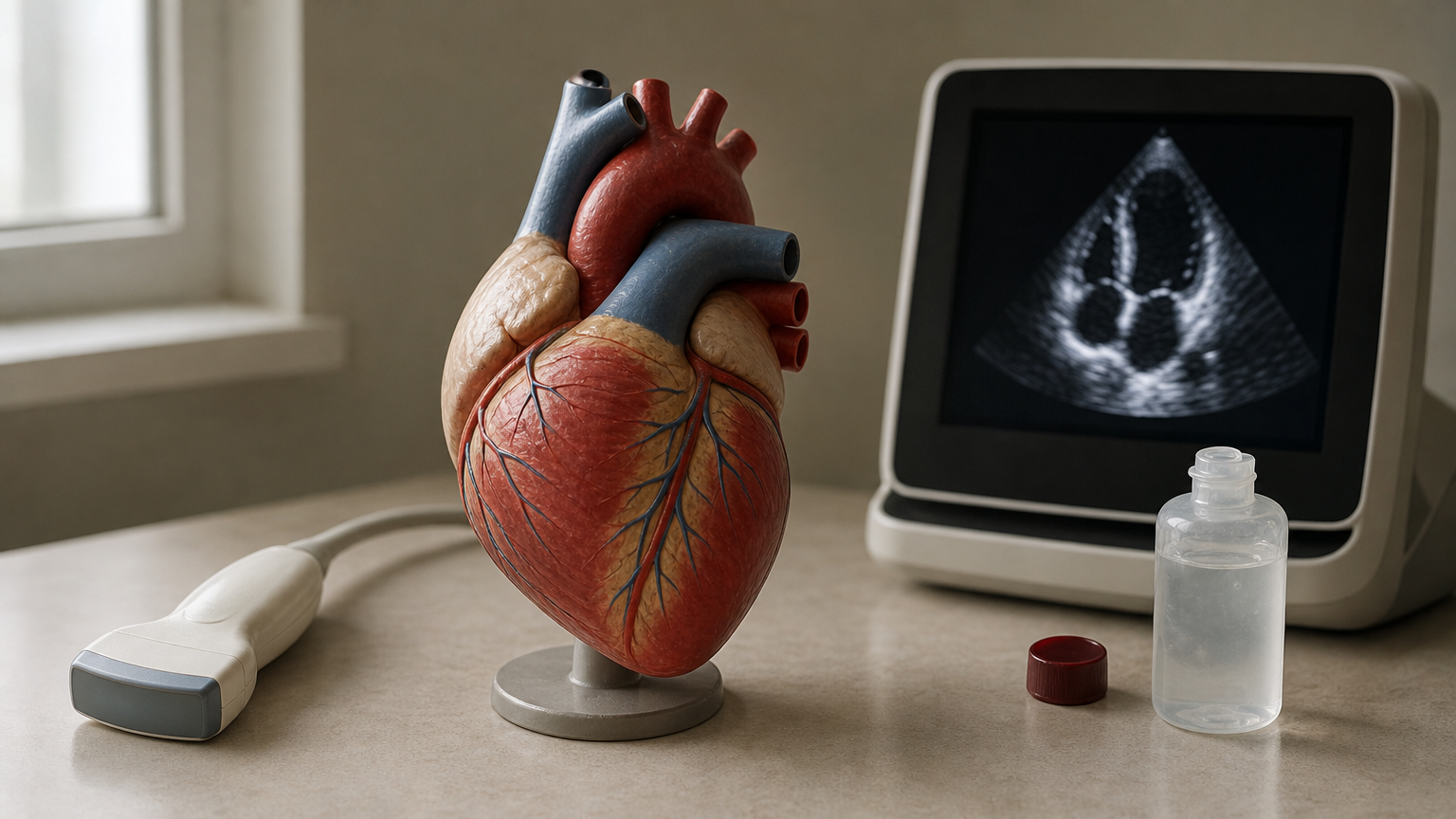
Fort Hays State’s hybrid diagnostic cardiac sonography certificate is the cheapest and shortest program on this list, at about $4,505 and six months. It is not a starting point, though. It is a specialty add-on for people who already hold a sonography credential.
Program snapshot
The program is hybrid and includes a clinical preceptorship, meaning you train under a working practitioner. FHSU is a public university accredited by the Higher Learning Commission, and it does not charge extra for out-of-state students in this program.
- Focus: diagnostic cardiac sonography (echocardiography)
- Length: 6 months
- Credits: 17
- Tuition: $265 per credit, about $4,505 total
- Example courses: cardiac pathophysiology I, echocardiography I and II
Admission requirements
You need to have completed a diagnostic medical sonography program, or hold at least one of these credentials: RDMS, RVT, RT(S), RVS, or SPI. You also need coursework in human anatomy, physiology, and basic principles of sonography. Applicants who do not yet hold a sonography credential will not qualify, so confirm your credential before you apply.
Who it suits
The best match is a sonographer certified in abdomen or OB/GYN who wants to add echocardiography skills and widen the jobs available. At 17 credits, the cost per month of study is low, and the six-month schedule works around a full-time job better than a longer program.
Because the clinical preceptorship happens in person, you still need a cooperating lab near you. Also check the program’s programmatic accreditation status and which registry exams the training prepares you for, since that determines your credentialing path.
If you already hold a sonography credential, a six-month cardiac certificate is the quickest way to add a specialty.
3. Boise State University for registry-focused training
Boise State’s online certificate in diagnostic medical sonography is the most expensive of the four, at about $20,915, and the most comprehensive. It prepares you for the ARDMS Registered Diagnostic Medical Sonographer exam and/or the ARRT sonography exam, which makes it a registry-focused choice for imaging professionals.
Program snapshot
BSU is a public university accredited by the Northwest Commission on Colleges and Universities. Like Fort Hays State, it charges no extra for out-of-state students, so the price is the same wherever you live.
- Focus: general diagnostic medical sonography
- Length: 12 months
- Credits: 47
- Tuition: $445 per credit, about $20,915 total
- Example courses: Doppler procedures, study of diseases in imaging sciences
- Clinical experience: in person, near your location
Admission requirements
The entry bar is one line: an imaging credential. Unlike Labette and Washburn, BSU does not list a long set of prerequisite courses. If you already work in imaging, for example as a radiologic technologist, you may be able to apply sooner than you could elsewhere.
Who it suits
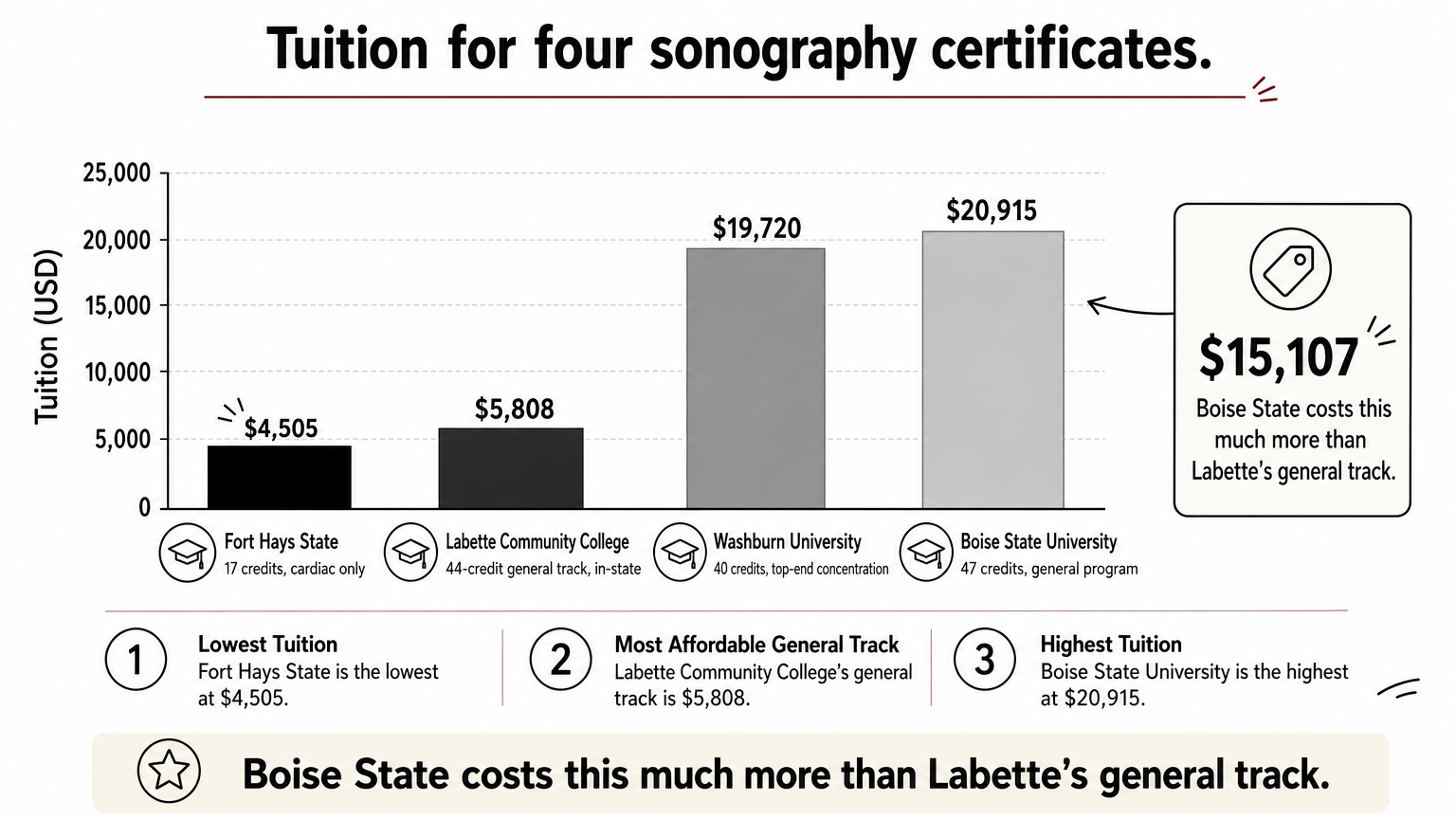
This program suits an imaging professional who wants a general sonography pathway and values a program built around registry exam preparation. The worked comparison matters here. Labette’s 44-credit general track costs about $5,808, while BSU’s 47 credits cost $20,915, a gap of $15,107 for a similar number of credits.
Ask what that extra money buys: faculty support, clinical placement help, exam preparation, or simply the university name. If the answer is vague, the cheaper program may serve you equally well.
BSU costs about $15,000 more than Labette’s general track, so make the program justify the premium.
4. Washburn University for choosing a concentration
Washburn’s online diagnostic medical sonography certificate is CAAHEP-accredited and offers three one-year options, the most of any program here. You choose between abdomen-extended and OB/GYN sonography, adult cardiac, and vascular.
Program snapshot
Washburn is a public university accredited by the Higher Learning Commission. It reports a 13-to-1 student-to-faculty ratio, which points to small classes and more instructor contact than a large lecture format.
- Concentrations: abdomen-extended and OB/GYN, adult cardiac, or vascular
- Length: 1 year
- Credits: 34 to 40, depending on the concentration
- Tuition: $493 per credit, an estimated $16,700 to $19,700 in total
- Graduation requirement: 1,104 clinical hours and passing all clinical competencies
- Example courses: sonography principles and instrumentation I, II, and III; OB/GYN sonography procedures I and II
Admission requirements
You need an associate degree or higher in a healthcare field. Required coursework covers communication, human anatomy and physiology I and II, mathematics, physics, and medical terminology. Check each course against your transcript before you apply, because a missing prerequisite can delay your start by a full term.
Who it suits
Washburn fits someone who wants a CAAHEP-accredited route and has not settled on a specialty. Choosing among abdomen, cardiac, and vascular inside one program is useful if you want to see what the job involves before you commit.
You pay for that flexibility. At 40 credits, tuition comes to about $19,720, nearly $14,000 more than Labette’s top-end figure. Clinical hours are also the highest on this list, so plan your work schedule around them.
Washburn gives you the widest choice of specialties, and you pay for that choice per credit.
Sonography certificate programs compared side by side
These four sonography certificate programs differ most in price and in who can enter, so read the cost and prerequisite columns first. Figures come from published program details as of spring 2026, and schools change rates, so confirm them on each program page before you budget.
Comparison table
| School | Focus | Length | Credits | Estimated tuition | Programmatic accreditation |
|---|---|---|---|---|---|
| Labette Community College | General or vascular | 14 months | 38 to 44 | $5,016 to $5,808 (in-state) | CAAHEP |
| Fort Hays State University | Cardiac | 6 months | 17 | $4,505 | Confirm with the school |
| Boise State University | General | 12 months | 47 | $20,915 | Confirm with the school |
| Washburn University | Abdomen/OB-GYN, cardiac, or vascular | 1 year | 34 to 40 | $16,700 to $19,700 | CAAHEP |
What the numbers mean
The cheapest option is not always the right one. Fort Hays State costs the least, but only credentialed sonographers can enter. Labette is the best value for a general track, while Boise State and Washburn cost three to four times as much.
School-wide retention rates also differ: 57% at Labette, 69% at Washburn, 77% at Fort Hays State, and 78% at Boise State. These describe the whole institution, not the sonography program, so treat them as a rough signal and ask each program for its own completion and credentialing pass rates.
Match the program to your starting credential first, then compare price, because eligibility rules the cheapest options out for most people.
What to check before you enroll in a sonography program
Whatever program you consider, in your own area or online, check four things: accreditation, clinical placement, the credential you will earn, and the prerequisites you still lack. A program that fails any one of these can cost you months or leave you ineligible for the registry exams.
Accreditation comes in two layers
Institutional accreditation covers the whole college and affects financial aid and credit transfer. Programmatic accreditation covers the sonography program itself. For sonography, the key one is the Commission on Accreditation of Allied Health Education Programs. You can search for accredited programs in the CAAHEP database, which also works for finding programs near you.
Some programs are not CAAHEP-accredited but still meet the credentialing standards of ARDMS, ARRT, or CCI. That can be legitimate, but it means you must verify your eligibility for those exams directly with the credentialing body before paying tuition.
Clinical hours decide how realistic a program is
Programs here require about 1,000 or more clinical hours, and you complete them in person at a hospital, clinic, or imaging center. Ask three questions: does the school place you, do you have to find your own site, and will your employer let you train there?
For entry-level certificate programs offered at local colleges, expect roughly 12 to 22 months of full-time study with hours on campus and at clinical sites. These are the programs to look at if you do not yet hold a healthcare degree.
Certificate and certification are different things
A certificate is an academic credential from a school. A certification, such as the RDMS from ARDMS, is a professional credential from a registry. Finishing a certificate program does not automatically make you certified. It prepares you to sit the exam, and many employers want the registry credential. Ask each program which exams its graduates are eligible for.
A certificate gets you trained, but the registry credential is what most employers actually screen for.
Is a certificate or a degree better for sonography?
A certificate is better if you already hold a healthcare degree and want the fastest route into sonography. A degree is better if you are starting from scratch. The U.S. Bureau of Labor Statistics lists an associate degree as the typical entry-level education for diagnostic medical sonographers, as shown in its occupational outlook.
Can you become a sonographer with just a certificate?
Yes, if the certificate is accredited and you then pass the registry exams your employer expects. The catch is that the certificates above require prior healthcare education, so for most readers the certificate sits on top of an earlier degree or credential rather than replacing it.
What is the fastest way to become a sonographer?
Your starting point sets the speed. A credentialed sonographer adding a specialty can finish in as little as six months. Someone with a healthcare associate degree can finish a post-primary certificate in about 12 to 14 months. Someone with no healthcare background should plan for prerequisites first, then an entry-level program of roughly one to two years.
What does the job pay?
The BLS reported a median annual wage of $89,340 for diagnostic medical sonographers in May 2024, with the top 10% earning more than $123,170. Outpatient care centers paid the most, with a median of $123,610 compared with $83,200 in medical and diagnostic labs. Registered nurses earn in a similar range, so the better pick depends on the work you want to do, not the paycheck alone.
Choose the shortest path that still leaves you eligible for the registry exam your employer requires.
Choosing your sonography program
Start with the credential you hold today. That one fact decides whether Labette, Fort Hays State, Boise State, or Washburn is open to you, and it sets your timeline. Then compare tuition, confirm programmatic accreditation, and secure a clinical site before you pay a deposit.
If you want to keep comparing, browse more program comparisons on Study Abroad Nations for online certificates, degrees, and courses that fit your budget and schedule.