The best vet assistant certificate programs are NAVTA-approved, include a supervised externship, and tell you the total price up front. If you want the strongest credential path, pick Animal Behavior College or VetBloom. If you want a low price and speed, U.S. Career Institute is the budget option, with a trade-off on approval. If you want in-person training, a community college program such as Brookdale’s is the better fit.
The problem is that veterinary assistant certificate programs look alike on their websites. Most promise flexible online study and a path into animal care. Few of them make it easy to compare what you pay, how long you study, how many hands-on hours you get, and whether the program qualifies you for the Approved Veterinary Assistant (AVA) exam. Vet assisting is largely unregulated, so the quality gap between programs is real.
At Study Abroad Nations we compare online courses, degrees, and certificate programs so you do not have to piece the facts together yourself. This article walks through five programs with the same checks for each: how it works, what it costs, how long it takes, and who it suits. A side-by-side table and a short guide to choosing follow the list.
1. Animal Behavior College
Animal Behavior College (ABC) offers a NAVTA-approved online veterinary assistant program that you finish at your own pace, with a required externship at a real clinic. It is the most externship-heavy option on this list.

How it works
You study online, then complete clinical training in person. The coursework covers the basics a clinic expects on day one, plus the business side of running a practice.
- Core topics: animal restraint, examination room procedures, surgical assisting, small animal nursing, and radiology
- Practice skills: managing medical records and inventory, working with a veterinary team, and writing a resume and interviewing
- Externship: up to 20 weeks, with at least 100 training hours
- Placement: you train at one of the school’s roughly 4,000 partner facilities
ABC also offers short add-on courses in pet fostering, dog walking, animal nutrition, and pet massage. They are optional, but they help if you want side income while you look for a clinic job.
An externship at a partner clinic is the single feature that turns an online certificate into something an employer can picture.
Cost, length, and who it suits
Tuition runs from $1,399 to $5,630, depending on the payment plan you choose. The program generally takes about a year. Ask which total you are being quoted before you sign, because the gap between the two figures is large. ABC offers payment plans and accepts military spouse education benefits.
This program suits you if you have no clinic experience and want help finding a placement. It is less ideal if you need a certificate within a few months, because the externship stretches the timeline.
2. VetBloom
VetBloom runs a NAVTA-approved online veterinary assistant program built from five modules that you complete in 26 weeks. It has the clearest timeline and price of the five.
How it works
The online modules cover the knowledge side of the job, and a required externship covers the hands-on side.
- Knowledge: basic medical terminology, animal anatomy and physiology, diseases and treatments, and nutrition
- Skills: grooming, medical calculations, updating patient records, discharge procedures, and phone etiquette
- Externship: six weeks in a full-service animal clinic or hospital, with a minimum of 120 training hours
Cost, length, and who it suits
The program costs $4,000, and that price includes the certification exam fee. Many programs charge for the exam separately, so this bundling matters when you compare totals. Spread over the 26 weeks, the tuition works out to about $154 per week. VetBloom offers payment plans, accepts employer tuition reimbursement, and takes military spouse benefits.
VetBloom suits you if you work full time, want a fixed schedule, and prefer one price with no surprises. It also suits you if your current employer, such as a clinic where you already work as a receptionist, will reimburse tuition. The externship is shorter than ABC’s but has a higher minimum number of hours.
3. Blackstone Career Institute
Blackstone Career Institute offers an NAVTA-approved online veterinary assistant program at a mid-range price. It suits you if approval matters to you but a $4,000 tuition does not fit your budget.
How it works
The program is delivered online, and graduates of NAVTA-approved programs are eligible to sit the AVA exam. The public details on externship hours and pacing are thinner than for ABC or VetBloom. Before you enroll, ask admissions these questions:
- Does the program include a supervised externship, and who arranges it?
- Is the exam fee included in tuition?
- What is the time limit to finish, and what happens if you need more time?
- What does the school charge if you pay monthly instead of upfront?
Approval tells you the curriculum is vetted, but only the answers to the questions above tell you what you will actually pay and do.
Cost, length, and who it suits
Published tuition has been about $1,214, which is well below VetBloom. Length depends on how fast you study, so confirm the maximum time allowed on the enrollment page.
This program suits you if you are self-disciplined, comfortable studying alone, and able to arrange your own clinic shadowing or volunteering. If you have no clinic contact at all, you may prefer a program that places you for the externship.
4. U.S. Career Institute
U.S. Career Institute offers a self-paced online veterinary assistant certificate that can prepare you for an entry-level role in as little as 4 months. It is the cheapest and fastest program here, and the only one without NAVTA approval.
How it works
Everything is online and self-paced. That works well for a fast introduction to terminology, animal handling basics, and clinic procedures. At the time of writing, the program is not on NAVTA’s approved list, so confirm its status on NAVTA’s AVA programs page before you pay.
That matters because the AVA exam is open to graduates of NAVTA-approved programs. A certificate from a program outside that list is a course-completion credential, not a route to the AVA title.
Cost, length, and who it suits
Published tuition has been about $689, and the length is as short as 4 months. Prices change, so check the current figure and what payment options apply.
This program suits you if you already have a clinic job lined up, you want a foundation before an interview, or you are testing whether the field is right for you. It is a poor fit if you want the AVA credential. As a rule, a cheap certificate is good value only when it does what you need it to do.
A $689 certificate that cannot lead to the AVA exam can cost you more than a $4,000 one that can.
5. Brookdale Community College
Brookdale Community College’s continuing education program, based in Lincroft, New Jersey, is an NAVTA-approved campus option run in collaboration with Red Bank Veterinary Hospital. It stands in for the in-person route you can find at community colleges across the country.

How it works
Instead of studying alone online, you learn in a classroom setting, with a working veterinary hospital as a partner. That partnership is the main draw. NAVTA’s approved list includes dozens of community colleges and career centers in many states, so a campus program may exist near you. Search the list by state before you assume online is your only choice.
Cost, length, and who it suits
Pricing and schedule for Brookdale’s program are set by the college and change between terms, so check its continuing education page for the current figures. Community college continuing education programs often have fixed start dates, which is the opposite of self-paced online study.
This program suits you if you live within commuting distance, learn better with an instructor in the room, or want a local clinic relationship that can lead to a job. It is less suitable if you need to study around a work schedule at any hour.
How to choose between these programs
Choose the cheapest program that is NAVTA-approved and includes a supervised externship. Everything else is a tiebreaker: schedule, price structure, and whether you learn better online or in person.
Side-by-side comparison
| Program | Format | Length | Published cost | NAVTA approved |
|---|---|---|---|---|
| Animal Behavior College | Online plus externship | About a year | $1,399 to $5,630 | Yes |
| VetBloom | Online plus 6-week externship | 26 weeks | $4,000 (exam fee included) | Yes |
| Blackstone Career Institute | Online | Confirm with school | About $1,214 | Yes |
| U.S. Career Institute | Online, self-paced | As little as 4 months | About $689 | Not on the list |
| Brookdale Community College | Campus | Confirm with college | Confirm with college | Yes |
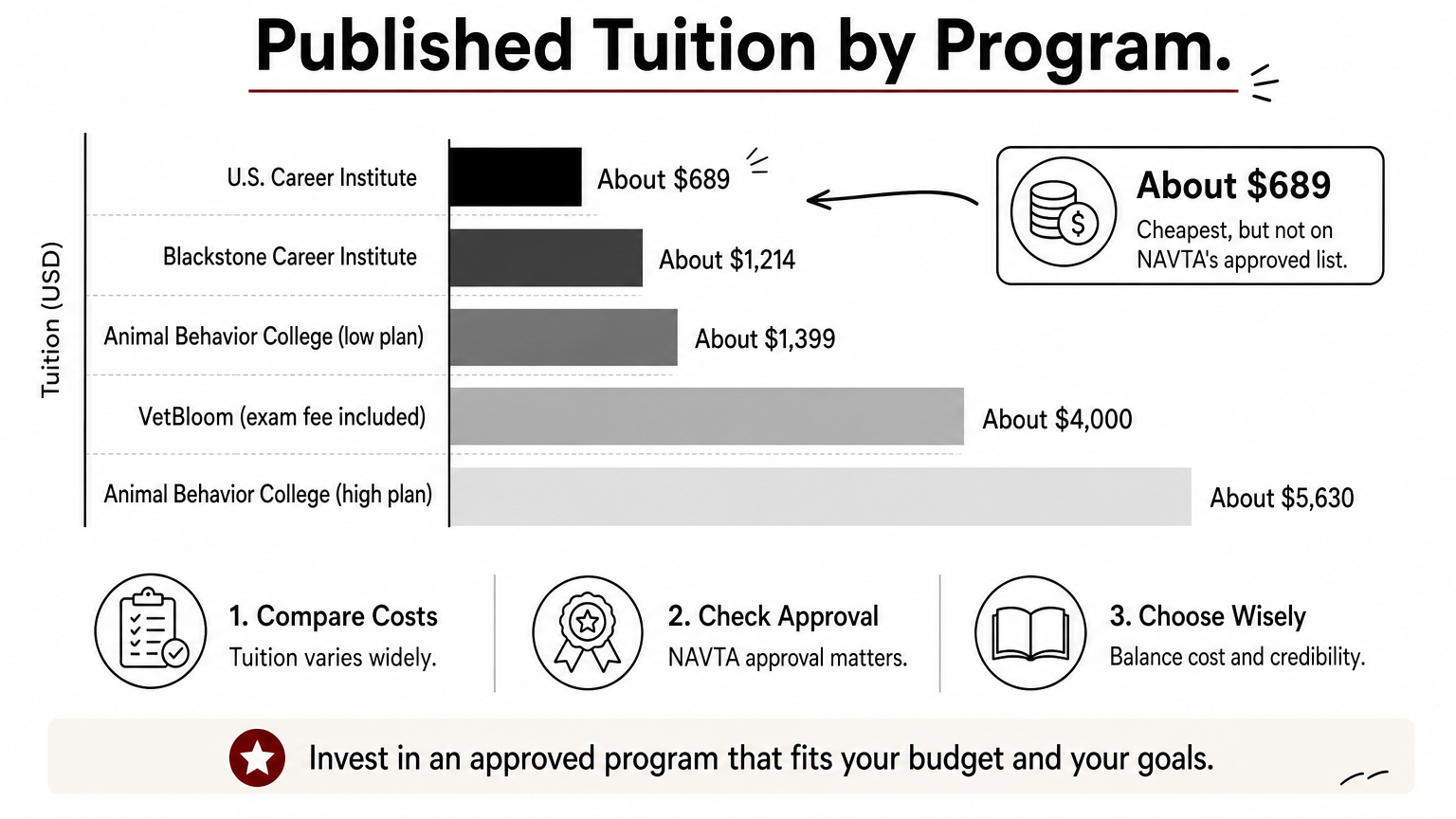
Here is a worked comparison. VetBloom at $4,000 over 26 weeks is about $667 a month if you spread it over six months. U.S. Career Institute at $689 over 4 months is about $172 a month. The second looks far cheaper, but only the first leads to AVA eligibility.
Is a vet assistant certificate worth it?
A certificate is worth it when it gets you hired faster or moves you toward the AVA credential. It is not worth it if you can get the same clinic job with on-the-job training. The U.S. median pay for veterinary assistants and laboratory animal caretakers was $38,150 in the Bureau of Labor Statistics’ May 2025 data, so keep the tuition modest. See the BLS occupational data for the latest figures. Projections point to roughly 8.7% job growth from 2024 to 2034.
Vet technicians generally earn more, but they need a two-year associate degree accredited by the American Veterinary Medical Association. A certificate and some clinic experience can be a stepping stone toward that degree.
Do you need a degree or the AVA credential?
You do not need a degree to work as a vet assistant, and you do not need a certificate. Many clinics train new hires on the job. The AVA credential is optional but adds proof of skills. To earn it, you complete a NAVTA-approved program, pass the AVA exam, and renew every two years with ten continuing education credits and a $10 fee.
Free courses can teach basics, but none of the approved programs above is free, and a free course will not make you eligible for the exam. NAVTA does not endorse third-party practice tests, so rely on your program’s own materials. Before you pay for any program, volunteer or shadow at a clinic for a few days. Loving animals and handling sick or frightened ones are different things.
Picking the program that fits you
If you want the AVA path with maximum hands-on practice, choose Animal Behavior College. If you want a fixed 26-week schedule and one price that includes the exam, choose VetBloom. Blackstone is a mid-priced approved option, U.S. Career Institute is a fast and cheap starting point without approval, and a campus program like Brookdale’s works best if you want in-person teaching.
Whatever you choose, verify NAVTA approval, ask about externship hours and who arranges them, and get the total cost in writing, including the exam fee. For more comparisons of certificate programs, free courses, and scholarships, browse the guides at Study Abroad Nations and build a shortlist before you enroll.