The best certificate programs for medical assistant training are accredited, prepare you for a national exam such as the CCMA, and quote one clear total price. If you want the fastest and cheapest route, Clinical Skills Institute lists about 2 months and about $900. If you want a self-paced course with a monthly payment plan, U.S. Career Institute fits. If you want a university-run course with 540 hours of instruction, Kean University’s CCMA program fits.
The problem is that prices run from about $900 to $4,000 and lengths run from 2 months to a year. Marketing pages rarely tell you which exam you will be eligible for, or whether the price includes the exam fee and clinical practice. Picking on price alone can leave you with a certificate that an employer does not value.
Study Abroad Nations compares online courses, degrees, and certificate programs, so this guide does the same for medical assisting. First you will see what to check in any program. Then come five programs, a side-by-side table with a worked cost example, and ways to cut the bill. Prices come from each school’s published pages, so confirm them before you pay.
What to check before you choose a program
A good program ties together three things: the exam it prepares you for, the accreditation behind it, and a total price you can verify. Check these before you compare brand names.
Which exam the program prepares you for
Most short online programs prepare you for the Certified Clinical Medical Assistant (CCMA) exam from the National Healthcareer Association. The other major credential is the CMA (AAMA), issued by the American Association of Medical Assistants. Its exam has 200 multiple-choice questions, 160 minutes of testing time, and a minimum passing score of 405 on a 200 to 800 scale. The AAMA reported that 69% of first-time candidates passed between July 2024 and April 2025.
The CMA (AAMA) route is built around graduates of programs accredited by CAAHEP or ABHES. Most fast online certificate programs are not, so they aim at the CCMA instead. A CMA is also not the same as a CNA. A medical assistant mixes clinical and front-office work, while a nursing assistant gives basic bedside care, so neither credential "outranks" the other.
Accreditation and hands-on training
DEAC accreditation covers the school as a whole. It does not by itself put you on the CMA (AAMA) route, so confirm eligibility with the AAMA if that credential matters to you. Most states do not license medical assistants, but what you may do on the job varies by state, and employers often ask for certification. Ask these questions before you enroll:
- Which exam does the program prepare me for, and is the exam fee included?
- How many total clock hours does the program cover?
- Is there an externship or in-person skills practice, and who arranges it?
- What is the full price with application, materials, and exam costs?
- Is the school accredited, and by whom?
Total cost and real length
Compare the all-in price, not the monthly figure. Add tuition, application charges, books, supplies, and the exam. Then compare length in clock hours. "4 months" at a self-paced school and "540 hours" at a university describe different amounts of instruction.
The right program is the one whose exam, hours, and total price you can confirm in writing.
1. Clinical Skills Institute
Clinical Skills Institute is the fastest and cheapest option here: a 100% online, self-paced program that lists about 2 months and about $900. It prepares you for the NHA CCMA exam and advertises support with clinical hours and an externship.
How the program works
You study online at your own pace, so your finish date depends on your schedule. The school lists support for clinical hours and an externship, which many bargain programs skip. Ask how that placement works, because hands-on experience is often what separates a certificate holder from a job offer.
The program targets the NHA CCMA exam. Ask whether the exam fee and study materials are bundled into the price.
Cost and length
The school lists about $900 and about 2 months. That is roughly $3,100 less than the $4,000 university course in this list. Verify the current price, what it covers, and the total clock hours before you pay. Prices change.
Who it suits
This program suits self-motivated learners on a tight budget who want to be exam-ready quickly. It is a strong fit if you already have some healthcare exposure. If you have never worked with patients, ask about externship length and placement first. Also confirm the school’s accreditation, which its listing does not state.
Choose Clinical Skills Institute when speed and price matter most, and verify the externship details first.
2. U.S. Career Institute
U.S. Career Institute offers a DEAC-accredited, 100% online, self-paced medical assistant program with a published price and a low monthly payment. It prepares you for the NHA CCMA exam and lists completion in 4 to 7 months part-time.
How the program works
The course has 27 lessons and 27 quizzes. The quizzes are open-note with no time limit, and there are no due dates. Every student receives a stethoscope and blood pressure cuff. The school also lists one-on-one career coaching and instructor support.
Exam help is a real selling point. The school says it reimburses up to $268 toward the CCMA exam, practice test, and study materials. You must submit the NHA receipt, finish the course, and pay tuition in full. The school also reports a 95% CCMA pass rate for its graduates against an 84% national average. Treat that as the school’s own claim.
Cost and length
You can pay $1,439 in full, with the application charge waived. Or you can pay $79 a month on a plan that totals $1,739 plus a one-time $29 application charge. That comes to $1,768, so paying upfront saves $329. The school lists a 5-day money-back commitment, but the application charge is non-refundable.
Who it suits
This program suits people who want a predictable monthly bill and a structured online course. Confirm that an in-person externship is part of the package, since the course centers on online lessons and a starter kit. Also check the school’s state-specific licensure information before enrolling.
U.S. Career Institute is the clearest pricing in this list, and paying in full saves $329.
3. MedCerts
MedCerts offers online medical assistant certification training that it says can have you working in as little as 6 months. It is a guided online pathway, but the details that decide value, such as price and inclusions, need a direct quote.
How the program works
MedCerts delivers its medical assistant training online and positions it as a route into the field in about half a year. Ask which certification exam the program prepares you for, since "certification" can mean different exams. Ask whether the exam voucher and any hands-on component are part of the tuition.
Cost and length
The listed timeline is as little as 6 months. Tuition changes with plans and promotions, so request a written quote that itemizes tuition, materials, and exam costs. A quote makes it easy to compare against the $1,439 and $4,000 figures elsewhere in this list.
Who it suits
MedCerts suits learners who want an online program with a defined timeline and who are willing to compare quotes before committing. It is less suited to anyone who needs a published price today. Use the checklist from the first section on the sales call. If you cannot get clear answers on the exam, externship, and total cost, move on to another program.
Treat MedCerts as a strong candidate only after you hold a written quote.
4. Kean University CCMA program
Kean University’s continuing education CCMA course is the university option here: 540 hours, 6 to 12 months, $4,000 total, and a certification voucher included. It is the most expensive program in this list and the most substantial in instruction time.
How the program works
The course is online and covers medical terminology, law and ethics, HIPAA rules, and scheduling systems. It also prepares you for front-office and back-office duties. Those include measuring vital signs, assisting with exams, lab testing, injections, and obtaining blood specimens. The listing says the CCMA voucher is included, so exam cost does not arrive as a surprise bill.
Applicants must be 18 with a high school diploma or GED. The listing also notes evening courses, job placement assistance, and childcare assistance.
Cost and length
Tuition is $4,000, with $0 in fees, books, and supplies. Against U.S. Career Institute’s $1,439 pay-in-full price, that is $2,561 more. You are paying for 540 hours and a university-run program. The state workforce site that lists it flags it as in-demand, so residents of that state may qualify for training funding through a career center. If you receive unemployment benefits, talk to a career counselor before enrolling.
Who it suits
This program suits learners who want a recognized institution, more instructional hours, and exam costs bundled in. It also suits people who may qualify for workforce funding. It is overkill if you only need the quickest credential.
Kean costs more because you get 540 hours and an included exam voucher.
5. Community college and health system programs
Community college continuing education departments and hospital systems run CCMA preparation programs that you can attend close to home. Brookdale Community College, LaGuardia Community College, Lehman College, and Virtua Health all list medical assistant or CCMA programs.
How the programs work
Brookdale prepares students for the NHA CCMA exam. Lehman’s online CCMA program stresses hands-on training in medical procedures, patient care, and clinical assisting. LaGuardia requires you to pass all five courses before you can sit the national exam. Virtua Health, a health system, lists a program of as little as 16 weeks. Because these are local institutions, they are the best match for searches like "certificate programs for medical assistant near me." Search your own community college’s continuing education page and nearby hospital systems.
Cost and length
Length varies from about 16 weeks to a year, and prices depend on the school and sometimes on residency. Ask for the all-in figure, including fees, books, lab supplies, and the exam. Also ask about local workforce funding.
Who it suits
These programs suit learners who want in-person labs, instructors they can meet, and a local employer network. They suit people who live near a campus and prefer a fixed class schedule. If you live outside the United States, confirm that the school enrolls international students and that the credential is recognized where you plan to work.
A local college is the best choice when you want in-person practice and a nearby hiring network.
How the five programs compare and which to pick
The five programs split cleanly by priority: speed and price, payment flexibility, guided online, university depth, or local in-person training. The table below sets the published figures side by side.
Side-by-side comparison
| Program | Format | Listed length | Listed cost | Exam prep |
|---|---|---|---|---|
| Clinical Skills Institute | Online, self-paced | About 2 months | About $900 | NHA CCMA |
| U.S. Career Institute | Online, self-paced | 4 to 7 months part-time | $1,439 paid in full, or $1,739 plus $29 on a monthly plan | NHA CCMA, up to $268 reimbursed |
| MedCerts | Online | As little as 6 months | Request a quote | Confirm the exam |
| Kean University | Online | 6 to 12 months, 540 hours | $4,000 | CCMA, voucher included |
| Community college and health system programs | Ask about labs | Varies, from 16 weeks | Varies | CCMA at several schools |
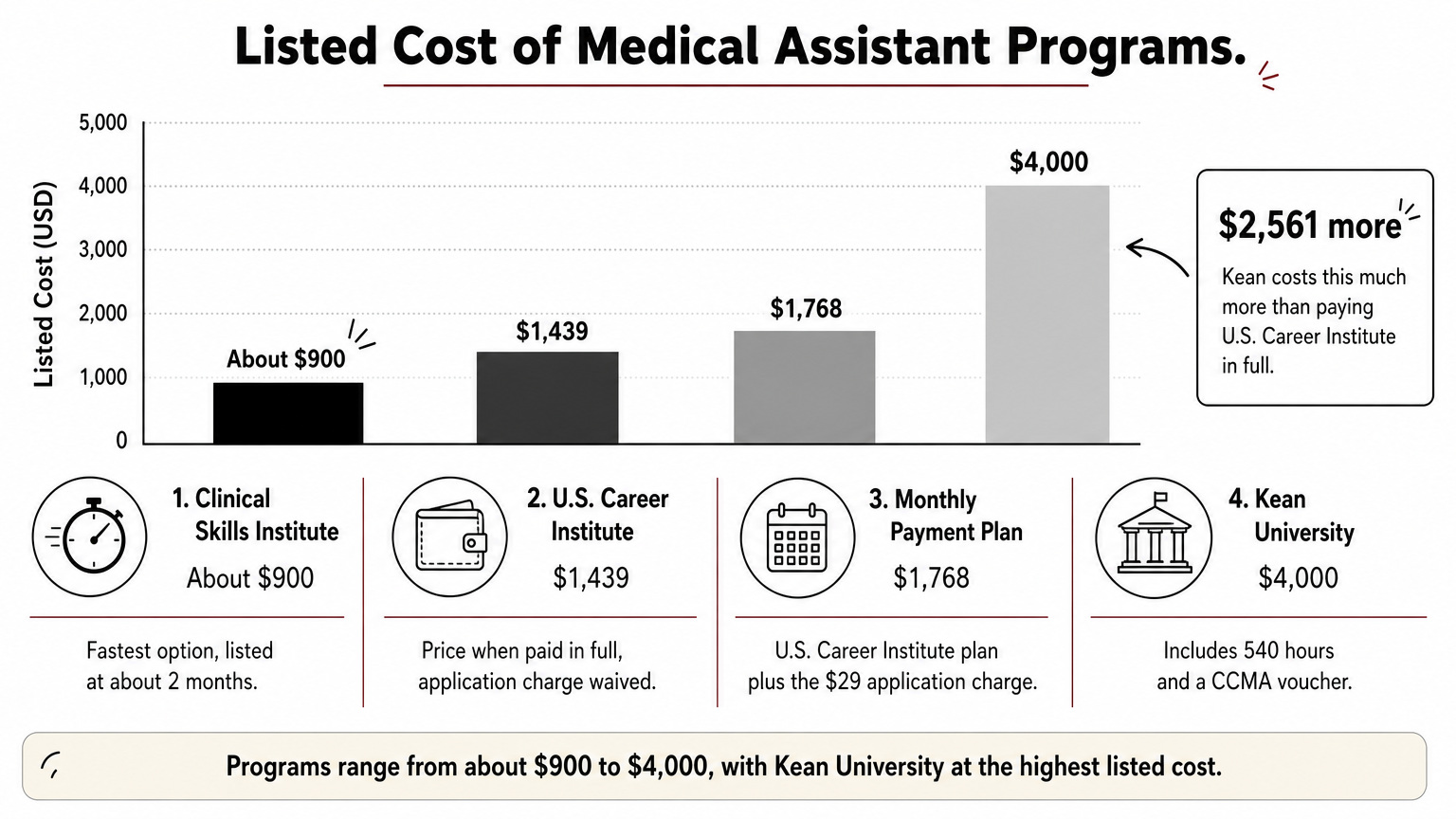
Here is the worked example. Paying U.S. Career Institute in full costs $1,439. The monthly plan costs $1,768 with the application charge. Kean costs $4,000, which is $2,561 more than the cheapest U.S. Career Institute option.
Which program fits your situation
If you want the quickest medical assistant program, start with Clinical Skills Institute. Be wary of anything much shorter than that. Ask for total clock hours and the externship plan. If you want a free route, true free training is rare. Check workforce funding through a local career center and employer-sponsored training. Some short programs of 150 to 599 clock hours and 8 to 15 weeks may qualify for Workforce Pell grants, which start July 1, 2026. The program must be approved by the state’s governor and the U.S. Department of Education, so ask the school directly.
Pick the program whose exam, hours, and all-in price you can confirm in writing.
Choosing your medical assistant program
Start with the exam, then check accreditation, hands-on practice, and the all-in price. Clinical Skills Institute wins on speed and cost. U.S. Career Institute wins on clear pricing and a payment plan. Kean University wins on depth and bundled exam costs. Local colleges and health systems win on in-person training. MedCerts is worth a quote.
Write down the answers to the checklist for your top two programs, then enroll in the one with the clearest total price and a real plan for hands-on practice. To compare more online courses, degrees, and certificate programs before you decide, browse Study Abroad Nations.