The best paralegal certificate programs share three traits: ABA approval, a cost you can carry, and a schedule that survives your real life. If you already hold a degree and want the most recognized credential, a university extension program such as UC Irvine’s or UCLA Extension’s fits. If budget decides everything, a community college certificate is the cheapest ABA-approved route. If you only want to test the field or pick up skills quickly, a short self-paced online course works, as long as you accept that it may carry less weight with employers.
The hard part is that certificate programs for paralegal careers range from about $1,400 to more than $9,000, from 14 weeks to two years, and from ABA-approved to unregulated. Program titles tell you almost nothing about those differences. Study Abroad Nations compares online courses, degrees and certificates for learners who want credentials without wasting money, and this guide applies the same lens to paralegal training.
Below you get five options, each broken down by format, cost, length, and who it suits. Then comes a side-by-side table, a checklist for verifying ABA status, and a straight answer on whether a certificate pays off. The programs are real examples of five formats, so the lessons carry over to schools in your own state. Prices come from program pages and change, so confirm them before you apply.
1. UC Irvine Division of Continuing Education
UC Irvine’s certificate is the best-documented ABA-approved option here, and it is the one I would shortlist first if you hold a degree.

Format, cost, and length
The program comes in two tracks. The part-time track meets in the evenings, lets you take one or more courses per quarter, and runs anywhere from 3 to 24 months. The compressed track fits all 11 courses into 16 weeks. Both are live online, with at least 15 units of synchronous instruction.
- Approval: American Bar Association approved
- Total: 30 units, about 300 hours of instruction
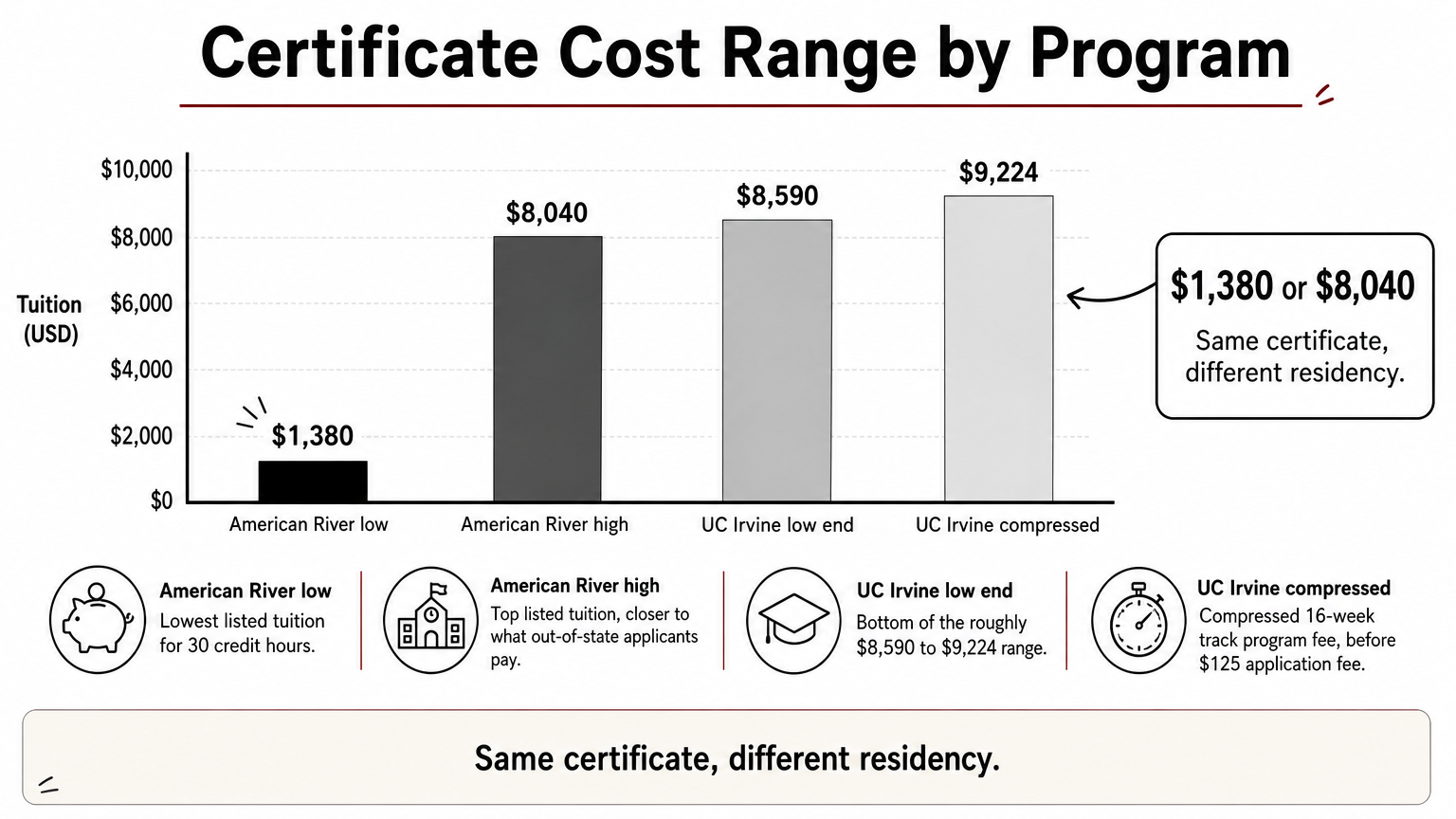
- Cost: roughly $8,590 to $9,224, with the compressed program fee at $9,224
- Extras: a $125 non-refundable application fee, plus books
Here is the math for the compressed track. The $9,224 fee plus the $125 application fee comes to $9,349 before books, or about $31 per hour of instruction. The price buys speed, but the speed is demanding. UC Irvine expects more than 40 hours a week of work outside live sessions and advises against holding a job or taking other classes during the 16 weeks.
The compressed track certifies you in one quarter, but only if you can treat it as a full-time job.
Who it suits
Admission requires an associate of arts or science degree, a bachelor’s, or a master’s from an accredited institution. An associate of applied science or vocational degree does not qualify. If your undergraduate education was not in English, you need a recent test score: TOEFL iBT 80, TOEIC 685, IELTS 6.5, or Duolingo 110.
This program suits career changers with a degree and anyone weighing law school who wants to test the work first. The compressed track offers a three-installment payment plan with a $100 participation fee, and the part-time track is approved for WIOA funding. It is the wrong pick if you have no degree or a tight budget.
2. UCLA Extension paralegal studies certificate
UCLA Extension offers an ABA-approved, graduate-level certificate that prepares students for work in law firms and other legal settings. It competes directly with UC Irvine for degree holders who want a major university name.
Format, cost, and length
Unit counts, term formats and per-course fees change, so pull current numbers from the program page rather than trusting a summary. Collect four items before you compare it with anything else:
- Total units and instruction hours
- Whether the sections you need are live online or on campus
- Tuition per course and the number of required courses
- Whether career coaching or an internship is included
Then run the same calculation as above: per-course tuition times required courses, plus books and fees, divided by total instruction hours. UC Irvine’s roughly $31 per hour gives you a benchmark. If a program costs far more per hour, ask what the extra money buys.
Compare programs by cost per instruction hour, because unit counts and course names vary too much to compare directly.
Who it suits
Choose this one if you hold a bachelor’s degree and want a recognizable university on your resume. The "graduate certificate" label points to degree holders, so confirm admission requirements before you plan around it.
Skip it if you need the lowest price. University extension certificates generally cost much more than community college programs, and you should weigh that gap against what the university name adds in your local job market.
3. UC Riverside Extension
UC Riverside Extension advertises a 31-unit paralegal studies certificate that you can complete within 15 months. Its main selling point is a clear finish line.
Format, cost, and length
Fifteen months is five quarters, so 31 units works out to about six units per quarter. That is a manageable load for someone who works full time. The program lists advanced legal knowledge, practical paralegal skills and current law among its learning goals.
- Length: 31 units within 15 months
- ABA status: verify in the ABA directory before you apply
- Cost: confirm total tuition on the program page
Do not assume ABA approval from a university brand. Extension programs differ, and a quick directory search takes two minutes.
A university name is not proof of ABA approval, so check the directory before you pay an application fee.
Who it suits
This option fits working adults who need a defined schedule. A fixed 15-month window forces progress, while UC Irvine’s part-time track lets you stretch courses over up to five years from your first class. If you tend to stall without deadlines, the shorter window helps.
It fits less well if your income is unpredictable. A rigid pace is hard to hold when work hours change, and you should ask what happens if you must pause a quarter.
4. American River College
American River College in Sacramento shows what the community college route looks like. Its ABA-approved legal studies certificate is the cheapest credible way into the field.
Format, cost, and length
The certificate takes 30 credit hours. Courses cover the American legal system, legal research and writing, torts, evidence, civil procedure, contracts, corporations, and estate planning and probate. Credits can also count toward an associate degree in paralegal studies. Listed tuition runs $46 to $268 per credit hour.
For a 30-credit certificate, that means $1,380 at the low end and $8,040 at the high end. The low figure typically reflects in-state residents, so out-of-state and international applicants should expect to pay closer to the top. Other community colleges add residency rules. Victor Valley College, for example, requires 33 units with 15 taken at the college itself.
The same certificate can cost $1,380 or $8,040 depending on residency, so check your tuition category before you compare.
Who it suits
Community colleges suit budget-focused learners, and many do not require a prior degree. Confirm admission rules, since they vary by school. They also suit people who want a path from certificate to associate degree.
The tradeoffs are pace and flexibility. Semester calendars are slower than a 16-week sprint, and some sections may be in person. If you live far from a campus, check which classes run online before you count on this route.
5. Self-paced online paralegal certificate course
A short online course is the lowest-commitment way to learn paralegal basics. One example is the online Paralegal Certificate Course at legalstudies.com, which splits into Paralegal I and Paralegal II. Each runs 7 weeks, so the full course takes 14 weeks.
Format, cost, and length
Courses of this type are built for working adults who study on their own schedule rather than meeting live. You get skills training and a certificate of completion, but approval status is the open question. Search the ABA directory for the provider. If it is not listed, treat the course as skills training, not as an ABA-approved credential.
- Length: 14 weeks across two 7-week courses
- ABA status: verify before you pay
- Cost: confirm on the course page, then compare it with UC Irvine’s $31 per instruction hour
A certificate of completion is not the same as an ABA-approved credential, and employers know the difference.
Who it suits
This format works for legal secretaries upgrading their skills, career changers testing whether paralegal work appeals, and employees whose firm will accept any training. It is a low-risk first step.
It is a weak choice if your goal is a credential that satisfies a state’s paralegal definition or a certification exam’s education rule. Many employers still prefer ABA-approved or degree-based training, so ask hiring managers in your area before you commit.
How to compare paralegal certificate programs
Compare programs on three things: ABA status, total instruction hours, and total cost including fees and books. Everything else is secondary.
Side-by-side comparison
| Option | ABA status | Length | Cost signal |
|---|---|---|---|
| UC Irvine DCE | Approved | 16 weeks compressed, or 3 to 24 months part-time | $8,590 to $9,224 |
| UCLA Extension | Approved | Confirm unit count | Confirm per-course tuition |
| UC Riverside Extension | Verify in directory | 31 units within 15 months | Confirm on program page |
| American River College | Approved | 30 credit hours | $1,380 to $8,040 |
| Self-paced online course | Verify in directory | 14 weeks | Confirm on course page |
Verify approval and hours
The ABA runs a searchable directory of approved paralegal programs. You can filter it by institution, city, state, degree type or program name, which also answers the "programs near me" question. Run every shortlisted school through it.
Then compare hours, not titles. UC Irvine’s certificate is 30 units and 300 hours. Cal State LA’s Downtown LA certificate requires six courses totaling 18 units. State universities elsewhere, such as the University of Georgia’s continuing education center, run their own versions. A shorter program is not automatically worse, but ask what it covers and whether your state or target employers accept it.
Match the program to your situation
- No bachelor’s degree: start with a community college certificate.
- Degree in hand and a need for speed: the UC Irvine compressed track.
- Working full time: part-time evening tracks, or a 15-month plan like UC Riverside’s.
- Budget under about $2,000: community college at in-state rates.
- Testing the field: a self-paced course, then upgrade if you like the work.
- Looking for a free program: I know of no free ABA-approved certificate. WIOA funding, which UC Irvine lists for its part-time track, is the closest route for eligible people.
Decide on budget and degree status first, and the shortlist usually shrinks to two programs.
Is a paralegal certificate worth the cost?
A certificate is worth it when you hold a degree, want into the legal field quickly, and pay a fair price for an ABA-approved program. It is worth less when you spend $9,000 on something a $1,400 community college program would have delivered.

What a certificate can and cannot get you
Many people ask whether a certificate alone is enough to become a paralegal. In many states it can be, because paralegal work is often not licensed. Rules differ, though. California, for example, ties the paralegal title to qualifications under Business and Professions Code Section 6450, and UC Irvine states that its certificates are valid under that section. Check your own state’s rules before you pay.
Scope is the same everywhere. Paralegals do delegated substantive legal work under a lawyer’s supervision. They cannot give legal advice, set fees, or represent clients in court, and they typically do not serve the public directly. If you want those powers, you are looking at law school.
A certificate opens doors in many states, but it never replaces a law license.
Certificate versus certification
A certificate comes from a school. Certification comes from an association after you meet eligibility rules and pass an exam. The most widely recognized is NALA’s Certified Paralegal (CP) credential, which is nationally accredited. Other bodies, such as NALS and the National Federation of Paralegal Professionals, offer their own credentials.
On timing, a compressed program can finish in 16 weeks, while most others take 12 to 24 months. Certification adds exam preparation and testing on top, and NALA’s eligibility routes vary, so read its requirements before you plan a timeline.
Pick the program that fits your life
The right paralegal certificate program is the cheapest ABA-approved option that fits your degree status, schedule and timeline. UC Irvine and UCLA Extension suit degree holders who want university credentials. American River College shows how far a community college can stretch your budget. A self-paced course works for testing the field, as long as you check approval first.
Run your shortlist through the ABA directory, calculate cost per instruction hour, and confirm what your state requires before you pay anything. If you want more comparisons of online courses, certificates and degrees that respect your budget, browse Study Abroad Nations for your next step.