The best online medical coding degrees and certificates share three traits. They sit at an accredited school or hold professional approval, they prepare you for a certification exam such as the CPC, and they show a total price you can add up before you enroll. Most people starting out do not need a full degree. A certificate of 16 weeks to about a year gets you exam-ready, and a degree makes sense mainly if you want a path into health information management. Of the four programs below, Davenport University is the fastest and cheapest, the University of Tennessee at Chattanooga bundles the most into one price, Oklahoma State University, Oklahoma City suits in-state students who may later continue to an associate degree, and Palm Beach State College is the longest, college-credit route.
The hard part is comparing them. Schools quote tuition per credit, as a flat total, or split by residency, and many programs called "degrees" are really certificates. A $1,895 course and a $7,000 certificate can lead to the same exam, so the sticker price tells you little without the context around it.
Study Abroad Nations compiles and compares online courses, degrees, and certificate programs, and this article applies that approach to medical coding. Each pick below uses the same checkpoints: cost and length, accreditation, exam path, and who it fits. The final section shows how to compare any other program the same way. Figures come from each school’s published pricing, so confirm them on the school’s site before you apply.
1. Davenport University CPC course
Davenport’s Certified Professional Coder course is the quickest and cheapest option here, at 16 weeks for $1,895. It is built around the CPC exam from AAPC and taught live online.

Cost, length and format
The published price covers materials, which keeps the total predictable. Here is what you get:
- Total cost: $1,895
- Length: 16 weeks
- Format: live-virtual classes, not self-paced
- Included: official AAPC training materials and current-year ICD-10-CM, CPT, and HCPCS Level II codebooks
The shortest route to a CPC attempt is also the cheapest, as long as you can attend live sessions.
Accreditation, exam and fit
Davenport is accredited by the Higher Learning Commission. The course prepares you for the CPC, and if you earn a national certification, six credits can transfer toward a bachelor’s degree. The published fee lists materials and codebooks, not the exam, so ask whether the exam fee is extra before you budget.
This course suits learners who want deadlines and a live instructor. It also fits anyone who wants to start fast. If you work irregular hours, a fixed live schedule may be a problem.
2. University of Tennessee at Chattanooga medical billing and coding
UTC’s fully online program costs $3,245 in total and runs 20 weeks (80 hours). Its strength is what the price includes.
Cost, length and format
The price looks higher than Davenport’s until you see what it bundles:
- Total cost: $3,245
- Length: 20 weeks, 80 hours
- Format: online, with optional live Zoom sessions that instructors record
- Included: all course materials, the CPC exam fee plus one free retake, and a one-year AAPC membership
UTC costs more up front, but it is the only pick here that folds the exam, a retake, and a membership into one price.
Accreditation, exam and fit
UTC is accredited by the Southern Association of Colleges and Schools Commission on Colleges. The program targets the CPC exam, and the free retake lowers the cost of a failed first attempt.
The recorded sessions let you study at your own pace. That makes this a good match for working adults who cannot commit to fixed class times but still want instructor-led material. The AAPC membership also gives you access to the organization’s job resources during your first year.
3. OSU-OKC medical coding certificate
Oklahoma State University, Oklahoma City offers a 17-credit Medical Coding Certificate, delivered 100% online. It uses the AAPC curriculum and includes an exam voucher.

Cost, length and format
Price depends on residency, which is why the total differs so much between students:
| Student | Tuition | Enrollment and online fees | Total (2026-27) |
|---|---|---|---|
| Oklahoma resident | $2,330 | $646 | $2,976 |
| Non-resident | $6,428 | $646 | $7,074 |
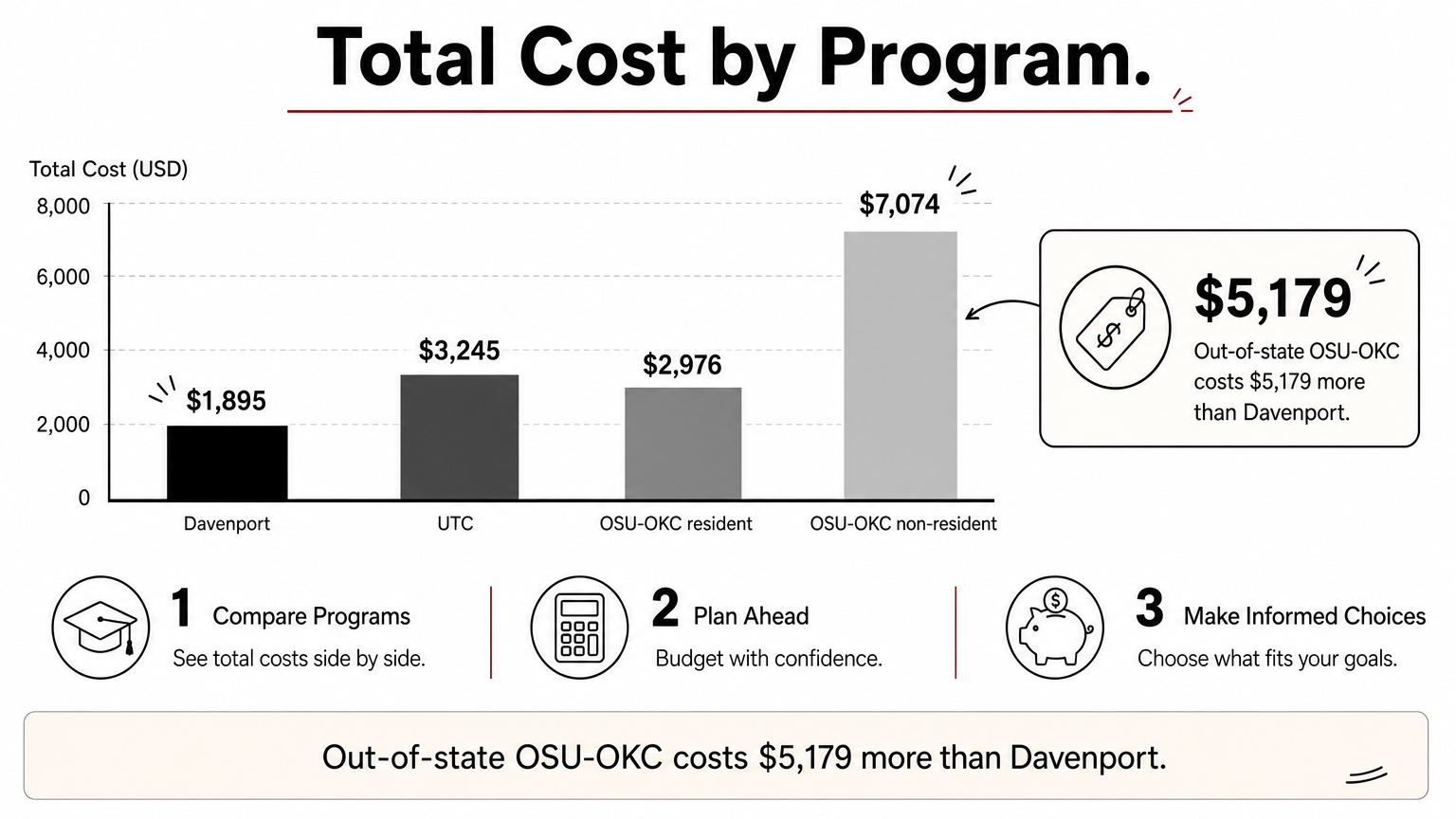
The program is 17 credits, with rolling admission. That residency gap is the main thing to understand: an out-of-state student pays $5,179 more than they would at Davenport ($7,074 minus $1,895), while an Oklahoma resident pays $2,976 and gets a voucher.
At a public college, your residency can matter more than the program itself.
Accreditation, exam and fit
The school is accredited by the Higher Learning Commission, and the AAPC-based curriculum aims at the CPC. The credits also count toward OSU-OKC’s fully online Healthcare Management associate degree, so you can stop at the certificate or keep going.
This is the right pick if you live in Oklahoma and want a certificate that can become a degree later. Non-residents should compare it against flat-price options first.
4. Palm Beach State College coder/biller certificate
Palm Beach State’s fully online Medical Information Coder/Biller certificate is the longest and most college-like option. It has 37 credits and takes about six semesters part-time, with fall, spring, and summer starts.
Cost, length and format
Tuition is $2,846 for Florida residents and $11,232 for out-of-state students, plus fees. Because fees are extra, the real total runs higher than those figures. This is the slowest and most expensive route for an out-of-state student, so it only makes sense if you want the college credits.
Pick this program for the credits and the degree path, not for speed.
Accreditation, exam and fit
The certificate is approved through the AHIMA Foundation’s Professional Certificate Approval Process. It prepares you for AHIMA’s Certified Coding Specialist (CCS) and AAPC’s CPC-A exams. The credits transfer into the college’s Associate in Science in Health Information Technology.
That makes it the best fit here for Florida residents who want a hospital-oriented credential and a clear route to an associate degree. If you only want a job quickly, one of the first three programs gets you there sooner.
How to compare online coding programs
Compare programs on four things in this order: whether the exam path matches the jobs you want, whether the school or program is approved, the total cost including the exam, and the time you can commit. The rest is detail.
Degree or certificate
Most entry-level coders start with a certificate. AAPC says online training can make you career-ready in 4 to 12 months, while an associate degree can take up to three years. A degree costs more and takes longer, and it still ends with a certification exam. Choose one if you want college credits or a route into health information management.
A degree also does not replace a credential. Employers look for the CPC from AAPC, and coders who finish a degree typically sit for it anyway. Pay data for the wider occupation is modest but steady. The BLS puts it at roughly $51,000 a year.
Accreditation and exam alignment
Look for regional accreditation of the school, then for program-level signals such as AHIMA approval or an AAPC curriculum. Then match the exam to your target workplace:
- CPC (AAPC): the common entry-level credential for physician-office, or professional fee, coding.
- CCA and CCS (AHIMA): CCA is entry-level across settings, and CCS leans toward hospital coding.
- CBCS (NHA): an entry-level billing and coding credential.
One note for international readers: ICD-10-CM and CPT are US code sets, so these credentials mainly serve US healthcare employers.
Side-by-side comparison
| Program | Total cost | Length | Exam path | Best for |
|---|---|---|---|---|
| Davenport | $1,895 | 16 weeks | CPC | Fastest, lowest price |
| UTC | $3,245 | 20 weeks | CPC, fee and retake included | One all-in price |
| OSU-OKC | $2,976 resident, $7,074 non-resident | 17 credits | AAPC exam voucher included | Oklahoma residents |
| Palm Beach State | $2,846 FL, $11,232 out-of-state, plus fees | 37 credits, about six semesters part-time | CCS, CPC-A | Degree path |
Add up tuition, fees, books, and the exam before you compare programs, because the headline price rarely includes all four.
Picking your program
If speed and price matter most, start with Davenport. If you want the exam and a membership included, choose UTC. Oklahoma residents get the best deal at OSU-OKC, and Palm Beach State is the pick when college credits and a degree path matter more than speed.
Confirm current tuition, check what the exam fee covers, and make sure the credential matches the jobs you want. For more side-by-side comparisons of online courses, degrees, and certificates, browse Study Abroad Nations.