The best nursing online degrees depend on where you start. If you are new to nursing, an online ASN or a BSN for non-nurses gets you to the licensing exam, but both require in-person clinical hours. If you already hold an RN license, an RN to BSN is the most flexible option, and an MSN or DNP is the step after that. No accredited program lets you become an RN entirely online, because every route to a first license includes supervised clinical practice in person.
That catch is where most searchers get stuck. Program pages blur "online" and "hybrid," and many promise RN degrees online without saying which parts happen in a hospital. They also rarely explain whether the program holds the accreditation that employers, graduate schools, and state boards look for. A wrong pick can cost you tuition and months of time.
This guide compares five accredited online nursing degrees, from ASN to DNP, using the same three questions for each: how it works, who it suits, and how long it takes. At Study Abroad Nations we compare online degrees and certificates, so we kept this list to pathways that lead to licensure or a recognized advanced credential. A final section shows how to verify accreditation and choose between them.
1. Online ASN: a two-year route to RN licensure
An online associate degree in nursing (ASN, also called ADN) is the shortest degree-level path to becoming a registered nurse when you are starting from scratch. The lectures move online, while labs and clinical rotations stay in person.

How it works
Online ASN programs deliver theory courses through a learning platform. They then require supervised clinical rotations at approved healthcare sites, often alongside on-campus skills labs. Clinical hour requirements vary by state and program, and some schools help arrange local placements while others assign sites. After graduating you sit for the NCLEX-RN, the national licensing exam. Herzing, for example, offers an online ASN pathway for students new to nursing.
An online ASN moves the classroom to your laptop, but it never replaces the in-person clinical hours.
Who it suits
This degree suits career changers with a high school diploma who want the fastest degree-level route to an RN license. It also usually costs less than a bachelor’s. Nursing has no age cutoff, and programs admit career changers in their 30s and beyond. You can finish a BSN later through an RN to BSN bridge (item 3) while you work.
Length and cost
Expect about 60 credits over 18 months to two years. Admission usually asks for prerequisite courses in anatomy, biology, and chemistry, plus a minimum GPA of roughly 2.0 to 2.5. To estimate cost, multiply the credits by the per-credit tuition, then add lab fees, uniforms, background checks, and travel to clinical sites.
2. Online BSN for students new to nursing
An online prelicensure BSN is a bachelor’s degree that leads to RN licensure, with online coursework and in-person clinicals. It fits when you want a bachelor’s-level credential from the start.
How it works
There are two formats. A traditional route runs about 120 credits over four years. An accelerated route is built for people who already hold a bachelor’s degree in another field, and these programs commonly run about 12 to 18 months. Both formats require in-person clinical rotations and often on-campus lab sessions. Herzing lists a BSN among its online pathways for non-nurses.
Accelerated online BSN tracks compress the same clinical requirements into fewer months, which leaves little room for a full-time job.
Who it suits
Pick this route if you already have a bachelor’s degree and want to switch careers, or if you want a BSN without earning an ASN first. Many employers prefer BSN-prepared nurses, and most graduate nursing programs ask for a BSN. Skip the accelerated version if you need to keep working full time.
Length and cost
Prior college credits can shorten the traditional route, so ask each school how many of your credits transfer. Typical admission asks for a high school diploma or earlier degree, science prerequisites, and a GPA around 2.5 to 3.0. Cost depends on whether the school is public or private, so compare total program tuition, not the per-credit rate alone.
3. Online RN to BSN for working nurses
RN to BSN is the nursing degree you can most often complete almost entirely online. It is built for nurses who already hold an RN license, and it is the option that most closely matches a fully online RN degree.
How it works
A bridge program gives you credit for your associate degree and nursing license, then covers the remaining bachelor’s coursework online. Some programs add a short practicum or community project. Georgia State’s online RN to BSN, for instance, runs three semesters and 30 credit hours, with all required coursework online except its clinical component.
If you are already an RN, this is the lowest-friction online nursing degree, because your license replaces most of the clinical requirement.
Who it suits
It suits ASN-prepared RNs who want a BSN for promotion or leadership roles. It is also the standard stepping stone to an online MSN. Look for programs accredited by CCNE or ACEN, since accreditation is what graduate schools check when they review your bachelor’s degree.
Length and cost
Most programs take one to two years, and some finish in as few as 15 months. UT Arlington’s online BSN, for example, lists total tuition of $21,675 with completion in as few as 15 months. Admission typically requires an ADN, an active RN license, and sometimes work experience. Ask your employer about tuition assistance before you apply.
4. Online MSN for registered nurses
An online master of science in nursing builds on a BSN or an RN bridge and leads to advanced roles. These include nurse practitioner, nurse educator, administrator, and informatics specialist.

How it works
Core courses run online. Clinical specialties such as nurse practitioner add in-person preceptor hours, often 500 to 1,000 clinical hours, while education, administration, and informatics tracks usually need fewer. Entry points differ: BSN-to-MSN, RN-to-MSN for nurses without a BSN, and direct-entry MSN for people with a non-nursing bachelor’s degree. Walden, for example, offers BSN-MSN, RN-MSN, and RN-BSN accelerate-into-master’s entry paths. A direct-entry MSN includes in-person clinicals that lead to a first RN license.
Choose your MSN specialty before you choose a school, because clinical placement rules differ most between specialties.
Who it suits
It suits RNs aiming at advanced practice, teaching, or management, and career changers who hold a bachelor’s in another field. Online study asks for self-discipline. U.S. News survey data show that 74% of online master’s in nursing students who entered in 2017-2018 had graduated by June 2022.
Length and cost
Plan on 30 to 40 credits over two to three years, often part time. Admission usually requires a BSN, an active RN license, and clinical experience, with a GPA of about 2.5 to 3.0. U.S. News ranks Ohio State first among online nursing programs, with Duke and the University of South Carolina tied for second.
5. Online DNP for advanced practice and leadership
The doctor of nursing practice is the practice doctorate for nurses who want top-level clinical, executive, or policy roles. It focuses on applying evidence rather than on academic research, which is the PhD’s job.
How it works
Coursework runs online. A practice immersion and a final DNP project happen in your own clinical or workplace setting, and programs commonly expect around 1,000 supervised practice hours counted across your master’s and doctoral work. Entry routes include BSN-to-DNP and post-master’s. Walden, for one, offers a CCNE-accredited DNP.
A DNP is for advancing a nursing career, not for becoming a nurse, so skip it if your goal is simply an RN license.
Who it suits
It suits MSN-prepared nurses, or ambitious BSN-prepared nurses, who aim at advanced practice, executive leadership, or health policy. Check your target job first. Many advanced roles still require only a master’s degree.
Length and cost
BSN-to-DNP routes often run three to four years, and post-master’s routes are shorter. Ask each program for its total credits and required practice hours before comparing tuition. Because programs count prior hours differently, two schools with similar tuition can differ by a full year of work.
How to verify accreditation and pick your path
Accredited online nursing degrees are legitimate, and employers care more about accreditation than about whether you studied online or on campus. Checking takes about ten minutes, and it should happen before you apply.
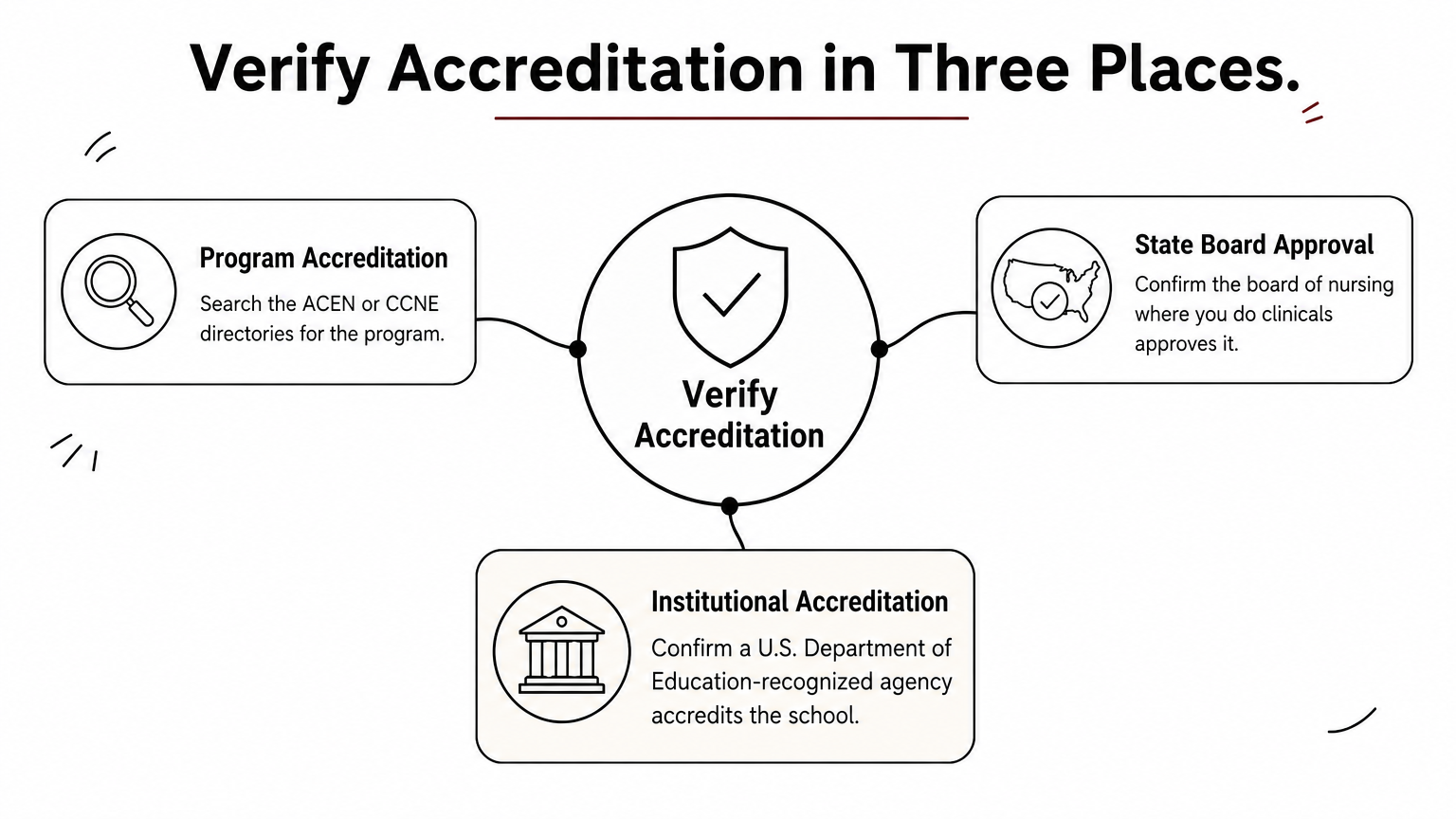
Verify accreditation in three places
- Program accreditation: search the directories of the Accreditation Commission for Education in Nursing (ACEN) or the Commission on Collegiate Nursing Education (CCNE). CCNE covers bachelor’s, graduate, and residency programs.
- State board approval: for any program that leads to a first RN license, confirm that the board of nursing in the state where you will do clinicals approves it.
- Institutional accreditation: confirm the school is accredited by an agency recognized by the U.S. Department of Education.
An unaccredited degree can block licensure, graduate admission, and federal financial aid.
If a program is not on the accreditor’s own directory, treat it as unaccredited, whatever its website says.
Compare the five degrees side by side
| Degree | Typical length | Usual entry requirement | Fully online? | Leads to |
|---|---|---|---|---|
| ASN | 18 months to 2 years (about 60 credits) | High school diploma, science prerequisites | No, clinicals in person | NCLEX-RN, entry-level RN |
| BSN for non-nurses | About 4 years; 12 to 18 months accelerated | High school diploma or prior bachelor’s | No, clinicals in person | NCLEX-RN, BSN-level roles |
| RN to BSN | About 1 to 2 years | ASN or ADN, active RN license | Mostly | BSN, graduate study |
| MSN | 2 to 3 years (30 to 40 credits) | BSN and RN license, or direct entry | Coursework yes, practicum in person | Advanced practice, education, leadership |
| DNP | About 1 to 4 years by entry route | BSN or MSN, RN license | Coursework yes, practice hours in person | Top clinical and executive roles |
For a hypothetical cost check, say a program charges $450 per credit and your RN to BSN needs 30 credits after transfer. That is $13,500 in tuition. Add a $150 technology fee for each of three terms and the total is $13,950.
Ask these questions before you apply
- Does the school arrange clinical placements near you, or do you find your own?
- What is the NCLEX-RN pass rate for graduates?
- Are there live online sessions at fixed times?
- How many prior credits transfer?
- What is the total cost, including fees?
If you live outside the U.S., also confirm that the program enrolls students from your country. A U.S. license may not be recognized where you plan to work.
Picking your starting point
If you are new to nursing, an online ASN or a BSN gets you to the NCLEX-RN, with in-person clinicals unavoidable. If you are already an RN, the RN to BSN is the easiest online step, and an MSN or DNP follows when you want advanced practice or leadership. Whichever you choose, verify accreditation on the accreditor’s own directory first.
Ready to compare more programs? Browse more online degree and certificate comparisons for options that fit your budget and timeline.