The best online education master’s degrees share three traits: accreditation from an agency recognized by the U.S. Department of Education, a total price you can state in dollars, and a format that fits your job. Purdue Global suits teachers who want to finish in about a year. WGU suits anyone minimizing cost. Texas A&M suits teachers who want a broad curriculum degree. Harvard suits experienced leaders, and the University of Florida suits readers who want a ranked specialization.
The names make comparison harder than it should be. The same degree appears as an M.Ed., an MSEd or an Ed.M., and schools quote prices per credit, per term or not at all. Completion is not guaranteed either. U.S. News survey data show that 73% of online master’s in education students who entered in 2018-2019 had graduated by June 2022.
This list compares five programs on cost, length, format and fit, using the figures each school publishes on its own program pages. At Study Abroad Nations we compile and compare online degrees, so we built the same three subheadings for every program. Prices change, so confirm each figure with the school before you apply.
1. Purdue Global online MSEd
Purdue Global’s online MSEd is the fastest option here, with an average completion time of one year for full-time students. It is built for P-12 teachers who want a defined path with a fixed price per credit.

Cost
Purdue Global charges $420 per credit, and the degree takes 45 to 46 quarter credits. That puts tuition at $18,900 to $19,320, before fees and before any reductions. One semester credit equals 1.5 quarter credits, so this is roughly 30 semester credits.
- Current servicemembers get 17 to 30% off per credit, and veterans get 14%.
- Transfer credit and ACE-evaluated military training can reduce the credits you pay for.
Multiply the per-credit rate by total credits before you compare any two programs.
Length and format
The program has 10 courses, six core and four in a concentration. Expect about 15 hours of course effort per week. Part-time students take longer than the one-year average. Courses start five times a year, and you need a bachelor’s degree to enroll.
Who it suits
Choose it if you teach P-12 and want to move toward teacher leadership, mentoring or curriculum work. The three concentrations are exceptionalities, leadership, and literacy and language. Purdue Global does not guarantee jobs or salary, and some careers need extra licensing.
2. WGU online education master’s programs
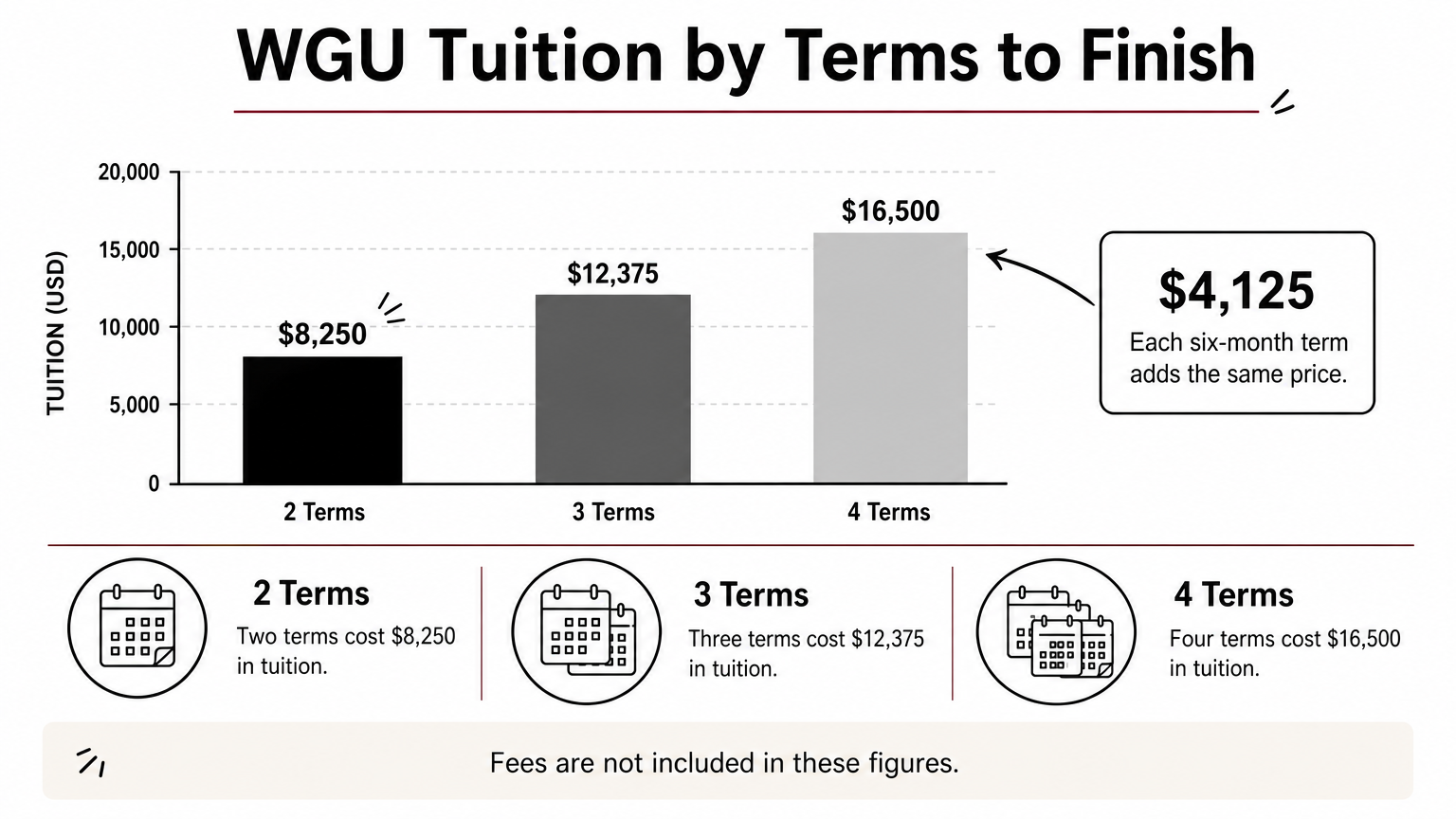
WGU is the cheapest route to compare because it charges $4,125 per six-month term instead of per credit. Its education master’s programs range from 14 to 20 courses, depending on the program you pick.
Cost
Flat term pricing rewards speed, since each extra term adds the same $4,125. Fees are not included in these figures.
| Terms to finish | Tuition |
|---|---|
| 2 | $8,250 |
| 3 | $12,375 |
| 4 | $16,500 |
At WGU, the number of terms you need sets your price, not the number of credits.
Length and format
The program is fully online. Because you pay per term, how many courses you clear each term decides both your timeline and your total. A 14-course program leaves more room to finish early than a 20-course one.
Who it suits
It fits self-directed, cost-conscious educators with steady study time. WGU separates programs by licensure status, so check whether you need the one for currently licensed teachers or a program that leads to a license. Confirm that your state accepts the program.
3. Texas A&M online M.Ed. in Curriculum and Instruction
Texas A&M offers a generalist M.Ed. that gives teachers a broad base in instruction and classroom research. It is a 36-credit-hour, non-thesis degree delivered primarily online.

Cost
The university does not post one all-in figure for this degree. Use its published cost and tuition rates page and the tuition calculator, then multiply the per-credit rate by 36. Fees and billing rules are explained on the same page.
Length and format
Courses use eCampus, video lectures, PowerPoint presentations, group projects, chat rooms and readings. Formats vary by class. You must apply to both the Department of Teaching, Learning and Culture and Texas A&M University, and the degree is not a teacher certification program.
This degree improves how you teach and lead, but it will not license you.
Who it suits
It suits working teachers who want research-based techniques. The curriculum covers academic learning, social climate and emotional well-being, school improvement, and family and community partnerships. It also works for teachers who already hold a license and want depth rather than a new credential.
4. Harvard Graduate School of Education online Ed.M.
Harvard’s online Ed.M. in Education Leadership is a part-time, two-year program for experienced education professionals. It is the most selective option on this list and the least suited to newcomers.
Cost
Harvard publishes its tuition on the program page. Pull the current figure and compare it with the totals above before you invest time in an application. For a program this specialized, the gap between sticker price and your expected career return deserves a hard look.
Length and format
The degree runs two years, part-time and online. It builds on the expertise you already bring, so expect coursework pitched at people already working in schools and education organizations, not at career changers.
Pick Harvard for leadership depth, not for speed or savings.
Who it suits
Consider it if you hold a leadership role or are close to one and want a leadership-focused degree. Skip it if you need a teaching license, a one-year finish or the lowest price. Its focus is leading organizations, not classroom instruction.
5. University of Florida online education programs
The University of Florida College of Education offers nine specialized online graduate and doctoral programs. U.S. News ranks UF tied for #2 among online education programs, behind Clemson at #1 and level with the University of Kansas.
Cost
Tuition differs by program, so confirm it on the page for your specialization. UF’s page lists the programs together, which makes it easy to compare total cost across tracks before you commit.
Length and format
Length depends on the specialization. Ask each program for its credit hours and whether any in-person parts are required. U.S. News notes that some online programs still require activities such as student teaching.
Ask for credit hours and in-person requirements before you trust any "100% online" label.
Who it suits
UF fits readers who want a defined specialty. U.S. News groups specialties such as curriculum and instruction, educational administration, instructional media and special education. If rankings drive your shortlist, add Clemson and Kansas to the comparison, since U.S. News bases its ranking on faculty credentials, graduation rates and reputation.
Choosing where to apply
Start with accreditation, then compare total tuition, not per-credit rates. Purdue Global is the fastest, WGU the cheapest to model, Texas A&M the broadest, Harvard the most leadership-focused, and Florida the deepest in specializations. Confirm licensure rules with your state before you pay an application fee.
When you are ready to compare more programs and look for funding, browse the degree comparisons and scholarship listings at Study Abroad Nations.