The best programming degrees online come from institutionally accredited schools whose price, schedule and math requirements match your situation. WGU suits working adults who want a flat-rate degree they can finish fast. UF Online suits Florida residents who want the lowest sticker price. FIU suits students who want computer science plus another subject. Oklahoma State suits anyone who wants a degree that is literally about programming. Maryville suits learners who want a specialization. Auburn suits transfer students with 60 credits. Illinois Springfield suits out-of-state learners. IU Indianapolis suits students who want internships and a path to a master’s.
The hard part is comparing them. Schools call the same degree computer science, applied computer programming or information systems. They quote prices per credit, per term or per unit. The advertised rate rarely tells you what the whole degree costs.
This article puts eight programs through the same lens: what the program covers, what it costs and how long it takes, and who it fits. First, it explains how to check accreditation, pick a degree type and judge whether the degree is worth it. Rates come from published school and ranking data and cover tuition only, so confirm current figures and fees with admissions before you apply. At Study Abroad Nations we compare degrees and certificate programs for cost-conscious learners, and this list follows that approach.
What to check before you compare programs
Check three things before you look at price: institutional accreditation, the degree type, and the job market you are training for. A cheap program that fails the first check can cost you more than an expensive one that passes it.
Check accreditation first
Institutional accreditation is the baseline. Without it, a school may not be able to offer federal financial aid or let you transfer credits into a master’s program. The schools in this list are accredited by bodies such as the Higher Learning Commission, the Southern Association of Colleges and Schools Commission on Colleges, or the New England Commission of Higher Education. Look for the accreditor’s name on the school’s own accreditation page.

ABET accreditation is a second, optional layer. ABET reviews individual computing programs, and WGU lists it for its Computer Science degree. Most programming degrees do not carry it, so do not rule out a program only for that reason. Treat it as a plus if an employer or graduate school you have in mind cares about it.
Institutional accreditation decides whether your credits and financial aid hold up, so verify it before you compare anything else.
Pick the right degree type
The label on the degree matters less than what is inside it, but the types differ in useful ways:
- B.S. in computer science: the most common choice, heavy on math, algorithms and systems. It keeps the most doors open.
- B.A. in computer science: the same core with more room for electives outside the field, as at FIU.
- Applied computer programming: built around writing software and mobile or business applications, as at Oklahoma State.
- Information systems or IT with a programming track: a good fit if you want to work where business and code meet.
- Associate degree: usually about two years. It is a cheaper first step, and a degree-completion program like Auburn’s can pick up from there.
Is the degree still worth it?
Yes, if you aim at software development or security rather than pure coding. The Bureau of Labor Statistics projects software developer jobs to grow 16% from 2024 to 2034, with a 2024 median salary of $133,080. It projects computer programmer jobs to fall 6% over the same period, with a median of $98,670. Information security analyst jobs are projected to grow 29%.
AI tools are absorbing routine coding, so a degree that teaches systems thinking, architecture and security ages better than one that teaches syntax alone. Age is not the barrier. If you are 27, 35 or 45, the real gate is math readiness, and several programs below test it at admission.
1. Western Governors University B.S. in Computer Science
WGU’s online B.S. in Computer Science is the best pick if you want an ABET-accredited degree at a flat price and the freedom to finish as fast as you can pass the assessments.
What the program covers
The degree has 39 courses, and WGU lists the program as ABET accredited. The path runs through Python, data structures and algorithms, operating systems, computer architecture, three Java courses and AI courses that include AI optimization. The math is serious: calculus, two discrete math courses and linear algebra.
Several certifications are built in: Linux Essentials, AWS Certified Developer Associate, WGU Java Developer, WGU Back-End Developer and WGU AI Optimization Developer. A team project closes the program. You advance by proving competency, so you sit assessments when you feel ready instead of attending scheduled lectures.
Cost and length
WGU charges a flat rate per six-month term, not per credit, so speed saves money.
- Tuition: $4,125 per term
- E-books and resources fee: $200 per term
- Total per term: $4,325
- Four terms (two years): $17,300
- Six terms (three years): $25,950
- Start dates: the 1st of every month
- WGU reports that 62% of graduates finish within 25 months
Who it fits
This program suits disciplined adults with jobs and families, especially those with prior credits. WGU’s unofficial estimate says an associate degree covers about 11 of the 39 courses, leaving 28. If you already know some programming, you can move through those courses quickly.
Admission needs a high school diploma plus proof of precalculus: a college GPA of 2.25 with a precalculus grade of C or better, or a high school GPA of 2.75 with a B or better in precalculus. No SAT or ACT is required. The lack of deadlines cuts both ways, so skip this one if you need a class schedule to stay on track.
WGU charges by the term, so the faster you pass your courses, the less the degree costs.
2. University of Florida Online B.S. in Computer Science
UF Online’s B.S. in Computer Science is the cheapest accredited option here for Florida residents, at $112 per credit in-state.
What the program covers
The program combines programming skills, computation theory and electives, with an optional co-op and a practical work component. Course titles include programming language concepts and algorithm abstraction and design, so expect real theory alongside the coding.
Classes are fully asynchronous, and the program is transfer-friendly. All UF Online students study online. Forbes’ data shows one of the highest retention rates and median alumni earnings ten years out among the ranked schools.
Cost and length
The program is 120 credits, and in-state students pay about 25% less online than on-campus peers.
- In-state rate: $112 per credit
- 120 credits at that rate: about $13,440 in tuition
- Start dates: three per year
- Application fee: $30
- Graduation rate: 72%
Tuition rises substantially for out-of-state learners. Ask admissions for the exact rate before you count on this price.
Who it fits
This program fits Florida residents who want a degree from a large public university at the lowest rate on this list. The $13,440 estimate is tuition only, but even with fees it undercuts most private options by tens of thousands of dollars.
For readers outside Florida the math changes. Ask admissions which rate applies to you and compare it against UIS below, which charges one rate to everyone. The program is accredited by SACSCOC.
If you qualify for in-state rates, UF Online is hard to beat on price.
3. FIU online B.A. in Computer Science
Florida International University’s online B.A. in Computer Science is the pick for students who want programming skills plus real room to study something else.
What the program covers
FIU combines foundational programming and database courses with interdisciplinary electives. Students take at least nine credits outside computer science in a subject of their choice. Major courses include systems programming and software engineering.
FIU has more than 25 years of online teaching experience, and the program has no in-person requirement. It is a B.A. rather than a B.S., which means more flexibility and typically less math and science weight than a B.S. track.
Cost and length
At 120 credits, this is a standard four-year degree.
- In-state rate: $236 per credit
- 120 credits at that rate: about $28,320 in tuition
- Application fee: $30
- Graduation rate: 69%
- Accreditation: SACSCOC
The out-of-state rate is not covered here, so check it with admissions.
Who it fits
A B.A. suits you if you want to pair code with business, design, communication or another field. A programmer who understands marketing or health care is easier to place than one who only writes functions. The electives let you build that combination inside the degree.
Forbes notes that FIU has one of the lowest median federal student loan debts among ranked schools and the highest share of Pell grant recipients. That points to a school used to students who need financial aid. If you want maximum technical depth for graduate study, a B.S. program like UF’s may serve you better.
Choose the B.A. when you want programming plus a second field, and the B.S. when you want maximum depth.
4. Oklahoma State B.S. in Applied Computer Programming
Oklahoma State’s online B.S. in Applied Computer Programming is the closest match to a degree that is literally about programming.
What the program covers
The program prepares students for software design and development careers. Courses include mobile applications development and C/C++ programming. If you organize your electives correctly, you can earn a built-in cybersecurity certificate along the way.
Support is a selling point. Online learners get the Software Programming Undergraduate Resource (SPUR) Center, and Forbes ranked the school best for student support among its picks.
Cost and length
This is a 120-credit degree, and the published rate is for part-time in-state students.
- Part-time in-state rate: $181 per credit
- 120 credits at that rate: about $21,720 in tuition
- Application fee: $50
- Graduation rate: 67%
- Accreditation: Higher Learning Commission
Full-time students pay a block rate, one standard price for 12 to 18 credits per semester. If you can carry a full load, ask for the block price and compare it with the per-credit math.
Who it fits
This program fits people who want to build software for a living and prefer an applied curriculum to a theory-first one. It is also a good choice if you want a security credential without switching majors.
Check the math requirements in the catalog before you commit. Applied programs vary, and the course list tells you more than the title does. The program has no in-person requirement.
If your goal is writing applications rather than studying computation theory, an applied programming degree puts the work front and center.
5. Maryville University B.S. in Computer Science
Maryville’s online B.S. in Computer Science is the best pick if you want to specialize, since each concentration ends in its own certificate.
What the program covers
Students choose from five concentrations: artificial intelligence, cybersecurity, data science, software development, and user experience and user interface design. Each leads to a separate certificate. Courses include database applications and project management.
The program runs asynchronously online and adds project-based classes and an optional internship. Students interested in a master’s can take up to 12 graduate credits at the undergraduate tuition rate through the Early Access program.
Cost and length
The program is 128 credits, eight more than most others here.
- Rate: $575 per credit
- 128 credits at that rate: about $73,600 in tuition
- Application fee: free
- Graduation rate: 74%
- Accreditation: Higher Learning Commission
That makes it the most expensive per-credit program in this list, so transfer credits matter a lot here.
Who it fits
This program suits students who know their direction, such as security or data work, and want a certificate to prove it. It also suits those who want the early-access shortcut toward a graduate degree.
Be honest about the price. Forbes gave Maryville its highest acceptance rate, 94%, which makes entry easy but does not make the degree cheap. Ask about transfer credit and institutional aid first, because they can change the total more than any other factor.
Maryville costs the most per credit here, so it pays off only if the concentration and certificate match your career plan.
6. Auburn University Bachelor of Computer Science
Auburn’s online Bachelor of Computer Science is a degree-completion program, and it is the best fit if you already have 60 transfer credits.
What the program covers
Auburn delivers courses in sessions of 7½ weeks, so you focus on fewer subjects at a time. Major courses include mobile application development and operating systems. The program is open to transfer students with a minimum of 60 transfer credits.
That requirement shapes who applies. The first half of the degree happens elsewhere, often at a community college, and Auburn handles the upper-division computer science work.
Cost and length
The full degree is 120 credits, and you bring in half of them.
- In-state rate: $574 per credit
- Remaining 60 credits at that rate: about $34,440 in tuition
- Application fee: $50
- Graduation rate: 82%
- Accreditation: SACSCOC
Forbes reports institutional aid covering 86% of tuition on average across the university. That is a university-wide figure, so ask what applies to online students.
Who it fits
This is the strongest path for someone with an associate degree or two years of college credit who wants a respected four-year computer science degree. Pairing a low-cost associate degree with Auburn’s upper-division courses is a smart way to cut total cost.
If you have no college credit yet, this program is closed to you until you earn some. Start with an associate degree, or pick one of the programs above that admits first-year students.
Auburn rewards planning: earn 60 credits cheaply first, then finish the bachelor’s here.
7. University of Illinois Springfield B.S. in Computer Science
UIS’s online B.S. in Computer Science is the best choice for out-of-state learners, because everyone pays the same rate wherever they live.
What the program covers
The B.S. covers programming languages and computer organization, among other courses. It is built for flexibility: you study at the hours that suit you and choose from multiple start dates each year.
Forbes ranked it the most flexible online option. It also noted one of the lowest student-to-faculty ratios and a high share of tuition covered by institutional aid.
Cost and length
The degree is 120 credits.
- Rate: $379 per credit, regardless of residence
- 120 credits at that rate: about $45,480 in tuition
- Application fee: $50
- Acceptance rate: 84%
- Graduation rate: 49%
- Accreditation: Higher Learning Commission
Who it fits
This program fits learners who do not get an in-state discount anywhere and want predictable pricing. If UF’s or FIU’s out-of-state rates turn out to be high for you, UIS may come out cheaper.
Take the 49% graduation rate seriously. Forbes’ ranking includes it, and it signals that many students do not finish. The flexibility that helps you also removes outside pressure, so build a weekly study routine before your first class and use the advising services.
A single rate for every student makes UIS easy to budget, but the low graduation rate means you must plan to finish.
8. Indiana University Indianapolis B.S. in Computer Science
IU Indianapolis offers an online B.S. in Computer Science with built-in practical experience, and it is the pick for students who want internships and a clear master’s route.
What the program covers
The curriculum includes computer structures and programming languages, with concentrations in data structures, programming and software engineering. It embeds practice-based projects and internships so you build experience before you graduate.
The school also offers a five-year bachelor’s-to-master’s pathway. Forbes noted one of the lowest student-to-faculty ratios on its list, which usually means easier access to instructors.
Cost and length
This is a standard 120-credit degree.
- In-state rate: $290 per credit
- 120 credits at that rate: about $34,800 in tuition
- Application fee: free
- Acceptance rate: 81%
- Graduation rate: 58%
- Accreditation: Higher Learning Commission
Who it fits
This program suits students who want a résumé with something on it, such as an internship or a team project, when they graduate. It also suits anyone who already thinks a master’s degree is likely and wants the shorter pathway.
Plan for the internship. Forbes notes that in-person participation is possible for it, so check where and how internships are arranged if you live far from Indianapolis. Otherwise, the program has no campus requirement.
If you want internships and a fast track to a master’s, IU Indianapolis gives you both inside one degree.
How the eight programs compare
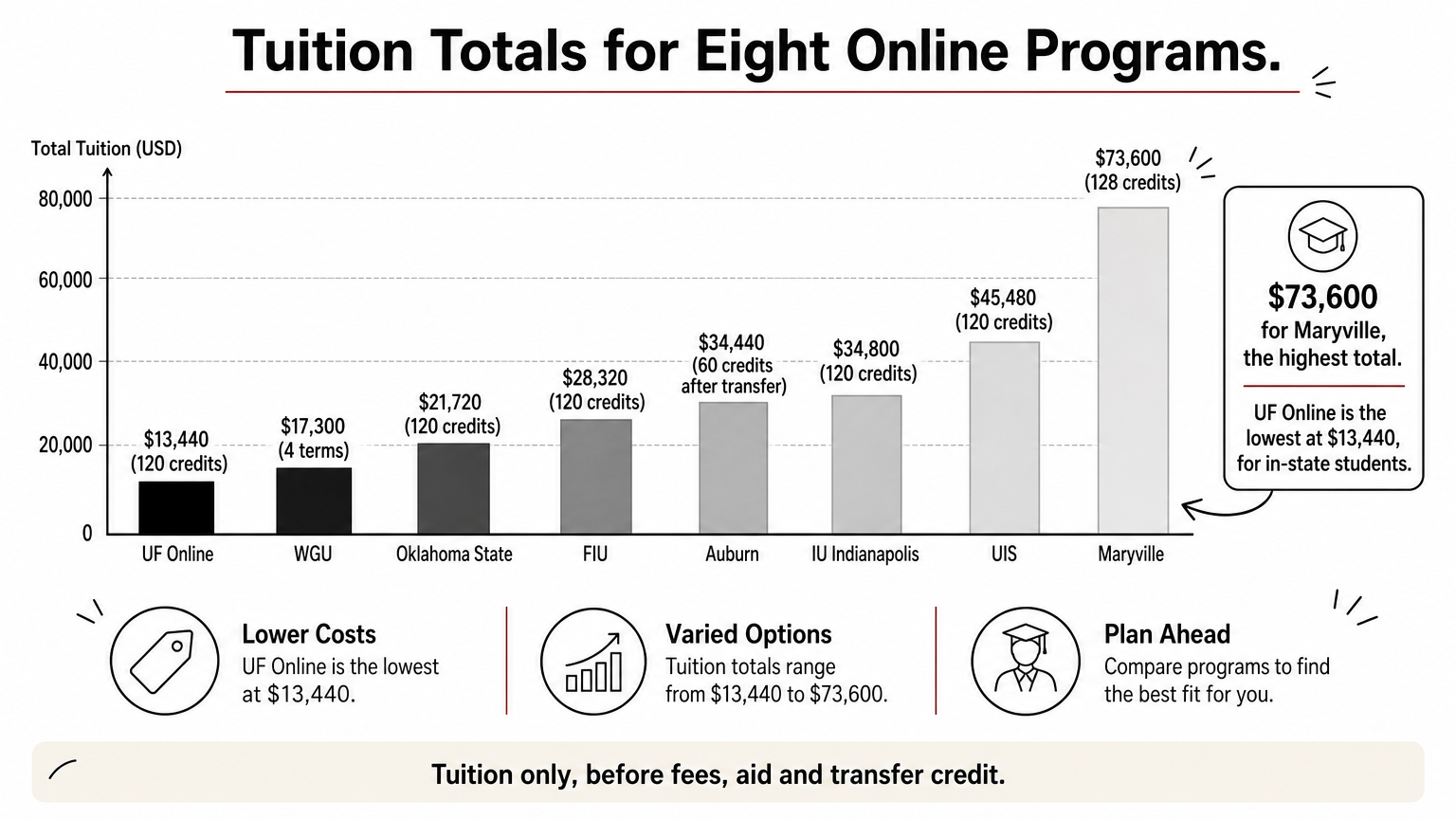
Cost per credit and total tuition differ widely, so a side-by-side view helps you narrow the list before you read admissions pages.
Side-by-side comparison
The totals below are tuition only, at the published rate, before fees, financial aid and transfer credit. WGU’s figure includes its $200 per-term resources fee over four terms.
| Program | Degree | Published rate | Illustrative tuition total |
|---|---|---|---|
| WGU | B.S. Computer Science | $4,125 per term plus $200 fee | $17,300 (4 terms) |
| UF Online | B.S. Computer Science | $112 per credit (in-state) | $13,440 (120 credits) |
| FIU | B.A. Computer Science | $236 per credit (in-state) | $28,320 (120 credits) |
| Oklahoma State | B.S. Applied Computer Programming | $181 per credit (part-time, in-state) | $21,720 (120 credits) |
| Maryville | B.S. Computer Science | $575 per credit | $73,600 (128 credits) |
| Auburn | Bachelor of Computer Science | $574 per credit (in-state) | $34,440 (60 credits after transfer) |
| UIS | B.S. Computer Science | $379 per credit | $45,480 (120 credits) |
| IU Indianapolis | B.S. Computer Science | $290 per credit (in-state) | $34,800 (120 credits) |
Matching a program to your situation
Work backward from your constraint. If cost is your limit, start with UF Online if you are a Florida resident and WGU if you are not. If time is your limit, WGU is the only one here built around finishing as fast as you can pass assessments. If you already have credits, Auburn or WGU will reward you most. If you want specialization, Maryville’s five tracks stand out. If you want an in-between degree that mixes fields, choose FIU.
Paying less, and what free really means
Accredited bachelor’s degrees are not free. Complete the FAFSA to see whether you qualify for federal grants and loans, and ask each school about scholarships and institutional aid. Transfer credits are the other big lever: the fewer credits you pay for, the lower the total.
What is free is skills training. Free courses in Python, Java and AI can show you whether you enjoy programming before you commit to years of tuition. They do not replace a degree, but they are a low-risk way to test your interest and build a portfolio while you apply.
Choosing your program
Pick on accreditation first, then on the constraint that matters most to you: price, speed, transfer credits, specialization or hands-on experience. Every program above is online, but each rewards a different kind of student, and the totals range from about $13,000 to over $73,000 in tuition alone. Request each school’s current rate and fee schedule before you decide, and apply to two or three programs so you can compare aid offers.
If you want help comparing more degrees, certificate programs, scholarships and free courses, you can explore more guides at Study Abroad Nations.