The best nurse practitioner degrees online share these three things in common: CCNE or ACEN accreditation, a clear plan for clinical placement, and a total price you can work out from a published per-credit or per-term rate.
Duke suits you if reputation matters most. Ohio State suits you if you want a top-ranked public school at a moderate price. Alabama suits you if cost leads. Western Governors University fits a self-driven nurse who wants a flat price per term. Texas State fits you if you want a 43-credit program with no GRE. UConn fits you if a doctorate is on your list.
Every school claims flexibility, accreditation, and support. The real differences sit in the numbers. Total tuition across online NP programs runs from under $20,000 to over $70,000, and the clinical hours stay in person no matter how online the coursework is. A nurse who compares only brand names or monthly payments often finds the gaps after enrolling.
This article compares six online family nurse practitioner (FNP) options, the most widely offered track, using published rankings, credit counts, and prices. A comparison section then shows how to check length, accreditation, clinical hours, and placement before you apply. Study Abroad Nations compares online degrees and certificate programs for cost-conscious learners, and the same approach applies here. Confirm every figure on the school’s own page before you apply, because rates change.
1. Duke University online FNP
Duke is the first pick if you want the highest-ranked program and can absorb the highest price. U.S. News ranks it #1 for online family nurse practitioner programs and tied for #2 in online nursing programs overall.
Format and length
Duke is a private university, and most of its graduate online nursing classes are recorded and archived. You can watch lectures around your shifts instead of logging in at fixed times. About 665 students are enrolled online, which is large enough to offer a deep alumni network.
- Ranking: #1 in online FNP programs
- School type: private
- Published rate: $2,250 per credit
- Credits and campus visits: confirm the total credit count and any required on-campus sessions on the program page
Tuition and who it suits
At $2,250 per credit, every 10 credits cost $22,500. A 45-credit master’s would reach about $101,250 before fees. Duke’s actual credit count may differ, so multiply the published rate by the number on the program page.
A top ranking costs the most per credit, so price the whole degree, not the first semester.
This program suits nurses whose employer reimburses tuition, or who work in a competitive hiring market where the school name carries weight. If you are paying out of pocket, the next two options deliver a lot of the same value for far less.
2. Ohio State University online FNP
Ohio State is the strongest public-university option here. U.S. News ranks it #1 in online nursing programs and tied for #3 in online FNP programs.
Format and length
Ohio State is public, and most of its graduate online nursing classes are recorded and archived. About 211 students are enrolled online, so cohorts feel smaller than at larger online schools.
- Ranking: #1 in nursing programs, #3 (tie) in FNP programs
- School type: public
- Published rate: $973 per credit (out-of-state)
- Credits and campus visits: check the program page for the credit total and any on-campus requirements
Tuition and who it suits
Ten credits at $973 cost $9,730, and a 45-credit master’s would come to about $43,785. Public schools usually charge residents a different rate, so if you live in the state, look up the resident figure and compare.
Ohio State gives you a top-ranked name at less than half Duke’s per-credit price.
This program suits nurses who want a recognized brand without private-school pricing. It also fits applicants who prefer a smaller online cohort. Expect competitive admission, and plan your clinical site arrangements early.
3. University of Alabama online FNP
The University of Alabama is the lowest-cost ranked pick in this list at $480 per credit (the out-of-state rate). U.S. News places it #5 in online FNP programs.
Format and length
Alabama is a public university where all graduate online nursing classes are recorded and archived. About 605 students are enrolled online, so the program is built for scale. You study on your own schedule and still earn a degree from a ranked school.
- Ranking: #5 in FNP programs, #5 (tie) in nursing programs
- School type: public
- Published rate: $480 per credit (out-of-state)
- Credits and campus visits: confirm on the program page
Tuition and who it suits
Ten credits cost $4,800, and a 45-credit master’s would be about $21,600 before fees. Other ranked public schools sit in a similar band: Georgia State publishes $450 per credit and Auburn $630.
If budget is your main filter, start with ranked public schools quoting under $700 per credit.
Alabama suits cost-conscious nurses who still want a ranked, accredited program. Check the clinical placement policy before you commit, because a low tuition bill means little if you spend months hunting for a preceptor.
4. Western Governors University MSN-FNP
Western Governors University (WGU) is the best fit if you want a flat price per term and a self-paced structure. Most graduates finish in about 2½ years, and tuition is $6,955 per six-month term.
Format and length
WGU is competency-based. You advance by passing assessments instead of sitting through set class hours, so nurses with strong clinical knowledge can move faster. Because the price is per term, not per credit, the pace you choose changes the total.
- Typical completion: about 2½ years
- Pricing model: flat tuition per six-month term
- Published rate: $6,955 per term
- Practicum details: confirm how clinical hours and placement are handled on the program page
Tuition and who it suits
Five terms cost $34,775 in tuition. If you finish in four terms, the total drops to $27,820. Fees and any extra terms are additional.
With flat-term pricing, every term you save cuts the bill by $6,955.
This option suits disciplined, experienced nurses who can study without deadlines pushing them. It is a weaker fit if you need the structure of weekly live sessions to stay on track. Ask how the school supports clinical placement, since that is where a self-paced program can feel lonely.
5. Texas State University MSN-FNP
Texas State is a good choice if you want a mid-sized program with no GRE. The online MSN-FNP is 43 credit hours, CCNE-accredited, and does not require the GRE.
Format and length
The program is fully online for coursework, with clinical hours completed in person. At 43 credits it sits between Sacred Heart University’s 42 credits and Texas Woman’s University’s 45 credits.
- Credits: 43 credit hours
- Accreditation: CCNE
- Admission test: no GRE required
- Per-credit rate and campus visits: see the program page
Tuition and who it suits
Take the published per-credit rate and multiply by 43 to get the base tuition, then add fees. That one multiplication tells you more than a “starting at” price on a landing page.
Total tuition equals the published rate times the credit count, so always do the multiplication yourself.
Texas State suits applicants who want to skip standardized testing and prefer a state-university price structure. It also suits nurses comparing credit counts, since a lower number usually means a shorter path and a smaller bill.
6. UConn online FNP, MS or DNP
UConn is the option to look at if you are still deciding between a master’s and a doctorate. It offers its online family nurse practitioner program as both a Master of Science and a Doctor of Nursing Practice.
Format and length
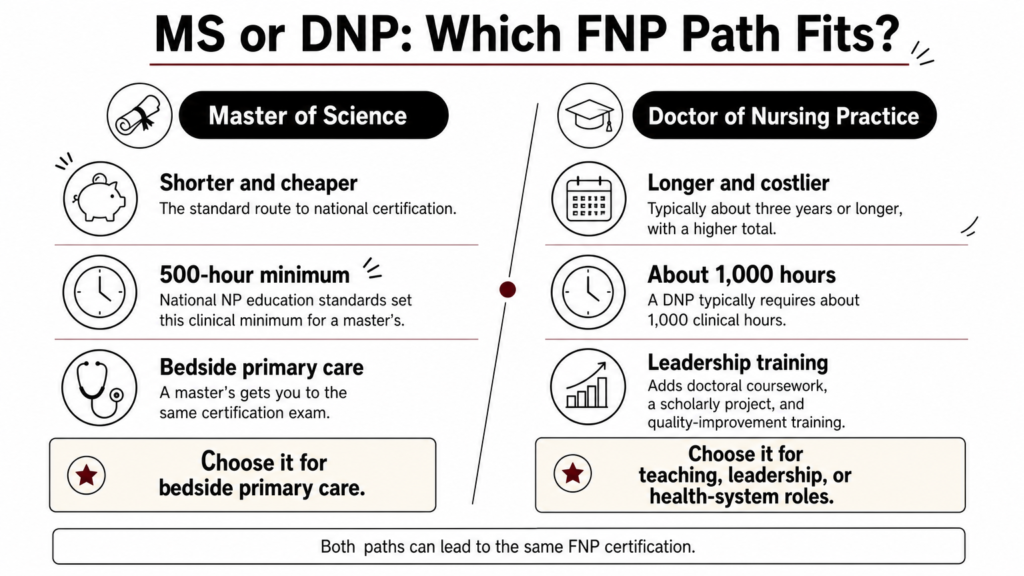
The two degrees prepare you for the same FNP role, but they differ in depth and time. A master’s prepares you for national certification. A DNP adds doctoral coursework and a scholarly project, and typically requires about 1,000 clinical hours, versus the 500-hour minimum that national NP education standards set for a master’s.
- Master’s (MS): shorter and cheaper, the standard route to certification
- Doctorate (DNP): longer, costs more, adds leadership and quality-improvement training
- Format and rates: confirm both on the program page
Tuition and who it suits
A DNP typically runs about three years or longer, so expect a higher total than a master’s at the same per-credit rate. The doctorate is worth the extra cost if you want teaching, leadership, or health-system roles. For bedside primary care alone, a master’s gets you to the same certification exam.
Choose the DNP for the career it opens, not because you think it is required to practice.
UConn suits nurses who want one school with both options, so they can start at one level and keep the doctorate in view.
How to compare online NP programs before applying
Compare programs by the length and credits, accreditation and certification, clinical hours, and placement support. Together, they separate a program you can finish from one that only looks affordable.
Credits, length, and price side by side
The table below combines the published figures from this article. The figures that are not covered here can be found on the program page as we have provided.
| Program | Published price | Credits | Typical length |
|---|---|---|---|
| Duke University | $2,250 per credit | See program page | See program page |
| Ohio State University | $973 per credit (out-of-state) | See program page | See program page |
| University of Alabama | $480 per credit (out-of-state) | See program page | See program page |
| Western Governors University | $6,955 per term | Competency-based | About 2½ years |
| Texas State University | See program page | 43 | See program page |
| Sacred Heart University | See program page | 42 | 2.5 years |
| Texas Woman’s University | See program page | 45 | 2 years full-time |
Be skeptical of any claim that an accredited MSN-FNP finishes in 12 months. A post-master’s certificate takes roughly 18 months, and a full master’s takes longer. If you hold an associate degree or a non-nursing bachelor’s, look for RN-to-MSN or bridge routes, because most programs above start from a BSN.
Accreditation, certification, and licensing
Accreditation from CCNE or ACEN is the first filter, because certification boards and employers rely on it. After graduating, FNP students sit for the ANCC or AANPCB certification exam. A board pass rate above 85 percent is a reasonable bar.
- Confirm CCNE or ACEN accreditation for the specific nursing program
- Ask for the first-time certification pass rate
- Confirm you hold, or can obtain, an active RN license in the state where you will do clinicals
- Check that the school can place you in your state
International applicants should note that online NP programs generally require an active U.S. RN license, and clinical hours must happen in an approved U.S. site.
Clinical hours and placement support
Expect at least 500 supervised clinical hours in a master’s, and 1,000 in a doctorate. Many FNP programs exceed the minimum, so ask for the exact figure.
Placement is the biggest hidden cost. Some schools find your preceptor and site, as Georgetown’s online FNP program advertises with its clinical placement support. Others expect you to arrange your own. Ask each school who secures the site, what happens if you cannot find one, and whether clinicals are allowed in your state.
Before you pay a deposit, get the school’s placement policy in writing.
Picking the right program
Match the program to your constraints. Choose Duke for reputation, Ohio State for a ranked public school, Alabama for the lowest cost, WGU for flat-term pricing, Texas State for a no-GRE 43-credit path, and UConn if a doctorate is possible. Then multiply the rate by the credits, confirm accreditation, and get placement terms in writing.
Rankings and prices change, so treat this list as a shortlist and verify each school’s current page. To compare more online degrees and certificate programs in one place, visit Study Abroad Nations and build a shortlist that fits your budget and timeline.