The best online LPN certificate programs are hybrid programs. You study theory online, then complete skills labs and clinical rotations in person. No legitimate practical nursing program can be finished entirely online, because you must practice patient care under supervision before you sit for the NCLEX-PN. Career-school hybrids suit working adults who need flexibility. Community college certificates suit anyone watching tuition. Accelerated programs suit people who can study full time.
The problem is that programs describe themselves in confusing ways. One calls itself online, another hybrid, and a third lists credits instead of months. Lengths range from about 10 to 18 months or more, and the rules depend on your state. It is hard to tell which LPN certificate programs online are real and which will leave you unable to take the licensing exam.
This article compares five formats side by side: how much happens online, what must happen in person, and how long each takes. At Study Abroad Nations we compare online courses, degrees and certificate programs, so we focus on the questions that decide your choice. Before you pay a deposit anywhere, confirm that your state board of nursing approves the program.
1. Hybrid programs at career schools
Hybrid career-school programs are the closest thing to an online LPN program that exists. They move most classroom learning to your computer and keep the hands-on work on site.
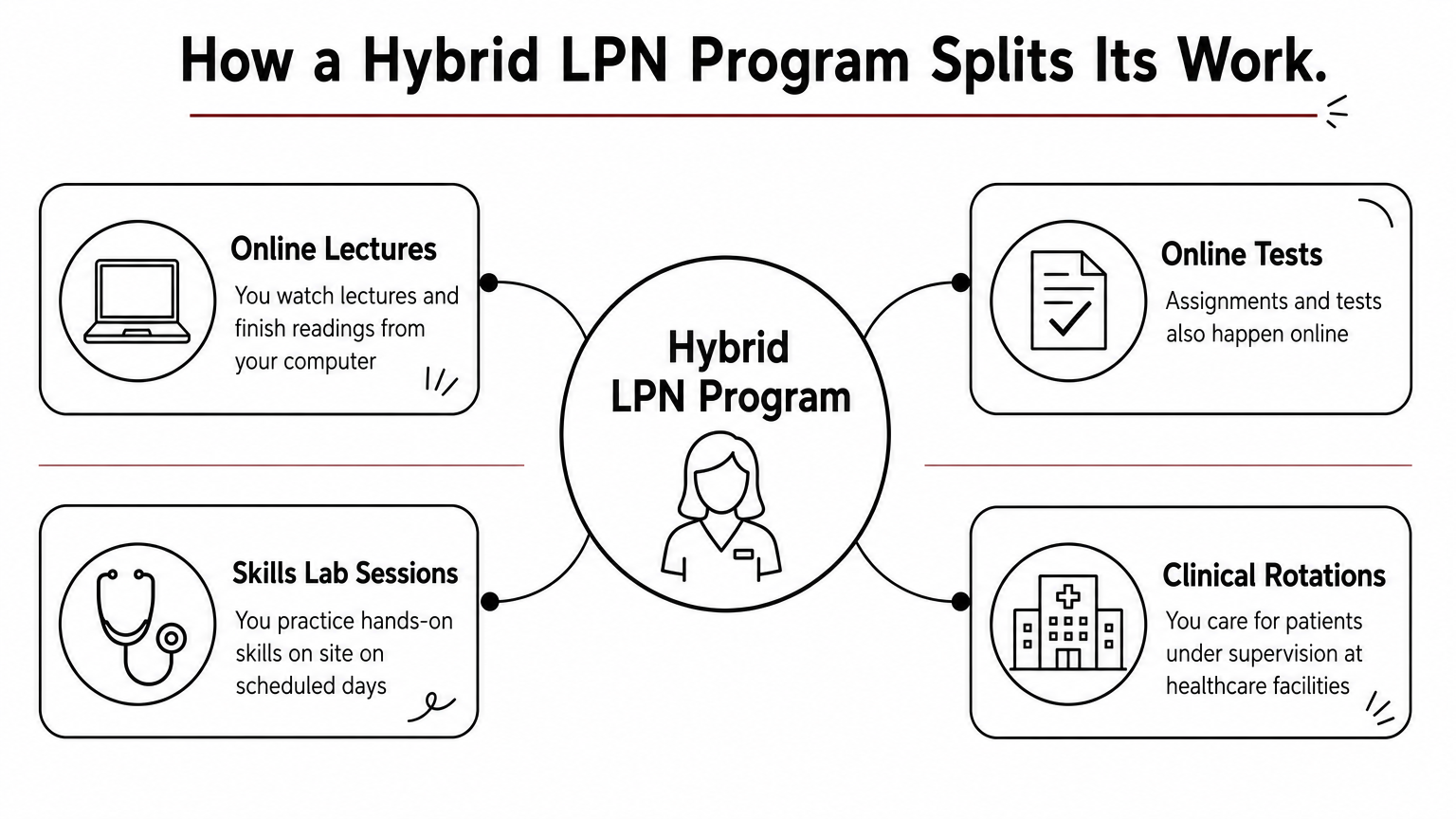
How the online and clinical split works
Lectures, readings, assignments and tests happen online. You then attend scheduled skills lab sessions and supervised clinical rotations at healthcare facilities. Some programs run about 12 months, and many schools arrange your clinical placements. Expect set deadlines and fixed in-person dates, not fully self-paced study.
- Online: lectures, readings, assignments, tests
- In person: skills labs and clinical rotations
- Typical length: about 12 months
Who it suits and what to check
This format fits working adults, parents and career changers who can’t sit in a classroom every day but can commit to scheduled lab and clinical days. Ask how many clinical hours the school arranges and how far you may need to travel to a site.
Online LPN programs are legit when your state board of nursing approves them and they include real clinical training. A program that promises a license without in-person practice is not. International applicants should also ask the school’s international office about student visa rules, because online-heavy study can affect eligibility.
A hybrid program is only as good as its clinical placements, so ask about them before you ask about price.
2. Community college certificates with online prerequisites
A community college certificate is usually the lowest-cost route, and it often lets you do the general education half online.

How the online and clinical split works
Colleges commonly split the certificate in two. One public college structures it as 46 credits: 16 general education prerequisite credits and 30 LPN course credits. Many schools let you take prerequisites online. The nursing sequence itself meets in person for lectures, labs and clinicals, and it can run 10 to 12 months full time.
- Online: many prerequisite courses (check each college)
- In person: the full nursing sequence
- Typical length: 10 to 12 months of nursing courses, plus prerequisite time
Who it suits and what to check
This option suits cost-conscious students who can tolerate a slower start. Admission is often competitive and based partly on your GPA in prerequisite courses, so finish those first and apply early.
Free LPN programs are rare. When tuition help exists, it usually comes from workforce grants or employer sponsorship, so ask the admissions office what your state offers. Also confirm whether prerequisites must be complete before you apply.
Do your prerequisites online and cheaply, then save your time and energy for the in-person nursing sequence.
3. Technical school full-time programs
Technical and vocational schools offer full-time certificates that fold lectures, labs and clinical work into one schedule. Online content here is limited.
How the online and clinical split works
A typical program is a 12-month, full-time certificate with integrated lectures, laboratory practice and clinical experience. Some theory courses may be available online, but delivery varies by school, so confirm it in writing. Clinical hours are always in person.
- Online: a few theory courses at most
- In person: lectures, labs and clinical rotations
- Typical length: about 12 months full time
Who it suits and what to check
If you learn better with a fixed daily routine and instructors on hand, this format works well. It also removes the guesswork about internet reliability and online exam setups.
Look at the NCLEX-PN pass rate the state board publishes for the program. Add up total cost, including uniforms, fees, supplies and exam registration, not only tuition. Then check whether the school is approved by your state board.
If a school can’t show its NCLEX-PN pass rate, treat that as a reason to look elsewhere.
4. Part-time and evening hybrid tracks
Part-time tracks stretch the same content over a longer period so you can keep earning while you study. Not every state or school offers one.

How the online and clinical split works
Theory is often delivered online or in evening classes, while labs and clinicals stay in person. The timeline is longer than 12 months, so ask for the exact start and end dates. The clinical schedule matters most, because rotations may fall on weekdays or weekends.
- Online: evening or asynchronous theory
- In person: labs and clinicals, on a schedule the school sets
- Typical length: longer than 12 months, confirm the calendar
Who it suits and what to check
This track suits caregivers, people with full-time jobs and anyone who can’t drop income for a year. You trade speed for stability.
Ask whether clinical days conflict with your work hours, and whether you can pause if life gets in the way. Financial aid may also be smaller for part-time enrollment, so check how the school calculates it.
Choose a part-time track only after you know exactly when the clinical rotations happen.
5. Accelerated full-time programs
Accelerated programs are the fastest legitimate route, with some certificates running about 10 months full time. No approved program takes 12 weeks.
How the online and clinical split works
State boards set minimum theory and clinical hours, so a program can’t shrink them to weeks. A 10-month schedule compresses the same work into a heavier weekly load. Some online theory may be offered, but expect most of your week on campus or at clinical sites.
- Online: limited, depending on the school
- In person: dense schedule of classes, labs and clinicals
- Typical length: about 10 months
Who it suits and what to check
This format fits students who have prerequisites done and can study full time without a job. It rewards focus, and it leaves little room for outside work or long commutes.
Treat any ad promising an LPN in weeks as a red flag. Confirm the program’s approval status, ask how many students finish on time, and compare its NCLEX-PN results with slower programs before you assume faster is better.
The fastest legitimate LPN certificate takes about 10 months, and anything quicker should make you suspicious.
Picking the program that fits your life
Online LPN certificate programs all share one rule: the theory can move online, but the clinical training can’t. The real choice is how much flexibility you need, how much you can spend, and how long you can commit. Hybrid career-school programs offer flexibility, community colleges offer lower cost, technical schools offer structure, part-time tracks protect your income, and accelerated programs offer speed.
Start by confirming state board approval, then ask each school for its clinical placement process, total cost and published exam results. To keep comparing online courses, certificate programs and other study options, browse more guides on Study Abroad Nations.