The best certificates in accounting online depend on what you need the credential to do. If cost is your limit, Lenoir Community College lists the lowest paid tuition below, at $1,064 in total for in-state students. If you need a flexible schedule, Liberty University starts students eight times a year. Minnesota State University, Mankato suits career changers who are aiming at the CPA exam. Two free courses, from Alison and the University of Pennsylvania, suit anyone who wants to test the field before paying.
The hard part is that online accounting certificates range from a free ten-hour course to a 30-credit program that costs close to $18,000, and the names all sound alike. A certificate is also not a certification, and a poor match can cost you a semester and a few thousand dollars. You need to compare cost, length, accreditation and career fit on the same scale.
This article does that for eight options, six paid and two free. Each one gets the same three checks: what it covers, what it costs and how long it takes, and who it suits. After the list, you get a side-by-side table, a short guide to choosing, and an honest look at what a certificate can and cannot do for your career. Tuition figures are published per-credit rates, and schools change them, so confirm on the program page before you apply.
1. Lenoir Community College accounting essentials
Lenoir Community College’s accounting essentials certificate is the lowest-cost accredited route in this list. It is a short, practical program built on core accounting and tax skills, and it is fully online.

What it covers
The program is 14 credits and includes a mandatory federal taxation course, which many short certificates leave as an elective. Lenoir also offers a separate bookkeeping certificate, so you can start narrower if ledger work is all you need.
- Accreditation: Southern Association of Colleges and Schools Commission on Colleges
- Credits: 14
- Prerequisite: high school diploma or equivalent
- Format: online, with no in-person requirement
- Length: one to two semesters
Cost and time
Tuition is $76 per credit at the in-state rate. That works out to $1,064 for the full certificate (14 credits × $76). The rate applies to North Carolina residents, so if you live elsewhere, ask the college what you would pay.
A $1,064 accredited certificate is the cheapest paid route here, but only if you qualify for the in-state rate.
Budget extra for textbooks and fees. Most students finish within one to two semesters.
Who it suits
Choose it if you want entry-level bookkeeping or clerk skills from a recognized college at minimal cost. Wayne Community College and Stanly Community College list the same $76 in-state rate. Wayne adds computer applications coursework, and Stanly stresses advising and success coaching.
Skip it if you want a national university name on your resume, or if you live out of state and the price rises.
2. Southern New Hampshire University certificate
Southern New Hampshire University (SNHU) offers an 18-credit undergraduate accounting certificate with programmatic accreditation. Few online accounting certificates carry that extra layer of review.
What it covers
Classes are asynchronous and run in eight- or 10-week terms. As part of the curriculum, you can earn Wiley Excel for Accounting certificates, a useful addition for anyone heading into spreadsheet-heavy work.
- Accreditation: New England Commission of Higher Education (institutional), plus ACBSP (program)
- Credits: 18
- Prerequisite: high school diploma or equivalent
- Application fee: free
- Length: two semesters
Cost and time
At $342 per credit, the 18 credits come to $6,156. That is about six times the Lenoir price, so the premium has to buy you something specific, such as accreditation or a recognized name.
SNHU says it accepts transfer credit through prior learning and exams. It also describes its certificate programs as financial-aid eligible. Confirm both with admissions, because eligibility depends on your situation.
SNHU is the pick when programmatic accreditation and Excel skills matter more than the lowest price.
Who it suits
It suits working adults who want a recognized online university, a predictable term structure and a credential that can later count toward a degree. It also suits readers who want Excel certificates alongside their accounting coursework.
Skip it if your budget is tight and you only need foundational bookkeeping skills. A community college certificate covers that for far less.
3. Liberty University undergraduate certificate
Liberty University’s online undergraduate certificate in accounting is the most flexible paid option here. You pick when to start and how fast to move.
What it covers
Classes are asynchronous and run in eight-week sessions, with eight start dates a year. The 21-credit program also covers business law and management principles, so it is broader than a pure accounting sequence. Liberty provides free electronic textbooks.
- Accreditation: Southern Association of Colleges and Schools Commission on Colleges
- Credits: 21
- Prerequisite: high school diploma or equivalent
- Application fee: $50
- Length: one to two semesters
Cost and time
Tuition is $390 per credit, so the full 21 credits cost $8,190. Liberty accepts up to 15 transfer credits. If all 15 applied, you would pay for only 6 credits, or $2,340 (6 × $390), though each transfer is evaluated individually.
If you already hold college credit, Liberty’s transfer policy can cut the bill by more than 70%.
The free e-textbooks also remove a cost that surprises many online students.
Who it suits
It suits busy professionals and anyone with earlier college credit, because the frequent start dates mean you never wait months to begin. It also suits readers who want business law and management context next to accounting.
Skip it if you have no prior credit and your budget is limited. Without transfers, it is the second most expensive of the paid programs below.
4. Minnesota State University, Mankato certificate
Minnesota State University, Mankato runs an online accelerated accounting certificate designed for people who did not study accounting and now want to pursue CPA licensure. It is the clearest CPA-oriented choice for career changers.
What it covers
The curriculum starts with introductory material to ease you into the field and is aligned with CPA licensure standards. Students must keep a minimum 2.0 GPA in the certificate. Master of Accounting students are admitted to the certificate automatically.
- Accreditation: Higher Learning Commission
- Credits: 16
- Prerequisite: high school diploma or equivalent
- Application fee: $20
- Length: two semesters
Cost and time
At $368 per credit, the 16 credits total $5,888. That is the second-lowest total among the four-figure university programs here, and it is built to finish in two semesters.
CPA rules are set by each state board of accountancy, not by the school. Before you pay, check your board’s accounting-credit requirements and ask whether this certificate’s courses satisfy them.
A CPA-aligned certificate only helps if your own state board accepts its courses.
Who it suits
It suits career changers with a bachelor’s in another field who need accounting coursework as a stepping stone. It also suits current M.ACC students, since they enter the certificate automatically.
Skip it if you are not pursuing licensure. A broader, cheaper program gives you the same bookkeeping basics.
5. Husson University accounting certificate
Husson University’s online certificate in accounting is the best fit here for hands-on learning. It pairs core courses with practical exercises and an optional internship.

What it covers
Core courses use practical exercises, and students who want real-world practice can add an optional internship. The 15-credit program covers both private and public accounting topics. Electives include managerial accounting, forensic accounting and federal taxation.
- Accreditation: New England Commission of Higher Education
- Credits: 15
- Prerequisite: none
- Application fee: $40
- Format: asynchronous classes with multiple start dates
Cost and time
Tuition is $448 per credit, so the certificate costs $6,720 (15 × $448). Listed length is one semester or more, and the multiple starts mean you can begin soon after you are admitted.
With no prerequisite and an optional internship, Husson suits people who need practice, not just coursework.
Ask about the internship’s requirements and any extra fees before you count on it.
Who it suits
It suits career starters who want to show employers applied work, not only transcripts. It also suits anyone without a high school diploma on hand, since no prerequisite is listed.
Skip it if you want the lowest price. Husson costs more per credit than SNHU or Mankato, and you are paying for the applied focus.
6. Ohio Dominican University accounting certificate
Ohio Dominican University has the deepest and most expensive program in this list. It is a 30-credit online certificate that goes well beyond the basics.
What it covers
Eighteen of the 30 credits are electives in topics such as advanced accounting, managerial finance and cost accounting. The program is asynchronous, has a 12-to-1 student-to-faculty ratio, and aligns with licensure exam requirements.
- Accreditation: Higher Learning Commission
- Credits: 30
- Prerequisite: high school diploma or equivalent with a minimum 2.3 GPA
- Application fee: free
- Length: one year or more
Cost and time
Tuition is $597 per credit. Published program tuition and fees come to roughly $17,900, the highest in this list. Plan on at least a year.
Thirty credits is also the usual gap between a 120-credit bachelor’s degree and the 150 credits many states ask of CPA candidates. Whether a state board counts undergraduate certificate credits toward that total is a question for the board, not the school.
At nearly $18,000, this certificate only makes sense if you need its depth and your state board accepts the credits.
Who it suits
It suits readers who want a near-degree accounting education without enrolling in a full degree. It also suits those with a CPA goal who have confirmed the credit rules.
Skip it if you are exploring accounting casually. Compare it with a full degree before paying this much.
7. Alison’s free Principles of Accounting course
Alison’s Principles of Accounting, created by Accounting Intuition, is the best free starting point for a complete beginner. You learn the core concepts in about a week or two of part-time study.
What it covers
The course has 11 modules and takes roughly six to ten hours, plus a final assessment. Topics include the accounting equation, double-entry bookkeeping, financial statements, the accrual principle, profitability ratios and cash flow.
- Cost to study: free
- Length: about 6 to 10 hours
- Certificate: awarded after completing the course and scoring at least 80% on the final assessment
- Credit: none toward a college degree
Cost and time
Studying costs nothing. Platforms change what they charge for the certificate document itself, so check the current certificate price before you finish. At four hours a week, an eight-hour course takes two weeks.
Use the free course as a low-risk test of whether you enjoy accounting before you spend thousands.
The time is short enough to finish before a semester start date, which makes it a sensible warm-up.
Who it suits
It suits complete beginners, small business owners and anyone deciding between a paid certificate and a different field. It is also a fair way to refresh the basics before a college program.
Skip it if you need a credential employers recognize on its own. It shows initiative, but it carries no college credit and no accreditation weight.
8. Penn’s free Accounting Analytics on Coursera
The University of Pennsylvania’s Accounting Analytics course on Coursera suits people who already know basic accounting and want to add data skills. It is self-guided and available in 22 languages.
What it covers
The course has four modules, each with videos, readings and quizzes. They cover ratios and forecasting, earnings management, big data and prediction models, and linking non-financial metrics to financial performance.
- Cost to study: free, per its listing
- Format: self-guided
- Languages: 22
- Certificate: offered on completion, so confirm the fee on the course page
Cost and time
Coursera’s pricing for certificates changes, so check whether the certificate is free for you before you invest hours. The course page lists the current hours and pacing.
Free analytics training adds more to a resume when you pair it with real accounting basics.
Because it is self-paced, you can fit it around a job or alongside one of the paid programs above.
Who it suits
It suits bookkeepers, finance staff and recent graduates who want to talk about forecasting and data in interviews. It also pairs well with a paid certificate, since it adds a modern skill the basics do not cover.
Skip it as a first course. If you cannot yet read a balance sheet, start with Alison’s course instead.
How to choose the right accounting certificate
Pick by goal first, then by accreditation, then by total cost. Starting with price alone is how people end up with a certificate that does not match the job they want.
Start with your goal
Your goal narrows the list faster than anything else. Match yourself to the closest line.
- Bookkeeping or clerk job at low cost: Lenoir, or a community college with the same in-state rate
- Applied experience with an internship: Husson
- Flexible start dates or transfer credit: Liberty
- Recognized accreditation and Excel skills: SNHU
- CPA path from another field: Mankato, then check your state board
- Maximum depth: Ohio Dominican
- Testing the field for free: Alison, then Penn
Check accreditation and transfer rules
Every paid program should come from a school with institutional accreditation. Without it, you risk credits that do not transfer and a credential employers may not accept. Programmatic accreditation, like SNHU’s ACBSP status, is a bonus, not a requirement.
If you live outside the United States, ask the school’s international office about eligibility and out-of-state pricing. Fully online study generally does not lead to a U.S. student visa, so confirm what the program does and does not give you.
Compare cost, time and fit
Online certificate students typically do not qualify for traditional federal aid. Look for employer sponsorship, tuition discounts and fee waivers instead, and ask your employer about professional development funds. The table puts the programs side by side.
| Program | Listed tuition | Size | Length | Best for |
|---|---|---|---|---|
| Lenoir Community College | $1,064 (in-state) | 14 credits | 1-2 semesters | Lowest cost |
| SNHU | $6,156 | 18 credits | 2 semesters | Accreditation, Excel |
| Liberty University | $8,190 | 21 credits | 1-2 semesters | Flexibility, transfers |
| Minnesota State, Mankato | $5,888 | 16 credits | 2 semesters | CPA path |
| Husson University | $6,720 | 15 credits | 1+ semester | Hands-on practice |
| Ohio Dominican University | about $17,900 | 30 credits | 1+ year | Depth |
| Alison | Free to study | 6-10 hours | Self-paced | Beginners |
| Penn on Coursera | Free to study | 4 modules | Self-paced | Analytics |
Are online accounting certificates worth it?
A certificate is worth it when it opens a specific entry-level door or fills a specific gap. It is not a substitute for a bachelor’s degree, and it will not make you a CPA.
What a certificate can do for your career
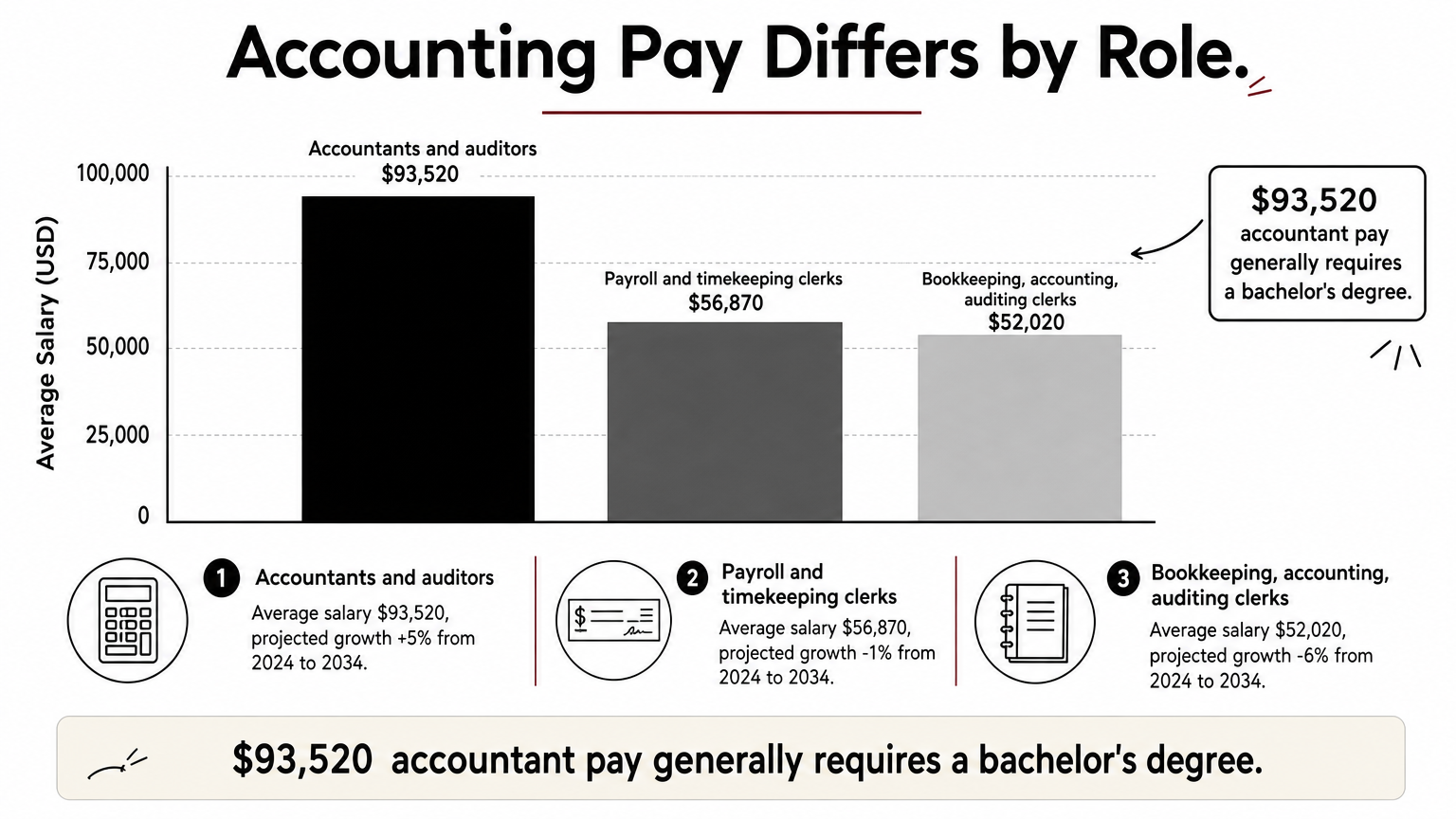
A certificate can qualify you for entry-level work such as bookkeeping and payroll, show employers that you can do the basics, and give you credits toward a degree. The U.S. Bureau of Labor Statistics (BLS) figures below show how the pay and outlook differ by role.
| Occupation | Average salary (2024) | Projected growth (2024-34) |
|---|---|---|
| Accountants and auditors | $93,520 | +5% |
| Payroll and timekeeping clerks | $56,870 | -1% |
| Bookkeeping, accounting and auditing clerks | $52,020 | -6% |
A certificate gets you clerk-level work, while the accountant salaries in the BLS data generally require a bachelor’s degree.
Certificate versus certification
A certificate is an academic credential for finishing a course sequence. A certification is a professional credential that combines education, experience and an exam. Many readers searching for the best certification in accounting want the second one.
The Certified Management Accountant credential, for example, requires a bachelor’s degree, two or more years of experience and a two-part exam. Many states require 150 credits for CPA licensure, against the 120 in a typical bachelor’s degree. A certificate can supply credits toward those requirements, but it does not replace any of them.
Choosing your first certificate
The right certificate is the one that matches your goal at a price you can carry. Lenoir wins on cost, SNHU on accreditation, Liberty on flexibility, Mankato on the CPA path, Husson on hands-on practice and Ohio Dominican on depth. Alison and Penn let you start for free. Confirm tuition, accreditation and transfer rules on each program page before you commit.
If you are still unsure, take the free Alison course this month. It costs little, and it tells you quickly whether accounting suits you. For more free courses, scholarship leads and guides to online programs, browse Study Abroad Nations and pick your next step.