The best degrees in social work online have three things in common: accreditation from the Council on Social Work Education (CSWE), a credit load that fits your life, and a supervised field placement you can complete near home. Capella University suits you if you want BSW, MSW and DSW options at one school. Texas State University fits a first-time bachelor’s student who wants a full online 120-credit BSW. West Virginia University and UNC Charlotte suit you if you already hold about 60 credits and want a degree-completion route. The University of Denver suits you if you have a bachelor’s in any field and want an MSW.
The hard part is comparing them. One school quotes cost per credit, another quotes a total, and a third hides credit counts behind a request-info form. A wrong choice can cost you thousands of dollars or leave you short of the degree your state licensing board requires.
This article gives you a short checklist first: accreditation, degree level, and the hidden requirements of online study. Then it breaks down five programs with the same subheadings so you can compare them side by side. At Study Abroad Nations we compare online degrees and certificate programs for cost-conscious learners. The figures below come from each program’s published pages, and tuition changes, so confirm the current numbers before you apply.
What to check before you choose an online social work degree
Check three things in this order: CSWE accreditation, the degree level that matches your career goal, and the real requirements behind "online," meaning field hours, campus visits and transfer credit. Do this before you read any marketing page.
CSWE accreditation comes first
The Council on Social Work Education accredits bachelor’s and master’s social work programs. Many social work jobs and state licensure paths require a degree from a CSWE-accredited program, so this is the one filter you cannot skip. Look the program up in the CSWE directory of accredited programs instead of trusting a school’s own banner. Institutional accreditation is a separate matter, and a school needs it too.
If you live outside the United States, remember that a CSWE degree is a US credential. Check whether your home country recognizes it, and whether the work you want there requires local registration.
Accreditation is the one box you cannot skip. Everything else is a trade-off.
Which degree level fits your goal
Pick the level by the job you want, not by the cheapest sticker price.
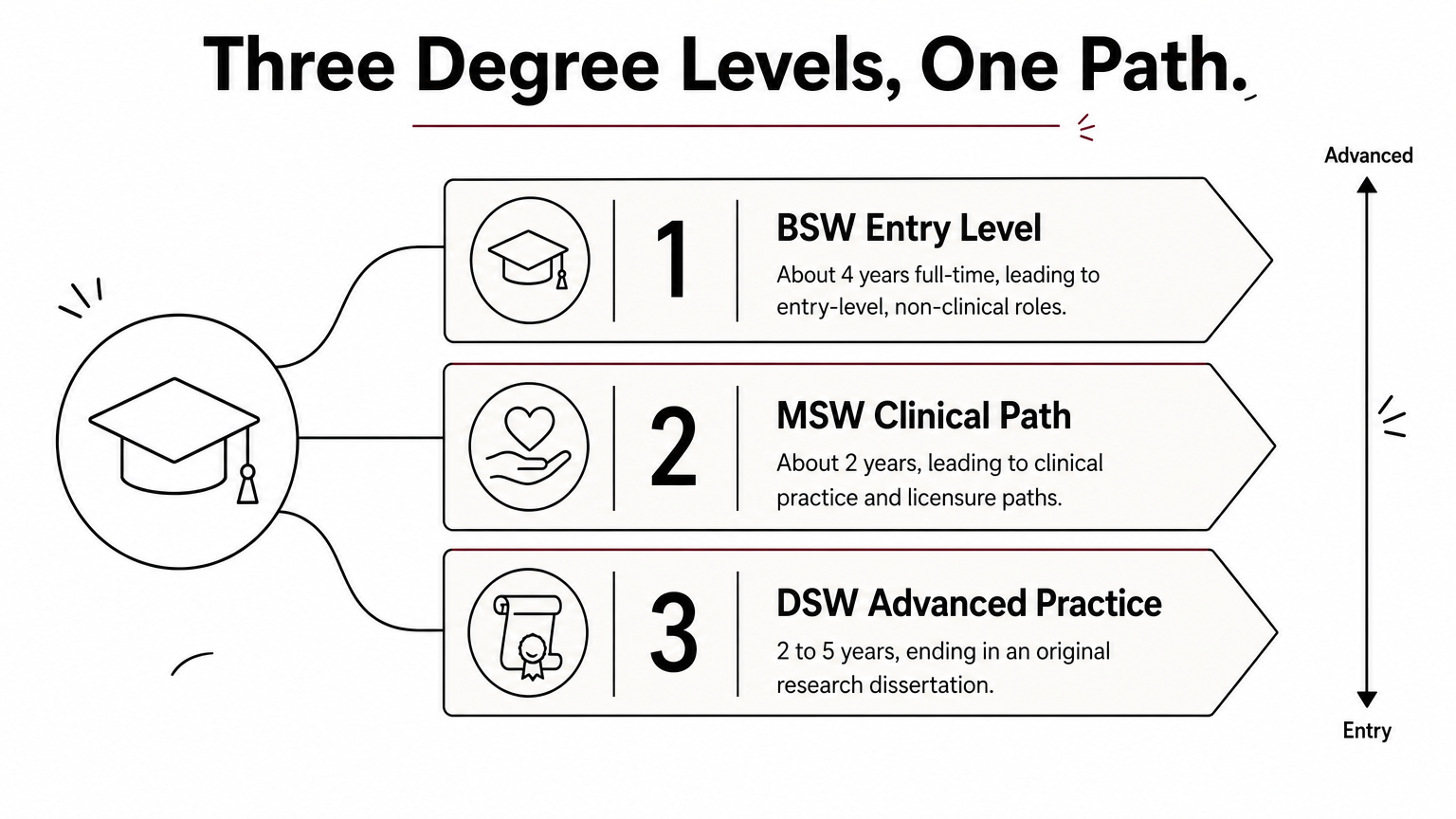
| Degree | Typical length | Field or research | Leads to |
|---|---|---|---|
| BSW | About 4 years full-time, 1.5 to 2 years if accelerated with an associate degree | 400 hours minimum of supervised field experience | Entry-level, non-clinical roles |
| MSW | About 2 years, as little as 12 months with advanced standing | Longer field placement than a BSW | Clinical practice and licensure paths |
| DSW | 2 to 5 years | Original research dissertation | Advanced clinical practice, research, leadership |
An MSW is the degree most states require for clinical licensure, though each state board sets its own rules.
Field hours, campus visits, and transfer credit
Online coursework does not remove field placement. Even fully online programs expect you to complete supervised hours at an agency near you. Some programs also require one or two campus visits a year, so ask before you enroll.
Transfer credit changes your total bill more than the per-credit rate does. Degree-completion tracks assume you arrive with about 60 credits. If you do not have them, you are looking at a different program.
1. Capella University
Capella is the pick when you want to stay at one CSWE-accredited online school for a BSW, an MSW or a DSW. Its program page lists all three levels.
Program snapshot
- Degrees offered: BSW, MSW and DSW.
- Accreditation: CSWE, as stated on the program page.
- Format: Online. The MSW is listed with full-time and part-time enrollment.
Capella’s page does not give a single price or length, because they differ by level. Ask for the total credits and total tuition for the level you need, and compare that total, not the per-credit rate.
Who it suits
Capella suits students who expect to climb the ladder. You might finish a BSW, work for a few years, then return for an MSW. Ask whether a CSWE-accredited BSW earns you advanced standing, which can shorten an MSW to as little as 12 months at programs that offer it.
The DSW is a different animal. It runs two to five years and ends in a dissertation. It fits experienced practitioners aiming at leadership, research or teaching, not newcomers.
One school for every level is convenient, but price each level separately.
2. Texas State University BSW
Texas State’s online BSW suits a first-time bachelor’s student who wants the full 120-credit degree delivered 100% online. It prepares students for generalist social work practice.

Cost, length, and format
- Credits: 120 credit hours.
- Format: 100% online when you are admitted to an Online Cohort.
- Total tuition listed: $51,056.
That total works out to about $425 per credit hour. This is the clearest published total of the programs here, which makes it a good benchmark for any other full BSW you consider. Your finish time depends on how many credits you transfer and whether you study full-time.
Who it suits
This program fits you if you are starting from scratch or bring only a handful of credits. A completion track would not accept you, and a full degree gives you the general education courses, the social work core and the practicum in one plan.
Because admission runs through an online cohort, check start dates and how the practicum placement works for students who live far from campus. That is a question to ask an advisor, not something to guess.
Texas State gives you a full-degree price to measure other BSW programs against.
3. West Virginia University BSW
WVU’s online BSW is the best fit when you already have roughly 60 credits and want a two-to-three-year completion route with a published per-credit rate.

Cost, length, and format
- Cost: $519 per credit hour.
- Load: 20 courses, 60 credits.
- Duration: 2 to 3 years.
Here is the worked example. Sixty credits at $519 comes to $31,140 in tuition, before fees. That figure covers only the credits you take at WVU. The 60 credits you bring with you are already paid for, which is why completion tracks beat a full BSW on cost when you qualify.
Who it suits
WVU fits students with an associate degree or a community college record who work while they study. The two-to-three-year span gives you room to pace yourself.
Before you apply, have your transcript evaluated. If fewer of your credits transfer, you will need more than 60 at WVU, and the example above stops applying. Ask for the evaluation in writing.
At $519 per credit, 60 credits cost $31,140 in tuition, so credit transfer decides your real price.
4. UNC Charlotte BSW online
UNC Charlotte’s online BSW is a two-year degree-completion program for applicants who have finished all prerequisites. It suits transfer students who want a fixed timeline.
Cost, length, and format
- Length: Two years.
- Type: Degree completion, not a full four-year degree.
- Entry rule: You must have met the program’s prerequisites before you start.
The program page does not give a price here. Ask which tuition rate applies to online students. Public universities often charge by residency, but some set one online rate.
Who it suits
This is the program for you if you finished general education and prerequisite courses at a community college and want a structured two-year finish. It is more rigid than a flexible completion track, but you always know where you stand.
Compare it directly with WVU. WVU publishes a per-credit rate and a two-to-three-year window. UNC Charlotte offers a firm two-year plan. Choose on price once you have both quotes, and on pace if you need the shortest path.
A fixed two-year plan helps you budget time, but get the tuition quote before you commit.
5. University of Denver MSW
The University of Denver’s online MSW suits you if you hold a bachelor’s degree in any field and want to move toward clinical practice. It offers full-time and part-time enrollment.
Cost, length, and format
- Length: As few as 12 months.
- Credits: 54 to 81 graduate-level credits.
- Concentrations: Mental Health and Trauma, and Health, Equity and Wellness.
- Admission: Bachelor’s degree from a regionally accredited institution, minimum 2.5 GPA, transcripts, letters of recommendation, resume and a career goals statement.
The wide credit range reflects different starting points, so ask which track you qualify for. For comparison, Syracuse University lists as few as 24 months and 36 to 60 credits for its online MSW.
Who it suits
Denver fits career changers. You do not need a social work bachelor’s, and a 2.5 GPA is a lower bar than many graduate programs set. The concentrations let you aim at trauma and mental health work or at public health settings.
Before applying, check your state board’s licensure rules, since requirements for clinical licensure vary by state. Then confirm the program’s CSWE status in the directory, as you would for any program.
If you hold a bachelor’s in any field, an MSW is the most direct online path into clinical work.
Choosing your program
Start with CSWE accreditation, then match the degree to your goal. A BSW opens entry-level roles, an MSW is the route toward clinical licensure, and a DSW is for advanced practice and research. Texas State shows what a full online BSW costs, WVU and UNC Charlotte suit students who bring about 60 credits, Denver suits career changers, and Capella suits anyone who wants every level at one school.
Get the full price in writing, including fees and any campus visits, and ask how field placement works where you live. If you want more side-by-side breakdowns, you can compare more online degrees and certificate programs on Study Abroad Nations before you apply.