The best online degrees in computer science for most readers are WGU for speed and a flat price, ASU Online for ABET-accredited depth, UF Online for a flagship name, LSU Online for a theory-heavy public degree, and University of Phoenix for flexible starts and career changers. All five are regionally accredited bachelor’s programs you can finish without moving. The real choice comes down to how the school prices the degree, how fast you can move, and how much theory you want.
Most program pages sell the same promise: flexible, career-ready, affordable. That tells you nothing about which one fits your budget and schedule. A degree that charges per credit rewards a different student than one that charges per term, and a program built on fixed course dates suits a different life than one built on self-paced exams.
Below, each program gets the same two checks: how it works, and what it costs and who it suits. Tuition changes every year, so I explain each pricing model and leave you to confirm current rates on the school’s site. One note up front: no accredited bachelor’s in computer science is free. If you want to test your interest first, take a free intro programming course before you commit to tuition.
1. WGU: the flat-rate, competency-based option
WGU is the best fit if you already know some IT or programming and want to move faster than a fixed calendar allows. It is a nonprofit, regionally accredited university where you advance by passing assessments, not by sitting through a set number of weeks.

How the program works
You study at your own pace and take an assessment when you feel ready. If you know a topic from work, you can pass it quickly and move on. WGU also says the program includes advanced certifications in the tuition price, which gives you credentials to show employers alongside the degree.
- Accreditation: regionally accredited by NWCCU
- Pace: self-paced inside six-month terms
- Extras: certifications included in tuition, per WGU
Cost and who it suits
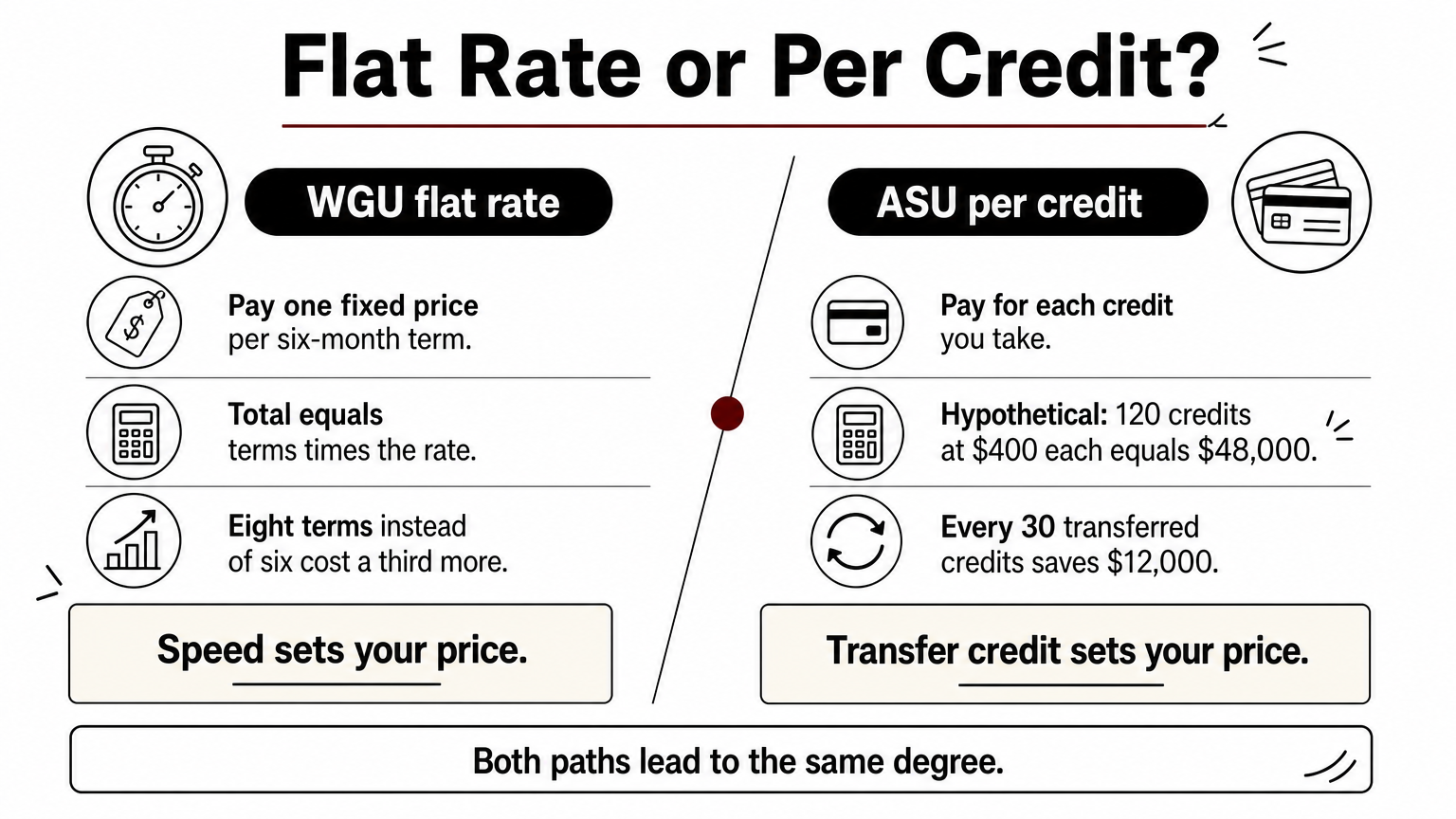
WGU charges a flat rate per six-month term, not per credit. Your total is the number of terms times the rate. Someone who finishes in six terms pays for six, and someone who needs eight pays for eight, a third more. That is why speed matters here more than anywhere else on this list.
At WGU, every extra term you need adds the same fixed bill, so your own pace sets your price.
It works for disciplined self-starters, usually working adults. Be realistic about a one-year bachelor’s. It only happens if you transfer in substantial credit and already know much of the material. If you need deadlines and instructors to keep you moving, pick a calendar-based program from this list.
2. ASU Online: ABET accreditation and broad specializations
ASU Online is the strongest pick when you want an ABET-accredited degree from a large public research university. ASU describes the program as building skills in AI, cybersecurity and software development, so it leans practical and current.
How the program works
Classes run in compressed sessions, typically around seven and a half weeks, with several start dates each year. You take two or three courses at a time, or one if work is heavy. That rhythm keeps momentum without a full semester commitment.
- Accreditation: ABET-accredited program, per ASU
- Focus: AI, cybersecurity, software development
- Format: short sessions, multiple starts per year
Cost and who it suits
ASU prices by the credit, so transfer credit directly lowers your bill. Take a typical 120-credit bachelor’s at a hypothetical $400 per credit. That is $48,000 before transfer credit, and every 30 credits you bring in saves $12,000. Community college courses are the cheapest way to cut that number, so confirm which ones ASU accepts before you enroll.
With per-credit pricing, the cheapest credits are the ones you transfer in.
It suits students who want an ABET stamp for graduate school or engineering-adjacent employers. International students should also check ASU’s admission rules for applicants abroad. Studying fully online from your home country is generally possible. F-1 visa holders inside the US, however, are generally limited in how much online study counts toward full-time status.
3. UF Online: a flagship name at public-university pricing
UF Online suits you if the school’s name carries weight with your target employers and you can handle selective admission. UF describes its program as one of the top bachelor’s of science computer science programs in the nation, though you should judge that claim by the curriculum and outcomes.
How the program works
You earn the degree from a flagship public research university, studying remotely with the same degree title as on-campus students. Expect a rigorous sequence in programming, data structures, algorithms and math.
- Accreditation: regionally accredited, as a University of Florida program
- Admission: more selective than open-enrollment programs
- Format: fully online coursework toward a BS
Cost and who it suits
Public universities usually price residents and out-of-state students differently, so look up the rate for your residency before comparing UF to anything else. If you qualify for the resident rate, UF can be among the better values on this list. If you do not, run the full-degree numbers against ASU and LSU.
If the brand matters to you, UF Online is worth the harder admission process.
It fits recent high school graduates and transfer students with strong grades who want a name-brand degree without relocating. If you need to start next month with a thin academic record, look at a more flexible option.
4. LSU Online: fundamentals-first from a public flagship
LSU Online is the pick when you want a traditional, theory-heavy curriculum from a public university. Its program focuses on programming, mathematics, data structures and algorithms, which is the foundation that employers and graduate programs expect.
How the program works
The emphasis is core computer science, not a trend-driven specialization. That makes it a good base if you plan to move toward software engineering, systems work or a master’s degree. The math requirements are real, so expect to spend time on them.
- Accreditation: regionally accredited through SACSCOC
- Focus: programming, math, data structures, algorithms
- Format: online bachelor of science
Cost and who it suits
Check whether LSU’s online rate depends on your state of residency, and whether it charges per credit or per term. Then price the whole degree, including fees, not one semester. Public-university pricing is often competitive for students willing to follow a semester-style calendar.
Choose LSU Online when you want strong fundamentals more than a flashy specialization.
It suits students who like structure and want depth in theory. It is a weaker match if you want to start fast and finish early, since the pace is more traditional than at WGU.
5. University of Phoenix: flexible starts for career changers
University of Phoenix works best for adults changing careers who need an easy on-ramp and a schedule built around a job. Its program emphasizes problem-solving, integration, leadership and software skills, which suits a move into entry-level tech roles.

How the program works
Courses are short and the school offers frequent start dates, so you rarely wait long to begin. Check the current start calendar and course length before applying. It is regionally accredited through HLC.
- Accreditation: regionally accredited through HLC
- Focus: problem-solving, integration, leadership, software
- Format: online with short courses and frequent starts
Cost and who it suits
Ask for a full-degree cost estimate that includes fees and your transfer credit evaluation, then compare it line by line with the programs above. Ask whether the program is ABET-accredited if you may want graduate school or engineering-track jobs. I would not assume it is.
Phoenix trades some academic prestige for speed and flexibility, so confirm the trade-off fits your goal.
It suits students who work full time and want to start quickly. It is less ideal if your plan is graduate study in theoretical computer science, where LSU or ASU is the stronger foundation.
Picking your program
Choose WGU if you want the lowest-risk way to move fast, ASU Online for ABET accreditation, UF Online for a flagship name, LSU Online for fundamentals, and Phoenix for flexibility. Whichever you pick, confirm regional accreditation, get a full-degree cost estimate and ask what transfer credit the school will accept.
A computer science degree pays off when you finish it and build projects alongside it. If you are still comparing schools, scholarships and free learning options, browse more guides on Study Abroad Nations.