The strongest online degrees engineering students can choose are civil, mechanical, electrical and computer, industrial and systems, and engineering management. A good pick has a regionally accredited university, ABET accreditation where the degree level allows it, a clear plan for labs, and a total price you can afford. Civil and mechanical suit future licensed engineers. Electrical and computer suits people who like hardware and code. Industrial and systems suits career changers. Engineering management suits working engineers moving into leadership.
The problem is that online engineering programs are hard to compare. They differ in level, lab requirements, and tuition, and every university page sells its own program. This article sorts five fields by what you study, how employers see the degree, and what it costs, so you can narrow your list quickly.
Study Abroad Nations compares online courses, degrees, and certificate programs for students who want stronger prospects. The notes below follow the same order: cost, credibility, then fit. Prices are rough ranges, so confirm current tuition with each university before you apply.
1. Civil engineering
Civil engineering is the safest online pick if you want to become a licensed engineer, because it has the clearest path from degree to license. Universities such as LSU Online group civil-related study with infrastructure design and construction programs.
What you study and how labs work
You study structures, geotechnical engineering, transportation, and water resources. The hard part to move online is hands-on work such as materials testing and surveying. Most fully online civil options sit at the master’s level.
For a bachelor’s, expect a hybrid format with on-campus lab sessions or summer residencies. Ask each program exactly how many days you must be on campus.
Credibility, cost, and who it suits
Most state licensing boards expect an ABET-accredited bachelor’s degree before you sit the FE and PE exams. Check your state board’s rules first. For a master’s, the university’s reputation matters more than ABET.
If you want a PE license, verify ABET accreditation before you look at price.
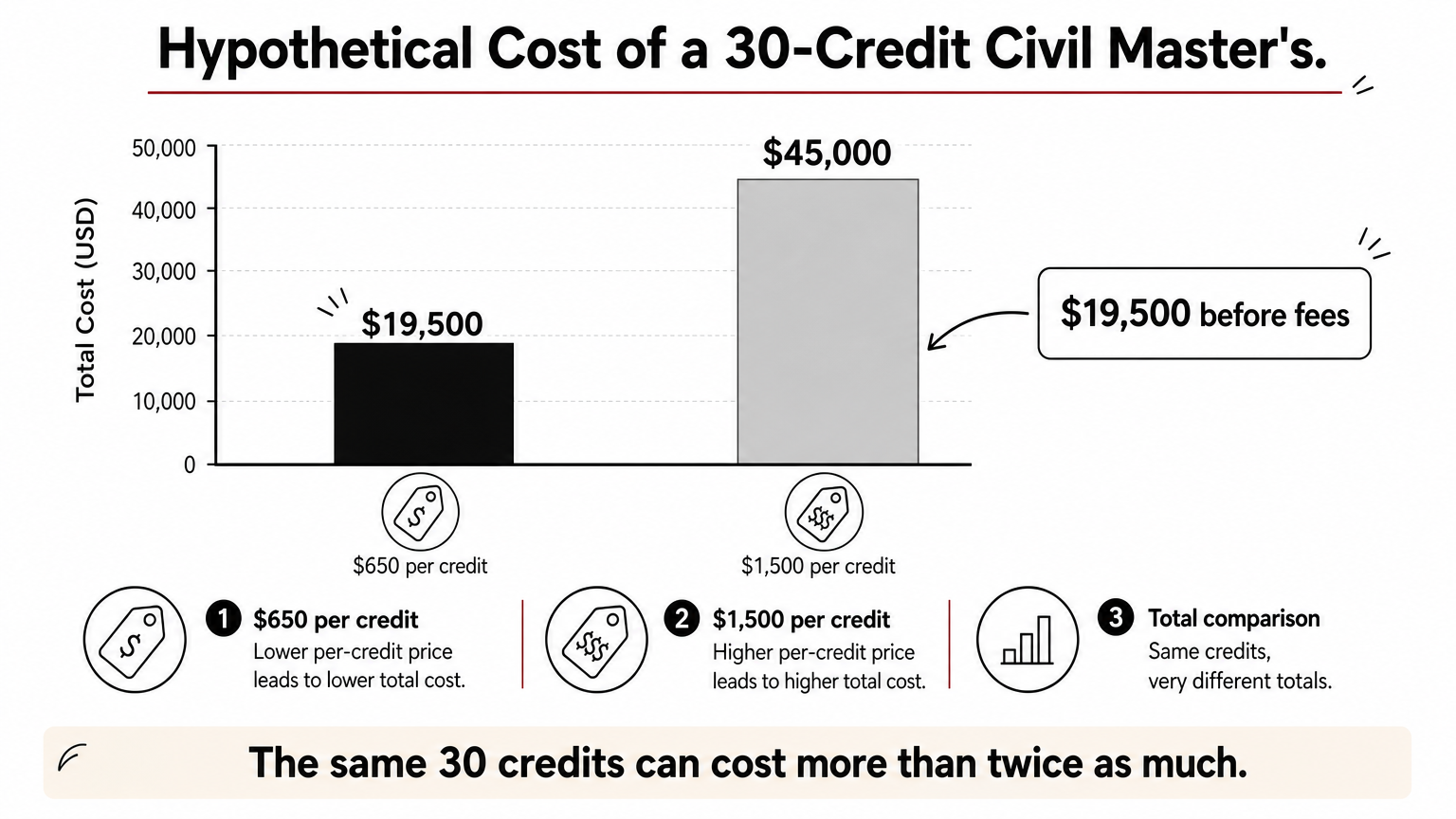
Tuition varies widely. A 30-credit master’s at a hypothetical $650 per credit costs $19,500 before fees. At $1,500 per credit it costs $45,000. This field suits working technicians, inspectors, and junior engineers who already know the licensing route.
2. Mechanical engineering
Mechanical engineering is the broadest online option and opens the widest range of employers, but it asks the most lab discipline. Georgia Tech’s College of Engineering lists mechanical engineering among its online programs.

What you study and how labs work
Core topics are thermodynamics, fluid mechanics, controls, materials, and machine design. Online programs lean on simulation software, CAD, and take-home kits to replace the lab bench.
Fully online bachelor’s degrees are rare here. Most online mechanical programs are master’s degrees for people who already hold an engineering or science bachelor’s.
Credibility, cost, and who it suits
A mechanical master’s carries weight when the school is known and your work record backs it up. ABET matters mainly for the bachelor’s, so confirm it only if you are starting from scratch. U.S. News publishes rankings of online engineering master’s programs, which make a useful shortlist but not a price guide.
Employers judge a mechanical master’s by the school and your projects, not the delivery format.
Costs usually fall in the same band as civil, with public universities cheapest. This field suits working engineers who want to specialize in areas such as controls or thermal systems.
3. Electrical and computer engineering
Electrical and computer engineering works online better than most people expect, because circuits and code can be simulated and tested at home. Arizona State University, for example, offers online graduate engineering degrees and certificates for working professionals.
What you study and how labs work
Expect circuits, signals, digital design, embedded systems, and power. Circuit simulators and low-cost lab kits cover most practical work. Some programs add short on-campus sessions for advanced equipment.
Programming runs through the coursework, so you build skills in MATLAB, Python, or C while you earn the degree.
Credibility, cost, and who it suits
Employers in electronics, energy, and software read this degree well when you add a portfolio of projects. Research universities such as Purdue appear near the top of U.S. News online engineering rankings.
In electrical engineering, a strong project portfolio makes an online degree as persuasive as a campus one.
A graduate certificate is a cheaper way to test the material, and you should ask whether its credits transfer into the full degree. This field suits software developers moving toward hardware, and technicians who want to become engineers.
4. Industrial and systems engineering
Industrial and systems engineering is the easiest field to study fully online and the best fit for career changers, because it relies on math, data, and software more than heavy labs. Georgia Tech lists industrial engineering among its online options.

What you study and how labs work
Typical topics are optimization, statistics, supply chain, quality control, and simulation. Coursework runs on spreadsheets, statistical software, and modeling tools you can use at home.
Because labs are light, more of these programs are fully online, and some are offered at the bachelor’s level.
Credibility, cost, and who it suits
Logistics, manufacturing, healthcare, and consulting employers hire for these skills. If you wonder whether 40 is too late to become an engineer, the answer is no. Online programs are built for working adults, and many students start in their 30s and 40s.
Pick industrial and systems if you want an engineering credential without a campus lab requirement.
Costs are moderate, and a graduate certificate is a low-risk first step. It suits professionals in operations, quality, or supply chain who want an engineering title and analytical depth.
5. Engineering management
Engineering management is the best online pick for working engineers heading toward leadership, but it is not a way into engineering for beginners. It is nearly always a master’s degree.
What you study and how labs work
You study project management, finance, operations, leadership, and technical decision-making. There are no lab components, so fully online delivery is the norm.
Many programs let you finish part-time in two to three years, which suits a full-time job. Ask how long the program allows you to take.
Credibility, cost, and who it suits
This degree builds on an existing engineering degree, so it is not a licensure route and ABET matters less. Accreditation of the university and the school’s name carry the weight.
Engineering management adds leadership skills to an engineering background, and it cannot replace one.
Check whether your employer offers tuition support before you pay out of pocket. If you live outside the United States, confirm that your country’s engineering body recognizes the degree. It suits engineers and technical managers aiming for team lead or director roles.
Pick the field, then check the paperwork
Choose by what you need the degree to do. Civil and mechanical lead toward licensure and need the closest look at ABET and labs. Electrical and computer rewards a strong project portfolio. Industrial and systems is the easiest way in without a campus lab requirement. Engineering management is the step up for people already working as engineers.
Whatever the field, confirm regional accreditation, ask how labs work, and work out the total cost before you apply. To compare more online degrees and certificate programs side by side, browse Study Abroad Nations.