The best online HR certificates depend on what you need the credential to do. If you want a name employers screen for, choose SHRM-CP or SHRM-SCP, or an HRCI credential such as the aPHR, PHR or SPHR. If you want practical skills fast, a self-paced program like AIHR’s fits. If you want structured coursework with a school behind it, pick a university certificate. If you just want to test the field, start with free webinars and low-cost courses.
The hard part is that these options look alike in search results but are different products. Some are exam-based certifications. Others are certificates of completion that teach skills but prove nothing on their own. Prices, time commitments and entry requirements vary a lot, and a few “online” options still require an in-person exam.
This guide compares five kinds of human resources certificate programs side by side, with the costs and time figures that are published. At Study Abroad Nations we compare online courses, degrees and certificate programs, and this list follows the same logic: what you get, what it costs, and who it suits. A comparison table near the end helps you match one to your experience and budget.
1. SHRM-CP and SHRM-SCP
SHRM offers two exam-based certifications: the SHRM-CP for operational HR work and the SHRM-SCP for senior, strategic roles. They are among the most recognized credentials in US HR.
What it is and how it works
You prepare online or in a classroom, apply during an open window, then take a computer-based exam. The exam itself is taken in person at a Prometric test center, so this is online prep, not an online credential. Prep options include self-study and SHRM Certification Prep+, which adds a live instructor in virtual, classroom or hybrid formats.
The exam is offered in two windows each year. You recertify every three years with professional development credits or by retaking the exam.
SHRM prep can happen at home, but the exam happens in a test center.
Cost and time
Exam fees include a $50 nonrefundable application fee. Study materials cost extra, and most people spend several months preparing.
| Rate | SHRM member | Nonmember |
|---|---|---|
| Early bird (CP or SCP) | $350 | $450 |
| Standard (CP or SCP) | $399 | $499 |
| Student, early bird | $150 | $250 |
SHRM reports global pass rates of 69% for the CP and 52% for the SCP. Membership dues are not included above, so weigh them against the savings. A nonmember paying the standard rate spends $149 more than a member who applies early ($499 versus $350).
Who it suits
Choose the CP if you work in HR operations or want to enter the field. SHRM’s page lists no degree or experience requirement for it. The SCP is for people with three or more years in strategic HR, or who have held the CP for three years. Pick the exam that matches your actual work, since SHRM says that is the strongest predictor of passing.
2. HRCI certifications and learning
HRCI is the other major credentialing body. Its ladder runs from the aPHR for beginners to the PHR, SPHR and the global GPHR, and it says it is the only certification body offering year-round online exams.
What it is and how it works
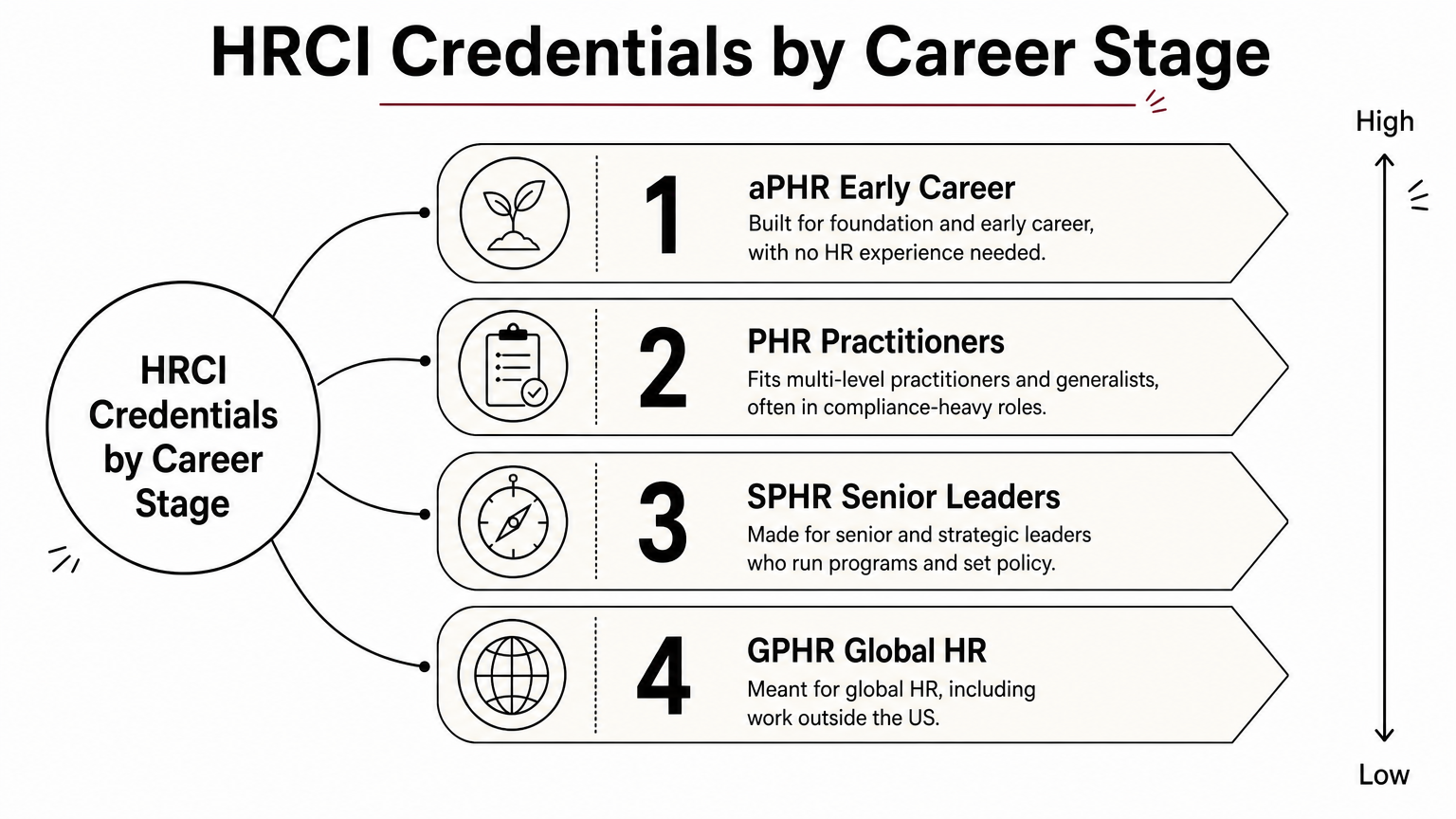
HRCI separates its credentials by career stage: aPHR for foundation and early career, PHR for multi-level practitioners, SPHR for senior and strategic leaders, and GPHR for global HR. You can sit exams at any time of year, which removes the waiting for a testing window.
HRCI also sells courses and certificates, plus an all-access subscription called HRCI ONE that bundles learning, certification and recertification. Its webinars are free and count toward recertification credit.
HRCI is the flexible-timing option, with year-round exams and a credential for every career stage.
Cost and time
HRCI’s page here does not list exam prices, so check its certification pages for current fees. Expect several months of study for the PHR or SPHR, and plan for recertification every three years.
Eligibility differs by credential. The aPHR is built for people without HR experience. The PHR and SPHR require professional HR experience, and the amount depends on your education, so confirm it before you pay.
Who it suits
The aPHR suits career changers and recent graduates. The PHR fits generalists, often in compliance-heavy roles. The SPHR is for people running programs and setting policy. If you work outside the US or support a global workforce, the GPHR is the one to look at.
3. AIHR certificate programs
AIHR offers fully online, self-paced certificate programs in specific HR domains. It is a training provider, not a credentialing body, so it teaches skills rather than replacing an exam-based credential.
What it is and how it works
AIHR lists 16+ programs, including HR Generalist, HR Business Partner, People Analytics, Artificial Intelligence for HR and HR Coordinator. You work through video lessons and real-world exercises, and finish with a capstone project. You earn a digital certificate for your LinkedIn profile once you pass the final exam with at least 70%. You can retake it within your access period.
AIHR builds skills in one HR domain, and it works best next to an exam credential, not instead of one.
Cost and time
Programs run roughly 25 to 45 hours. At five hours a week, the 33-hour HR Business Partner program takes about seven weeks, and the 45-hour HR Generalist program about nine. There are no eligibility requirements, so you can start right after enrolling.
AIHR sells its Full Academy Access membership, with unlimited access to all programs. Check its site for current pricing. Programs are eligible for SHRM PDCs and earn recertification credits with HRCI and other associations, which makes them a cheap way to keep a credential current.
Who it suits
It suits working HR staff who need a specific skill, such as people analytics, and career changers who want a structured path without a degree. It is a weaker choice if an employer explicitly asks for SHRM or HRCI credentials.
4. University HR certificate programs
University programs give you structured human resources management certificate programs with set courses, instructors and a school’s name on the credential. Examples include UNC Charlotte, LSU Online and SNHU.
What it is and how it works
UNC Charlotte’s online professional certificate has 10 courses, covering recruitment, performance management, compensation, labor relations and employee engagement. LSU Online’s Human Resource Management Certificate has seven courses, including Compensation and Benefits, Employee Selection, Performance Management and Equal Employment. SNHU lists career-focused online HR certificates at an accredited school.
A university certificate trades speed and price for structure and a school’s name.
Cost and time
The published pages don’t give fees, so check each school’s tuition page. These programs typically cost more than self-paced providers and run longer, because they follow academic schedules. Before enrolling, ask three questions:
- Is the school accredited?
- Do the credits transfer toward a degree?
- Does the program prepare you for SHRM or HRCI exams?
Who it suits
It suits beginners who learn better with deadlines and instructors, and people considering a degree later. It also suits anyone whose employer reimburses tuition from an accredited school. If you only need credentials fast, it is rarely the cheapest route.
5. Free and low-cost HR courses
Free and low-cost courses are the lowest-risk way to try HR before you commit to an exam or tuition. They teach real skills, but they carry the least weight with employers.
What it is and how it works
LinkedIn Learning, a subscription service, has a topic page of courses for HRCI exam preparation. HRCI’s webinars are free and count toward recertification credit. Working HR professionals also commonly point to webinars from HR.com, SHRM and WorldatWork. Providers such as HRcertification.com advertise online courses that earn SHRM and HRCI recertification credits.
Use free courses to test the field, then pay for a credential once you know HR is your path.
Cost and time
Webinars cost nothing and take about an hour each. Subscription courses usually run from a few hours to a few weeks of casual study. Always confirm credit eligibility before you count on a course for recertification.
Who it suits
It suits cost-conscious students and career changers deciding whether HR fits. It also suits credentialed HR staff who need cheap recertification hours. Add a certificate of completion to your résumé as a bonus, not as your main proof of skill.
How to choose the right online HR certificate
Match the certificate to your goal first, then to your experience and budget. If a hiring manager will screen for credentials, take an exam-based one. If you need a skill, take a program. If you are unsure about HR, start free.
Side-by-side comparison
| Option | Type | Exam | Best for |
|---|---|---|---|
| SHRM-CP / SHRM-SCP | Certification | In person, Prometric | Credential-focused US HR careers |
| HRCI (aPHR to SPHR) | Certification | Year-round online | Flexible timing, every level |
| AIHR programs | Certificate of completion | Online final exam | Domain skills, no prerequisites |
| University certificates | Academic certificate | Course assessments | Structure, transferable credit |
| Free and low-cost courses | Course or webinar | None | Testing HR, cheap credits |
Matching one to your situation
With no HR experience, start with the aPHR or the SHRM-CP, or build a base through an AIHR program or university certificate. With two to five years of experience, a PHR or SHRM-CP plus a skills program gives you both the credential and a specialty. If you lead HR strategy, look at the SPHR or SHRM-SCP.
On a tight budget, use free webinars first, then pay for one credential instead of several certificates. Many people combine routes: an exam-based credential for hiring screens and a skills program for daily work.
Where to go from here
Online HR certificates split into two groups. Exam-based certifications from SHRM and HRCI give you a credential employers know. Programs from AIHR, universities and free providers give you skills, structure or a low-cost trial. Pick the group that fits your goal, then pick the option that fits your experience and budget.
Check current fees and eligibility on each provider’s own page before you apply, since both change. For more comparisons of online courses, degrees and certificate programs, browse the guides at Study Abroad Nations.