The best certificate programs for a short, affordable start lead to one defined job and a credential that employers recognize. Among the ten below, nursing assistant and solar installer training are the fastest, often finishing in weeks. Medical assistant, phlebotomy, pharmacy technician, and dental assistant programs are the strongest entry points into healthcare. Computer programming has the highest median pay, and an insurance license or project management credential suits you if you want to study from home.
The hard part is not finding programs. A single college catalog can list dozens, and each one claims to prepare you for a job. You need to know how long a program really takes, what it costs, whether employers care about it, and whether you can complete it at a college near you or must go online.
This article covers ten programs, each broken into what it teaches, the time, cost, and pay, and who it suits. After the list, you get a side-by-side table and a checklist for vetting any program. At Study Abroad Nations we compile and compare online courses, degrees, and certificate programs, and this guide applies that same approach. Pay figures are national medians for the occupation, taken from U.S. News reporting in early 2025. They describe the job, not a guaranteed result of the certificate.
1. Medical assistant certificate
A medical assistant certificate is the most flexible way into healthcare. It takes about one year and prepares you for both office and clinical work in clinics and doctors’ offices.
What it covers
Medical assistants handle administrative, clinical, and management tasks. Programs teach you to collect specimens and perform basic tests, record patient information, and support the clinical team. Most also include a supervised practicum in a real clinical setting.
- Clinical skills: specimens, tests, patient care support
- Office skills: data entry and patient records
- Practicum: some programs require around 160 hours, often unpaid
Time, cost, and pay
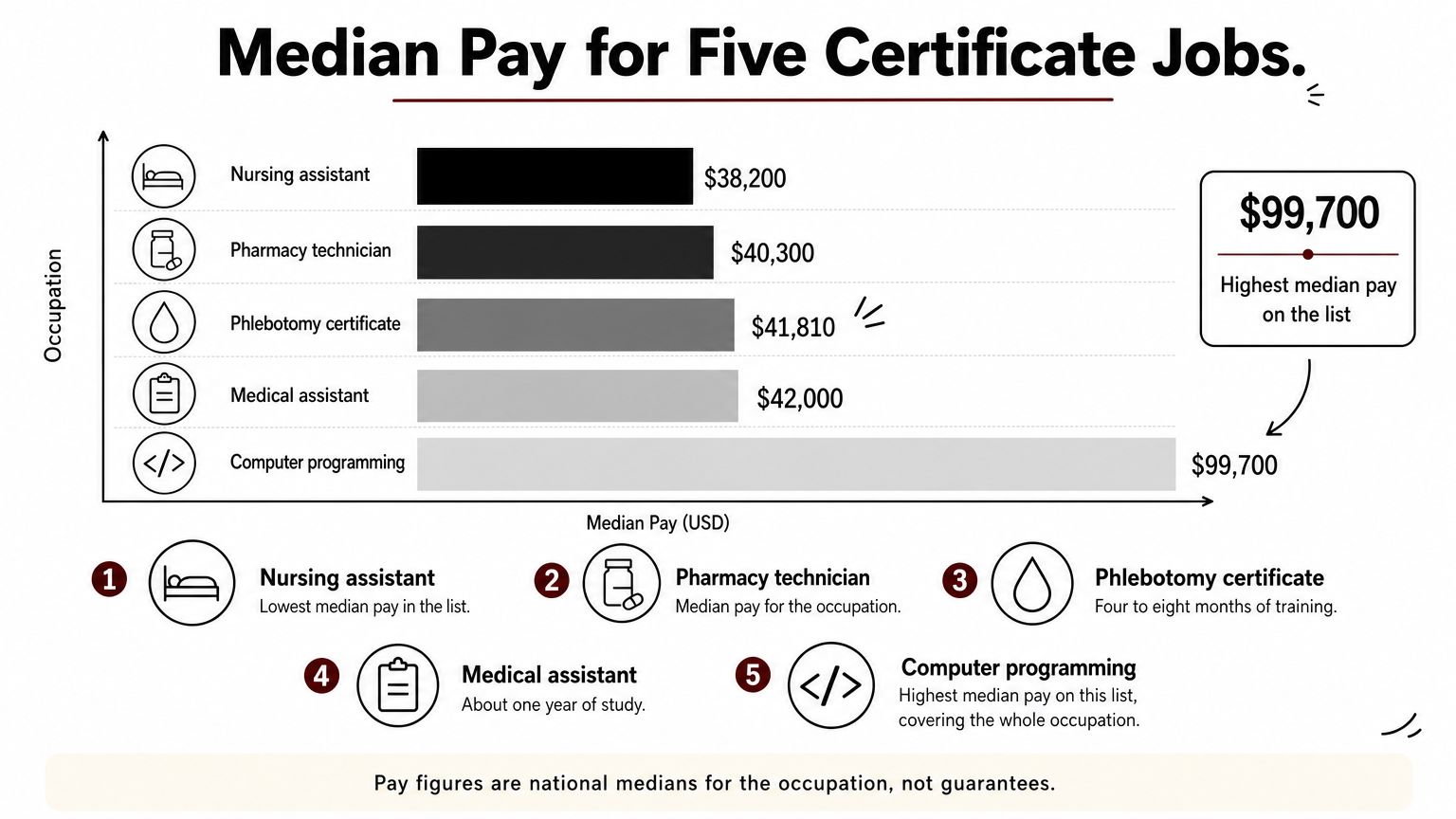
Expect about one year of study, and the practicum is the part that most often stretches the schedule. The median pay for the occupation is $42,000. Cost depends on the school, so start with your local community college’s tuition page and add fees, books, and the exam.
Who it suits
Choose this if you want patient contact and variety without committing to nursing school. You can mix front-desk and clinical duties, which keeps your options open when you apply.
Plan for the practicum before you enroll. It cannot be done online, and unpaid hours can be hard to fit around a job.
A medical assistant certificate trades one year of study for work in almost any clinic.
2. Phlebotomy certificate
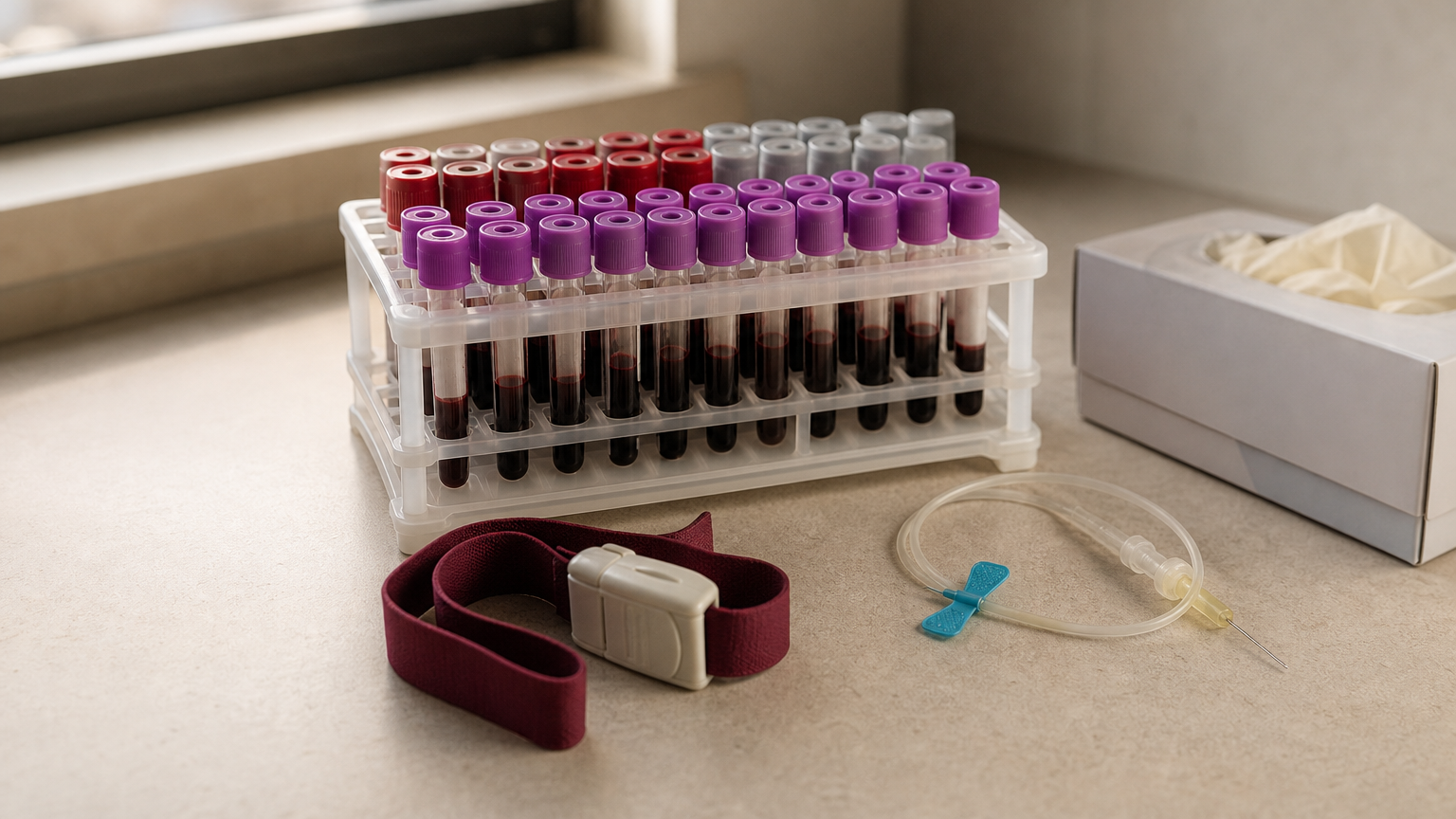
A phlebotomy certificate is one of the shortest healthcare options. It takes four to eight months and trains you to draw blood for tests, transfusions, and donations.
What it covers
Phlebotomy programs are narrow on purpose. You learn venipuncture technique, patient communication, infection control, and specimen handling. The focus is on doing a few skills correctly and safely.
- Drawing blood from patients
- Labeling and handling specimens
- Infection control and patient communication
Time, cost, and pay
Programs typically run four to eight months, and the occupation’s median pay is $41,810. Most states do not require certification, but most employers want you to finish a certificate program and earn a professional certification. That is the part you should plan for. You can find programs at community colleges, vocational schools, and technical schools.
Who it suits
This fits you if you want healthcare work quickly and are comfortable with blood and needles. It also works as a first credential you can build on later.
Check your state’s rules and a few local job postings before paying. Employers set the real standard here, not the state.
Phlebotomy certification is often optional by law and expected by employers.
3. Nursing assistant certificate
Nursing assistant training is the quickest certificate on this list, usually four to twelve weeks. It prepares you to work in nursing homes and hospitals.
What it covers
Nursing aides take blood pressure and temperature, help patients with daily care, and document patient activity. Training combines classroom study with supervised clinical practice. Passing a competency exam usually follows.
- Taking vitals and recording them
- Helping patients with daily activities
- Clinical practice under supervision
Time, cost, and pay
Requirements are set by your state. Ohio requires 75 hours of classwork followed by a state-administered evaluation, while Arizona requires 120 hours of training plus an exam. Median pay is $38,200, the lowest in this list. You generally must renew your certification every few years.
Who it suits
Pick this if you need income fast or want to test healthcare before investing more. It also works as a stepping stone. Licensed practical nursing programs typically take about a year, and some of that experience helps you choose.
Verify that a program is approved by your state’s nursing board. An unapproved course may not qualify you to sit the exam.
Your state decides how many hours nursing assistant training takes, so look up its rules first.
4. Pharmacy technician certificate
A pharmacy technician certificate takes anywhere from a few months to two years, depending on your state. It prepares you to support pharmacists in measuring, labeling, and dispensing medication.
What it covers
Pharmacy technicians measure, mix, count, and label medication dosages. They also communicate with insurance companies and help patients navigate coverage. Accuracy matters more than speed in every part of the job.
- Preparing and labeling prescriptions
- Working with insurance questions
- Patient service at the counter or by phone
Time, cost, and pay
Duration varies with state requirements, which is why the range is so wide. Median pay is $40,300. You can earn certification through the Pharmacy Technician Certification Board or the National Healthcareer Association. Classes are available at community colleges, vocational schools, and adult education centers.
Who it suits
This suits careful, detail-oriented people who prefer structured work. If you dislike repetition, the job may feel monotonous.
Before choosing a program, confirm it prepares you for the certification exam your state or employer expects. Ask the program which exam its graduates take.
In pharmacy work, precision matters more than speed, and the training reflects that.
5. Dental assistant certificate
A dental assistant certificate takes nine months to two years and supports dental offices with both clinical and administrative duties.
What it covers
Dental assistants help during procedures, use imaging and dental equipment, schedule appointments, and maintain patient records. Your exact duties depend on your credentials and your state’s rules.
- Chairside help during procedures
- Imaging and equipment use
- Scheduling and patient records
Time, cost, and pay
Programs run nine months to two years. Median pay is $46,540, the highest of the healthcare entries here apart from licensed roles. Look for a program approved by the Commission on Dental Accreditation. You may be able to get hired before you are certified, but your duties will be limited.
Who it suits
Choose this if you like steady, scheduled work with a small team and regular patients. It also suits you if you want a clinical role without hospital shifts.
Weigh the long end of the range carefully. If a program stretches toward two years, compare it with a medical assistant program that takes one.
Accreditation by the Commission on Dental Accreditation is the first thing to check in a dental assistant program.
6. Computer programming certificate
A computer programming certificate takes four to twelve months and teaches you to write code in a specific language. It has the highest median pay on this list.
What it covers
These programs prove your skill in a language and teach its styles and techniques. Expect small and large projects for practice. The projects matter because they become the work you show employers.
- One or more programming languages
- Practice projects of increasing size
- A portfolio you can show employers
Time, cost, and pay
Some university programs can be finished in as little as four months, while certain community college programs take a year. Computer programmers have a median pay of $99,700. That figure covers the whole occupation, and many programmers hold degrees, so treat it as a ceiling to work toward. Online delivery is common here.
Who it suits
This suits self-directed learners and career changers who can practice on their own. It also fits readers drawn to AI and technology who want a credential to go with their projects.
Employers often look at what you can build as much as the credential. Finish with two or three working projects, not just a certificate.
A programming certificate gets you noticed, but a portfolio of finished projects gets you hired.
7. Insurance license course
An insurance license course is the cheapest credential in the list in time, about 20 hours of coursework. It qualifies you to sell insurance once you hold your state license.
What it covers
Insurance agents may sell life, health, disability, long-term care, and casualty insurance. The more types you want to sell, the more coursework you complete. There is no national standard, because each state regulates insurance differently.
- Coursework for each insurance type
- State licensing requirements
- A license that doubles as your certification
Time, cost, and pay
Plan on roughly 20 hours of coursework, though your state and chosen lines may add more. Median pay is $59,080. Your state’s department of insurance can help you find approved courses. Confirm any provider is approved there before you pay.
Who it suits
It suits people comfortable with sales and building a client base. It also works if you want a credential you can start in the evenings.
Remember that median pay hides a wide spread in sales roles. The license opens the door, but your income depends on how well you find clients.
An insurance license is certification and permission to work in one step, set by your state.
8. Solar photovoltaic installer certificate
A solar installer certificate can take as little as a few days or as long as a few months. It prepares you to install solar panels on homes and businesses.

What it covers
Training focuses on installing solar panels safely and correctly. Your local community college or technical school may offer classes that lead to certification. Longer courses add depth.
- Panel installation on homes and businesses
- Safety practices
- Certification at the end of the course
Time, cost, and pay
Courses range from a few days to a few months. You may be certified and employed within the week, though a longer, more complex class makes a better-paying job more likely. Median pay is $48,800. Tuition varies widely, so compare the cheap short course with the longer one.
Who it suits
Pick this if you prefer physical, outdoor work to a desk and want to enter a growing trade without a degree. Expect to work on roofs, so be sure you are comfortable with heights.
Don’t assume the shortest course is the best value. Ask employers hiring installers which training they prefer.
A solar installer course can be quick, but a longer one usually leads to better pay.
9. Commercial driver training for bus work
Commercial driver training is a certificate path that leads to a commercial driver’s license. It typically takes a few months and qualifies you to drive city or school buses.
What it covers
Bus drivers safely shuttle passengers. The certificate you need depends on your state, and often it allows you to hold a commercial driver’s license. That license makes you eligible for city and school bus driver jobs.
- Preparation for the CDL
- Safe passenger transport
- State-specific testing and requirements
Time, cost, and pay
Training varies by state but may last a few months. Transit bus drivers have a median pay of $60,170. Some city departments pay employees for the time it takes to obtain a commercial driver’s license, so look at employer-sponsored training before paying tuition.
Who it suits
This suits people who want to be out of an office, work set routes, and move into steady public sector employment. It also helps if you need pay during training.
Check the employer first. If a transit agency or school district will cover or reimburse training, that beats any paid program.
Before you pay for CDL training, ask whether an employer will cover it.
10. Project management certificate
The Certified Associate in Project Management (CAPM) is an entry-level project management credential offered by the Project Management Institute. It is aimed at high school graduates and college undergraduates.
What it covers
The credential teaches project management fundamentals. It shows employers organizational, time management, and collaboration skills. That matters even if your title is not project manager, since coordinators and administrators run small projects daily.
- Core project management concepts
- Planning, scheduling, and teamwork
- A recognized credential from the issuing institute
Time, cost, and pay
The Project Management Institute sets the exam fee and eligibility rules, so check its site for current figures. Prep time depends on how you study, and many learners prepare online. No single median pay applies, because the credential supports many job titles.
Who it suits
Choose this if you work in an office or want to move toward coordinator roles. It is also the best fit in this list if you need to study entirely from home.
Treat it as a support credential, not a job title. It strengthens a resume, but it works best alongside real work experience.
The CAPM proves you understand how projects work, which helps in almost any office role.
How to compare, vet, and find programs near you
You can compare certificate programs on four things: time, total cost, pay, and whether you can finish them online. Verify accreditation or state approval before you pay anything.
Side-by-side comparison
This table sets the ten programs next to each other. Pay figures are national medians for the occupation, not guarantees.
| Program | Typical time | Median pay | Format |
|---|---|---|---|
| Medical assistant | About 1 year | $42,000 | Practicum in person |
| Phlebotomy | 4 to 8 months | $41,810 | In person |
| Nursing assistant | 4 to 12 weeks | $38,200 | In person |
| Pharmacy technician | A few months to 2 years | $40,300 | Varies by state |
| Dental assistant | 9 months to 2 years | $46,540 | In person |
| Computer programming | 4 to 12 months | $99,700 | Online or campus |
| Insurance license | About 20 hours | $59,080 | Check state approval |
| Solar installer | Days to months | $48,800 | In person |
| Bus driver (CDL) | A few months | $60,170 | In person |
| Project management | Varies by provider | Varies | Online |
For quick wins, nursing assistant and solar installer courses are the fastest. If you need an answer on what pays most, computer programming leads, with commercial driving and insurance following. If you wonder what you can learn in three months to get a job, those same short options are your best bets.
Costs, free routes, and budgeting
Plan for $1,000 to $5,000 or more for a certificate, and some cost more. A common community college rate is around $100 per credit, so a 12-credit certificate would cost about $1,200. An 18-credit program would cost about $1,800, and a 30-credit one about $3,000. Add books, fees, and exam costs on top of that.
Truly free routes exist but are limited. Some employers pay for training, as with certain city bus driver programs. Some platforms let you learn for free but charge for the credential or exam, so always check what the certificate itself costs. Ask the school whether the program qualifies for federal student aid at studentaid.gov.
Online or at a college near you
Hands-on fields such as phlebotomy, nursing assistant, dental assistant, and solar installation need in-person practice. Programming, insurance pre-licensing, and project management lend themselves to online study. For in-person programs, start with community colleges, vocational schools, and adult education centers in your area. Some state higher education agencies also publish lists of approved certificate programs.
Checks before you enroll
Run every program through the same short list:
- Is the school accredited, and is the program approved by your state or the relevant accrediting body?
- Does the program prepare you for the exact certification or license employers in your area ask for?
- What is the total cost, including books, fees, practicum, and exam?
- Are clinical or practicum hours required, and are they unpaid?
- Do local job postings mention this credential?
Check pay claims against the Bureau of Labor Statistics Occupational Outlook Handbook, and ask each school what its graduates do after finishing.
The right certificate is the one local employers ask for, from a program you can verify.
Choosing your first certificate
Certificate programs work best when you pick one job first and then the program that leads to it. Healthcare entries like medical assistant and phlebotomy balance time and demand. Nursing assistant and solar installer courses are the fastest. Programming offers the highest pay, and insurance licensing and project management let you study from home.
Before you enroll, confirm accreditation or state approval, add up the full cost, and check that local employers want the credential. A cheap, short program that employers ignore costs more than a longer one they trust.
If you want more guides that compare courses, degrees, and certificate programs, browse the articles at Study Abroad Nations. Use the comparison table above to narrow your list to two programs, then compare those two on cost and local demand.