The best CNA certificate programs online are state-approved hybrid programs. You study theory online, then finish your skills practice and clinical hours in person at a nursing facility. No legitimate program is 100% online, because every state requires hands-on training. A community college program suits you if cost matters most. A tuition-free or employer-sponsored program suits you if you have little money to spend. A 4 to 6 week private school program suits you if speed matters most.
Finding online CNA certificate programs is easy. Finding one your state will accept is harder. A cheap or fast course that your state does not approve costs you money and weeks, and it will not let you sit for the state exam.
This guide explains how these programs work and how to verify approval where you live. Then it walks through six program types with real examples, costs and lengths. At Study Abroad Nations we compare online courses and certificate programs.
How online CNA certificate programs actually work
Online CNA certificate programs deliver the classroom portion online and the practical portion in person. That split is the same in every state, and it decides what you can and cannot do from your couch.
Online theory, in-person clinicals
Federal rules set the floor at 75 hours of training, including 16 hours of supervised practical work. Many states ask for more. California, for example, expects about 160 hours, split into 60 classroom hours and 100 clinical hours. Only the classroom hours can move online.
Some sites sell study modules and call them a CNA course. Those can help you review, but they do not replace an approved program. A site that promises a CNA certificate with no in-person component is a red flag, not a bargain.
Online covers the classroom, a nursing facility covers the rest, and no state skips that second part.
How to confirm a program is state approved
Your state’s own list is the only source that counts. Look for the approved nurse aide training programs on the website of your state health department or nurse aide registry, not on the school’s marketing page. Follow these steps:
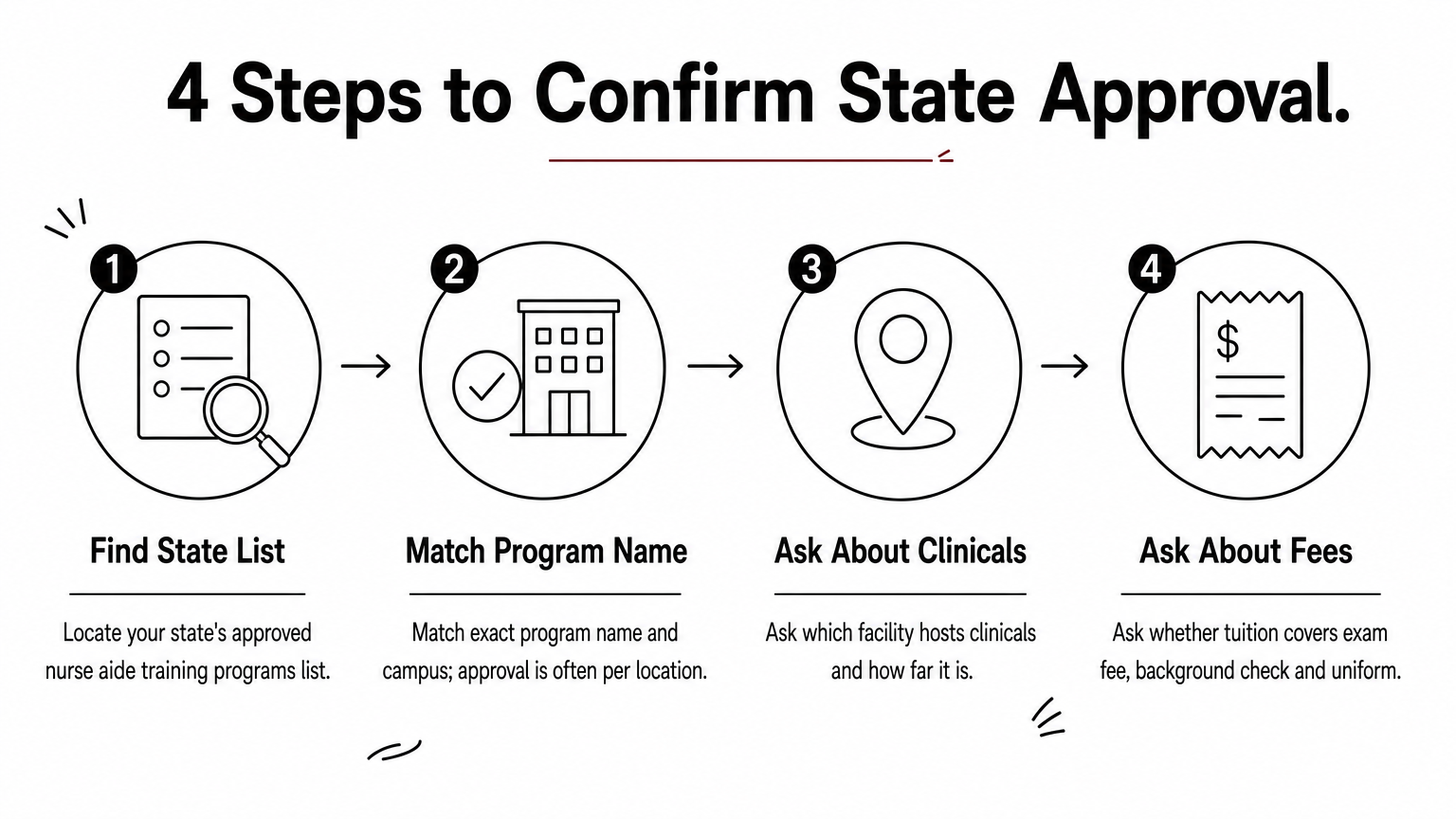
- Find your state’s list of approved nurse aide training programs.
- Match the exact program name and campus, because approval is often per location.
- Ask which facility hosts the clinicals and how far it is from you.
- Ask whether tuition covers the state exam fee, background check and uniform.
Certificate of completion versus certification
Finishing the program earns you a certificate of completion. You become a certified nursing assistant only after you pass your state’s competency exam and clear a background check. Minimum ages differ, with some states at 16 and many schools asking for 18. In California, exam results can take up to 60 days to reach the state after you test, so plan for a gap before you start work.
Six options at a glance
| Option | Length (example) | Cost (example) | Best for |
|---|---|---|---|
| Community college | 7 weeks | About $750 | Lowest cost |
| Tuition-free or employer-sponsored | About 7 weeks | $0 tuition | No cash |
| Accelerated private school | 4 to 6 weeks | $3,255 | Speed |
| Association-backed | Varies | Check provider | Live instruction |
| Nonprofit workforce program | Varies | Varies, funding possible | Support and job help |
| University continuing education | 10 weeks | $2,900 | Evening schedules |
The costs come from the California examples in the sections below. Your state’s prices will differ.
1. Community college nurse assistant programs
Community colleges offer the cheapest approved CNA certificate programs online and in hybrid form. They are the first place to look if price decides your choice.
How it works
Public colleges usually deliver the classroom portion online or in a hybrid format and send you to a partner facility for clinicals. Modesto Junior College in California shows the pattern. It combines 60 hours of online instruction with 100 clinical hours, finishes in seven weeks, and starts at the beginning of the fall, spring and summer semesters.
Colleges also tend to hold the approvals that matter. Still, confirm state approval yourself, because a college in another state cannot qualify you in yours.
Cost and length
Public colleges sit at the bottom of the price range. Two California examples show how low:
- Modesto Junior College: no tuition, about $750 for fees, textbooks, uniforms and the state exam.
- Glendale Community College: $747 total.
- Length at Modesto: about seven weeks.
Seven weeks for 160 hours works out to about 23 hours a week. That is a part-time job’s worth of time, although clinical shifts follow the facility’s schedule.
A public college program can cost about $750 all in, a fraction of what private schools charge.
Who it suits
This route suits you if you want the lowest total cost and can plan around semester start dates. The tradeoff is timing.
A missed start date can mean waiting months for the next one. If you need to begin within weeks, look at option 3 instead.
2. Tuition-free and employer-sponsored programs
Free CNA certificate programs exist, and they come from two sources: training organizations that waive tuition and nursing homes that train their own staff.
How it works
Some providers run tuition-free classes. ProCareer, for instance, advertises a free online CNA class that lasts seven weeks, meets in the evening from 6 pm to 10 pm, and includes job placement. In other cases a nursing home trains you in house and expects you to work there afterward.
Federal rules generally bar nursing homes from charging training fees to nurse aides who are employed, or who have a job offer, when the program starts. That makes it worth asking any facility that is hiring whether it sponsors training.
Cost and length
Free tuition can still leave costs and conditions behind. Ask each provider:
- Does it cover the state exam fee, uniform, background check and health screening?
- Must you work for the facility, and for how long?
- Do you repay anything if you leave early?
Treat ProCareer’s advertised 97% pass rate and 100% job placement as the provider’s own claims. Ask for current numbers before you rely on them.
Free tuition is only free if you can live with the conditions attached.
Who it suits
Choose this route if cash is your main obstacle and you are comfortable working for the sponsoring employer. You trade flexibility for a $0 tuition bill.
Run the same state approval check on every free program. "Free" and "approved" are separate questions, and only the second one gets you to the exam.
3. Accelerated 4 to 6 week private school programs
Private career schools offer the fastest online CNA certificate programs. You pay more, and you give up most of your weekdays.

How it works
These schools run hybrid courses built for speed: online theory, on-campus lab practice and a clinical externship. High Desert Medical College’s six-week program in California follows this model and ends with a Certificate of Completion. SisuCare advertises a state-approved hybrid CNA in as little as six weeks with a self-paced syllabus, and CAL ACE lists 4 and 6 week fast-track options.
Self-paced theory helps, but lab and clinical hours still run on fixed schedules you cannot move.
Cost and length
Private programs cost the most. High Desert Medical College lists $3,255, about $2,500 more than the roughly $750 community college route.
A faster program does not shorten the hours, it compresses them. If your state requires 160 hours, here is what each pace asks of you:
- 4 weeks: 40 hours a week.
- 6 weeks: about 27 hours a week.
- 7 weeks: about 23 hours a week.
A 4-week CNA program is a full-time job, because the hours stay the same and only the calendar shrinks.
Who it suits
This route suits you if you can clear weeks of your schedule and value speed over price. Federal student aid often does not apply to short, non-credit CNA programs, so ask about payment plans or the school’s own financial aid before you commit.
4. Association-backed programs with live instructors
Programs built on an industry curriculum give you a live instructor instead of recorded modules. The American Health Care Association’s CNAonline is the clearest example.
How it works
CNAonline is based on the AHCA’s curriculum and delivers RN instructor-led coursework online with in-person skills training. The AHCA represents long-term care providers, so the content is shaped around nursing home practice, where many CNAs start their careers.
Instructor-led formats usually mean scheduled sessions rather than study-whenever modules. You can ask questions in real time, but you must show up.
Cost and length
Tuition, length and the states where the program is offered all vary, so read the program page before you plan around it. Bring these questions to the provider:
- Where is the skills training held, and how far is it from you?
- Is the program approved in your state?
- Is the exam fee included in tuition?
Instructor-led online coursework only helps if your state approves the program behind it.
Who it suits
Pick this route if you learn better with an instructor than alone and expect to work in long-term care. Employers in that setting often know the curriculum.
It fits less well if you want to start tomorrow or study at 2 a.m. Scheduled classes ask for fixed hours you must keep.
5. Nonprofit workforce training programs
Nonprofits such as Goodwill train CNAs as part of broader job-readiness work. These programs often cost less than private schools and come with extra support.

How it works
Goodwill’s Certified Nurse Assistant Training Program offers classroom instruction and hands-on clinical training to prepare you to qualify for the state certification. Programs like this are often mostly in person, so ask whether any theory is online.
Nonprofits also tend to connect training with career services and employer partners. Ask what job help comes with enrollment, since that support is a main reason to choose this route.
Cost and length
Pricing and schedules depend on the local organization, so there is no single figure to quote. Check for funding before you pay anything. Your local American Job Center can tell you whether you qualify for workforce funding for approved training.
Confirm these points in writing:
- Total tuition and what it includes.
- Whether funding or grants apply to you.
- Supplies, health screening and exam fees.
Ask about workforce funding before you ask about price, because it can change the whole bill.
Who it suits
This route suits you if you want structure and in-person support, are starting a new career, or may qualify for funding. It suits you less if you need fully remote theory, since the format leans toward classrooms.
6. University continuing education hybrid programs
Universities run CNA courses through their continuing education divisions. They cost more than a community college and less than the priciest private schools, and they often add student services.
How it works
Cal State San Marcos runs a 10-week hybrid Certified Nursing Assistant Program. It combines online theory with in-person skills labs and clinicals, held at a long-term care facility under a certified nurse instructor. Traditional and evening class options exist, and the course ends with a two-day review before the state exam.
Student services include tutoring, career mentoring and job placement assistance. Those extras matter if you want guidance rather than just coursework.
Cost and length
The program costs $2,900 and runs 10 weeks. That is about $850 less than the $3,255 private six-week example, but four weeks longer.
Admission is not casual. Cal State San Marcos asks for:
- Age 18 or older and a government ID.
- A physical exam and a negative TB test or clear chest X-ray.
- A background check and BLS/CPR certification.
- Vaccination records.
Requirements differ by school, so collect your paperwork early.
University programs trade a longer calendar for tutoring, exam review and job help.
Who it suits
This route suits working adults who need evening classes and want support through the state exam. It is a middle choice on price, so it works best when a community college has no open seat and you do not need the fastest option.
Pick the program your state will accept
Every legitimate online CNA program pairs online theory with in-person clinicals, so your real choice is how you want to trade cost, speed and support. Community colleges win on price at roughly $750 in the examples above. Employer-sponsored programs win when you have no cash. Private schools win on speed, and association, nonprofit and university programs win on instruction and support.
Whichever you choose, verify approval on your state’s official list first, then ask about exam fees and clinical locations. If you want to keep comparing, you can browse more online course and certificate program comparisons on Study Abroad Nations.