The best medical assistant certificate programs combine a clear price, exam prep for a national credential, and real clinical hours. If you want the fastest all-in-one route, ODU’s five-month program prepares you for three NHA certifications. If tuition is your main concern, Clinical Skills Institute lists $900 for NHA CCMA prep. Texas State suits you if you want an exam voucher bundled into the course. Mercy College of Health Sciences and Harper College suit you if you want a CAAHEP-accredited college credential.
Programs in this field range from under $1,000 to more than $20,000. Certificates, Diplomas, CCMA and CMA all show up in the same search results. You probably also want quick answers to a few questions. How fast can you finish? Is a certificate worth it? Can you really do it with 4-week certificate programs online? You can’t. The quickest programs below take about five months, because they include clinical practice.
Each pick below gets the same three checks: how the program works, what it costs and how long it takes, and who it suits. Prices and start dates come from the schools and change often, so confirm them before you enrol.
1. ODU Certified Medical Assistant Program
ODU’s program is the most complete short option here, it spans for just 5 months and combines online coursework with hands-on clinical experience. At the end of the program, students are offered the opportunity to sit for the NHA national exams for Clinical Medical Assistant, EKG, and Phlebotomy. The cost of each of these certification exams is included in the program tuition.
How the program works
This is a non-credit, 16-week online program, and the coursework is fully asynchronous. You study at any hour, but assignments have fixed due dates. It prepares you for three NHA exams: Clinical Medical Assistant, EKG Technician and Phlebotomy Technician. ODU reports that 94% of students passed their exams on the first attempt, and 98.6% passed the CMA exam.
An 80-hour in-person externship is required. ODU places students in the Hampton Roads area, and anyone who wants a site elsewhere must find their own.
Three credentials in one program is the strongest value here, but the 80-hour in-person externship is not optional.
Cost and length
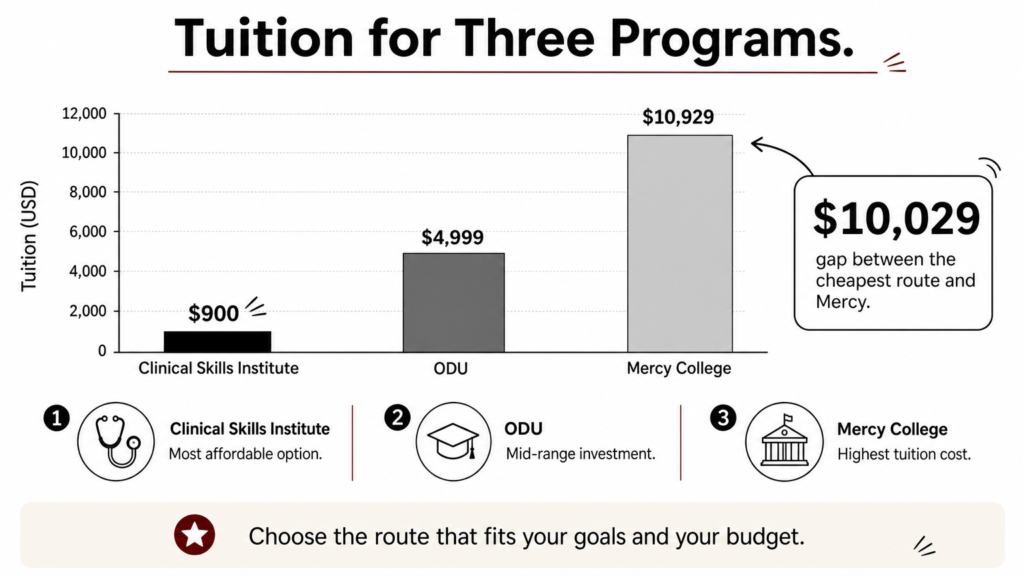
Tuition is $4,999 and includes the workbook, class materials, credential exams and externship support. The Spring 2027 session runs February 15 to July 11, 2027, with an application deadline of February 4, 2027.
| Item | Detail |
|---|---|
| Tuition | $4,999 |
| Minimum down payment | $1,550 |
| Remaining balance | $3,449 |
| Balance over five payments | about $690 each |
| Withdrawal | Written request 7 days before start, minus a $100 fee |
Because the program runs only a few times a year, plan your payments around the start date.
Who it suits
Pick ODU if you want maximum credentials per dollar and can attend an externship in southeastern Virginia. You must be 18 or older, or 17 and a high school senior or graduate. You also need a background check, immunization records, a current CPR and First Aid certificate, and a drug screen at your own expense.
2. Clinical Skills Institute
Clinical Skills Institute is the budget pick. It lists $900 tuition for online preparation for the NHA CCMA exam, and the exam fee is included.
How the program works
The training is online and flexible, and it prepares you for the NCCA-accredited NHA CCMA exam. The CCMA is the credential that most short programs target. It focuses on clinical tasks such as vitals, phlebotomy and EKG. The school also lists externship placement, so you are not left to find a clinical site alone.
A $900 price tag is only a bargain if the exam fee and the externship placement really are included, so verify both in writing.
Cost and length
At $900, this is $4,099 less than ODU’s tuition. You are not buying the same package, though. ODU adds EKG and phlebotomy credentials, and Clinical Skills Institute targets one exam. Ask the school how long the course takes, since the published listing does not give a fixed length. Also ask whether the externship has any separate costs, such as background checks or immunizations.
Who it suits
Choose this route if you are paying out of pocket and want one recognized credential quickly. It also fits you if you already have some healthcare exposure and mainly need a structured path to the exam. Ask local employers whether they accept the CCMA before you pay.
3. Texas State University CCMA course
Texas State’s continuing education CCMA course is the pick for a university-branded, fully online route that bundles the exam. The voucher is part of the listing.
How the program works
This is a 100% online course that prepares you for the Certified Clinical Medical Assistant exam from the National Healthcareer Association. The voucher covers your exam attempt, so the test itself does not come as a surprise charge. Like any CCMA prep, it works best when you also complete clinical practice. Ask how the program handles hands-on skills such as blood draws before you commit.
A bundled exam voucher removes the most common surprise cost in non-credit programs.
Cost and length
The listing we reviewed does not state a current price or length, so ask the university for tuition, start dates and any extra fees. Compare that quote against the two programs above. Check that the quote covers the course, the voucher and any books or supplies.
Who it suits
This fits you if you value a university name on your resume and want self-paced study. It also suits you if you live in a place with few local programs and need a remote option. If you need federal financial aid, ask directly. Non-credit continuing education courses often do not qualify.
4. Mercy College of Health Sciences
Mercy’s medical assistant certificate is the pick for accredited, college-level training that you complete almost entirely online. It is also the most expensive short certificate on this list.
How the program works
The program is CAAHEP-accredited and designed to be finished in one year. Instruction is 100% online, with two six-hour skills labs and a 160-hour clinical practicum. The college runs cohorts in several states, so confirm yours is open. CAAHEP accreditation matters because the AAMA’s CMA exam generally requires graduating from an accredited program.
Choose accreditation first and price second if you want the widest set of exam and job options.
Cost and length
Total tuition is $10,929, about $10,029 more than the $900 CCMA-prep route. The extra money buys accreditation, a longer practicum and a college transcript. Nurse.org’s ranking lists a combined graduation and transfer-out rate of 62% for the institution overall, so do not read it as a rate for this program alone.
Who it suits
Mercy suits you if you want a broader credential path, plan to continue into nursing or healthcare administration, or need a program that employers or later schools will recognize. It is a poor fit if you want the cheapest and fastest route to a first job.
5. Harper College medical assistant certificate
Harper College offers the most college-like option on this list, at a price that depends on where you live. For in-district students, it is also one of the cheapest accredited routes.
How the program works
This is a 36-credit certificate accredited by CAAHEP. Many courses are asynchronous online classes, and you can study part-time. Graduates are eligible for the AAMA’s Certified Medical Assistant (CMA) exam. That makes Harper the pick if local employers specifically ask for the CMA instead of the CCMA. Neither credential is universally best, so scan job postings in your area and match the one they name.
Let local job postings decide between CCMA and CMA, because employers set the real standard.
Cost and length
Tuition depends on residency, and universal fees add $792 (2026-27 figures).
| Residency | Tuition | With $792 fees |
|---|---|---|
| In-district | $5,247 | $6,039 |
| Out-of-district | $14,760 | $15,552 |
| Out-of-state | $17,478 | $18,270 |
Your timeline depends on how many credits you take per term, so a part-time schedule takes longer than the five-month programs above.
Who it suits
Harper fits you if you live in its district, want college credits and an accredited credential, and can spread study over several terms. If you live out of state, the price climbs to roughly three times the in-district total, and Mercy or ODU may be better value.
Picking the program that fits your goal
If speed and credential count matter most, ODU gives you three exams in about five months. If cost matters most, Clinical Skills Institute starts at $900. For accreditation and the CMA exam, choose Mercy or Harper. A medical assistant certificate is worth it if the program includes clinical hours and prepares you for an exam employers recognize. The Bureau of Labor Statistics reports a median pay of $45,690 for the job, per its occupational outlook.
Before you enroll, confirm the exam fee, the externship terms and your eligibility for financial aid in writing. Then, if you want to see more options, browse our comparison of online medical assistant programs on Study Abroad Nations.