Fully online LPN degrees do not exist because every approved practical nursing program requires in-person labs and supervised clinical hours. What you can find are accredited hybrid programs: online lectures plus hands-on training, finished in 12 to 18 months, ending in a certificate or diploma and eligibility for the NCLEX-PN exam. A good pick is approved by your state board of nursing, accredited by a recognised body such as ACEN, and has clinical sites you can realistically reach. Community college certificates suit budget-minded students. Career college diplomas suit people who want a structured, fast start. Bridge and LPN-to-ADN routes suit people already working in healthcare.
The trouble is that search results mix real hybrid programs with promises of 6-month online licenses. The words certificate, diploma, and degree get used as if they meant the same thing. They do not, and the difference affects your cost, your timeline, and where your credits can go later.
This article sorts the options into five paths and explains how each works, who it suits, and what it costs. Study Abroad Nations is an education publication that compares online courses, degrees, and certificate programs for students. We are not a school, so nothing here is ours to sell. Confirm every detail on the school’s own page and with your state board before you apply.
Why no LPN program is fully online
Every approved practical nursing program includes in-person labs and supervised clinical hours, so a fully online LPN program is not possible. The online part is theory: anatomy, pharmacology, and core nursing concepts, taught through lectures, assignments, and discussions. You then report to a campus lab and to hospitals, nursing homes, or clinics for hands-on training. Published programs commonly require 500 or more clinical hours, though the exact number depends on the school and your state.
That also answers the question about a 6 month LPN program online. With theory plus 500-plus clinical hours, 12 to 18 months is the realistic range. Treat a 6-month promise as a warning sign. State boards approve programs, so whichever state you live in, ask your board whether a hybrid program qualifies you for a license there.
A program that promises an LPN license without in-person clinical hours cannot lead to licensure.
What accredited means for an LPN program
Two checks matter. State board approval decides whether you can sit for the NCLEX-PN and get licensed. Accreditation, most often from the Accreditation Commission for Education in Nursing (ACEN), signals that the curriculum and clinical training meet national standards. It also affects federal financial aid and whether other schools will accept your credits later. Verify both before you pay a deposit:
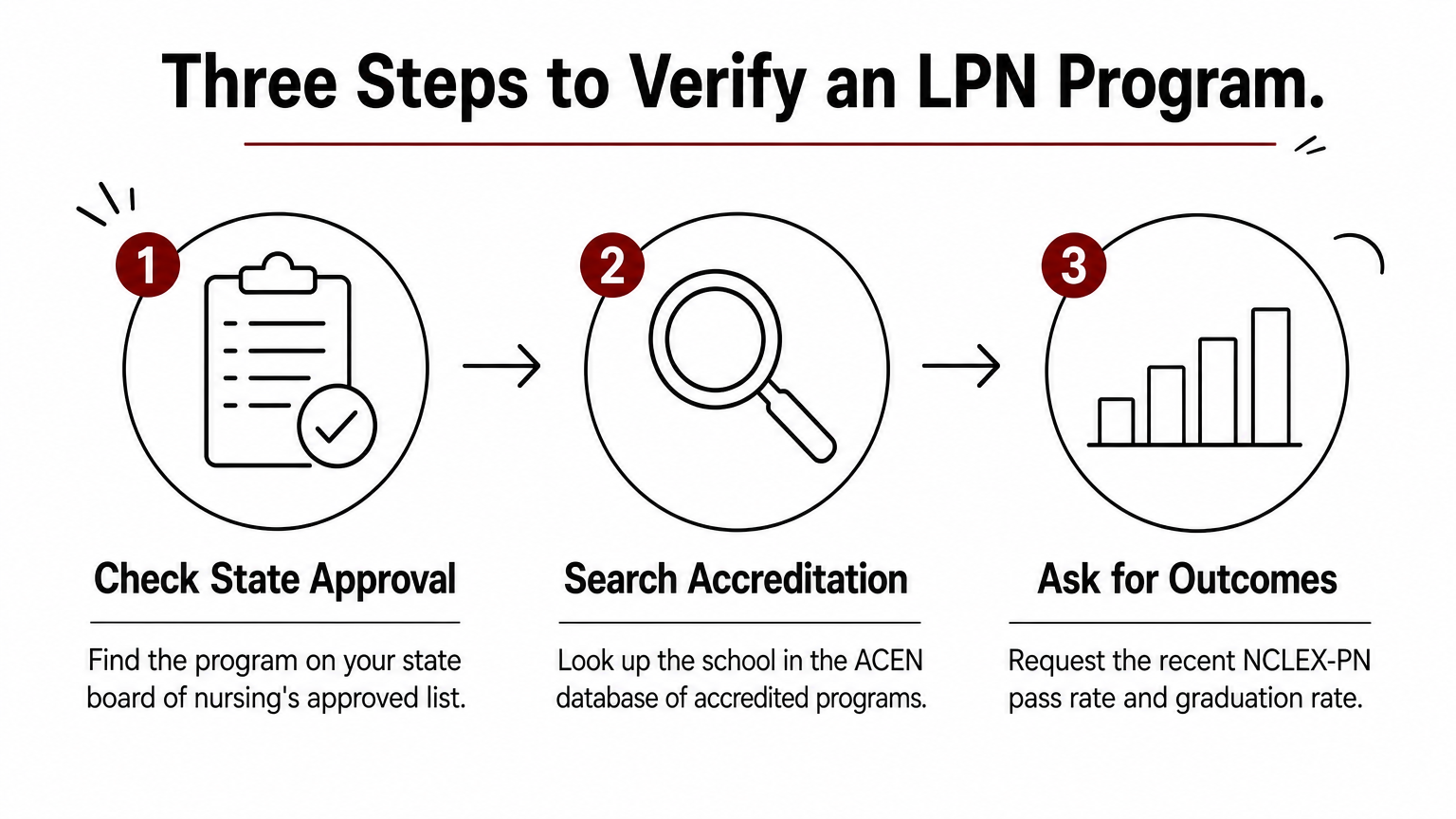
- Find the program on your state board of nursing’s list of approved programs.
- Search the school in the ACEN database of accredited programs.
- Ask the admissions office for the program’s recent NCLEX-PN pass rate and graduation rate.
Length, cost, and admissions at a glance
Programs differ, but published examples fall into similar ranges. Use this table as a baseline when you compare offers.
| Factor | Typical range |
|---|---|
| Length | 12 to 18 months |
| Credits | About 37 to 50 |
| Clinical hours | Often 500 or more, set by state rules |
| Admissions | High school diploma or GED, minimum GPA near 2.5, entrance test such as the TEAS |
| Extras | Background check, immunizations, prerequisite courses, CPR certification |
| Tuition | About $110 per credit at a public college for residents, up to roughly $390 per credit as an average among ranked private programs |
Tuition is only part of the bill. Budget for books, lab fees, uniforms, travel to clinical sites, and the licensing and exam fees at the end.
1. Hybrid LPN certificate at a community college
How it works
You take theory classes online or partly online, then attend labs and clinical rotations in person at local healthcare facilities. Published community college programs run 12 to 16 months and 42 to 45 credits. Public colleges are typically approved by the state board, and many hold ACEN accreditation, so check both.
For most students, a public community college certificate is the lowest-cost route to an LPN license.
Expect a competitive application. Common requirements include:
- A TEAS score, sometimes with a minimum percentage in reading
- A GPA near 2.5 or higher, sometimes in science courses specifically
- Completed prerequisites such as biology, English, and psychology
- A background check, drug screening, and CPR certification
Who it suits, length and cost
This path suits cost-conscious students who can attend local labs and clinicals on a set schedule. Resident tuition in published examples runs about $110 to $135 per credit. At 45 credits, that is $4,950 at $110 and $6,075 at $135, before books and fees. Out-of-state students pay far more. Examples of $280 to $308 per credit would put 45 credits at roughly $12,600 to $13,860. If you live near a state line, ask whether the college has a neighboring-state rate.
2. Practical nursing diploma at a career college
How it works
Career colleges offer practical nursing diplomas with online coursework plus on-site skills training. Herzing, for example, lists a 37-credit practical nursing diploma with online and campus classes. United Career Institute offers a 12-month online/hybrid practical nursing program, and Fortis offers PN programs that prepare you to sit for the NCLEX-PN. Campus availability and approval vary by state, so confirm the exact location you would attend.
A diploma and a degree are different credentials, and the difference shows up when you try to transfer credits.
Before you commit, ask these questions:
- Is this campus approved by my state board of nursing?
- Is the program accredited, and by whom?
- Would these credits transfer toward a later RN degree?
Who it suits, length and cost
This path suits students who want a structured schedule and a short, defined program. Cost is usually higher than at a public college. One rankings site averages about $390 per credit in state across its ranked programs. At 42 credits, that is $16,380 in tuition. Compare that with the $4,950 to $6,075 community college range above, and ask each school for a written total that includes fees, books, and clinical costs.
3. Part-time and evening or weekend hybrid programs
How it works

Some schools schedule practical nursing classes in the evenings and on weekends. A one-year schedule is possible, and part-time tracks can stretch to 16 or 18 months. The theory runs online or in a classroom after work hours. The catch is clinicals. Many rotations happen at set times in healthcare facilities, so ask exactly which days and shifts you will need to cover.
Ask for the clinical schedule in writing before you enroll, because the clinicals decide whether you can keep your job.
Questions to ask the program:
- Are clinical rotations offered on evenings or weekends?
- Can I request placements near home?
- Does the program set a maximum time to finish?
Who it suits, length and cost
This route suits working parents, caregivers, and people holding a full-time job who cannot step away for a daytime program. Per-credit tuition is the same as in the day program at the same school, so the cost is similar. A longer timeline means more months of living expenses. Part-time enrollment may also change how much financial aid you qualify for, so ask the financial aid office to run both scenarios.
4. CNA or medical assistant to LPN bridge programs
How it works

Bridge programs give credit for what you already know, so you skip some foundational nursing courses and finish faster. Medical assistant to LPN bridges typically mix online coursework with in-person clinicals. Some states and programs expect an active CNA certification during clinical training, so confirm that requirement early. Bridge programs still require approval by the state board and lead to the same NCLEX-PN.
Bridge credit shortens the program, but it never replaces the clinical hours or the licensing exam.
What to bring to the credit evaluation:
- Transcripts from your CNA or medical assistant training
- Proof of your active certification
- A record of your work experience in healthcare
Who it suits, length and cost
This path suits CNAs, medical assistants, and other healthcare workers who want a clear step up in scope. Fewer required courses can mean fewer credits to pay for, so a lower tuition bill, but only if the school accepts your prior work. Ask for the credit evaluation in writing before you pay. Employers sometimes offer tuition reimbursement for staff in these roles, so check with your human resources office.
5. LPN-to-ADN or LPN-to-BSN online degrees
How it works
This is the path where you actually earn a degree. If you already hold an LPN license, LPN-to-ADN and LPN-to-BSN programs combine online coursework with in-person clinicals and prepare you for the NCLEX-RN. These programs are usually accredited by ACEN or the Commission on Collegiate Nursing Education (CCNE). Accreditation matters more here, because master’s programs typically only accept credits from accredited schools.
If you want a true degree, you start from a license you already hold, and you earn the degree through a bridge program.
Pick the school based on how it treats your existing credits:
- Does the program count your LPN coursework and license toward the degree?
- How many credits remain after the evaluation?
- Where do clinical placements take place?
Who it suits, length and cost
This path suits licensed LPNs who want RN responsibilities and a degree on their record. Length and cost depend on how many credits the school accepts, so request a written credit evaluation from each school before you compare. Because many of these programs cost less per credit at public institutions, start with public colleges in your state, then compare private options.
Choosing your path
If you want the lowest cost, start with a hybrid certificate at a public community college. If you want structure, compare career college diplomas. If you work, look at evening or weekend tracks. If you already work in healthcare, price out a bridge. If you hold an LPN license, a bridge to an ADN or BSN is where the degree lives. Whichever you choose, confirm state board approval and accreditation first.
Comparing programs takes time, and details vary by school and state. Study Abroad Nations keeps comparing online courses, degrees, and certificate programs, so you can explore more education options while you narrow your list, starting with our tips for choosing a nursing degree.