If teachers shape minds and doctors save lives, which impact truly matters more when life itself is on the line? A teacher may prepare you for the future, but a doctor ensures you live long enough to see it.
Mr. Chairman, panel of judges, accurate timekeeper, co-debaters, and esteemed readers, this article supports the motion that states that doctors are better than teachers. Both professions are very important in society.
A farmer is an individual who works in agriculture, managing land to grow crops or raise livestock for food, fiber, and raw materials. A doctor, on the other hand, is a licensed, highly trained healthcare professional who diagnoses, treats, and prevents injuries and illnesses to maintain patient health.
I am not trying to downplay the vital role teachers play in shaping the minds of individuals and influencing them in ways that profoundly impact their entire lives. However, doctors nurture life itself. They help save lives, fight infections, and carry out groundbreaking research that makes life more conducive for everyone.
This article supports the motion and argues that doctors are superior to teachers, using the points outlined below.
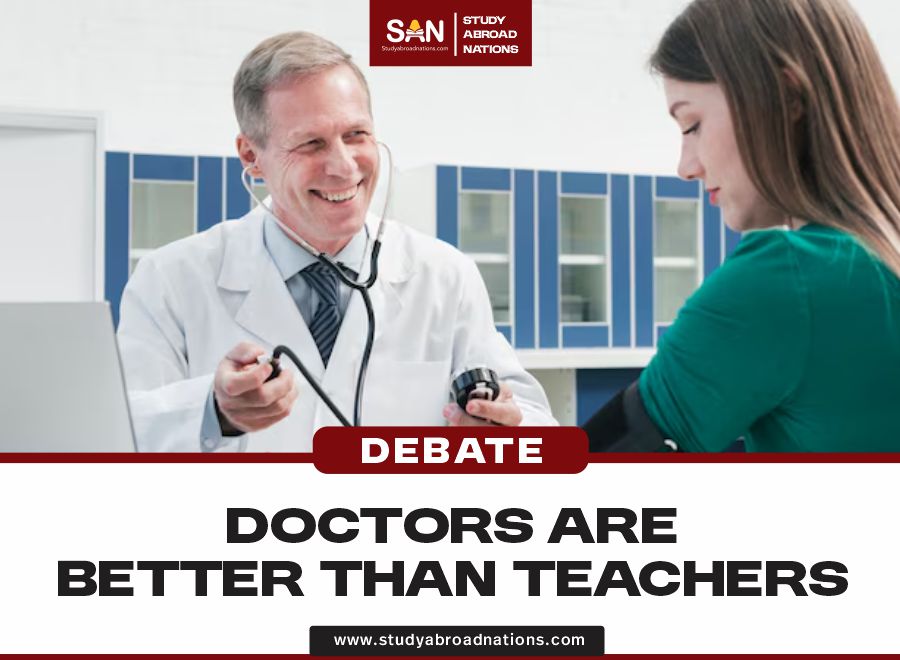
7 Reasons Why Doctors Are Better Than Teachers: Debate Points
- Doctors are lifesavers
- Doctors deal with irreversible consequences
- Doctors apply knowledge under chaos
- Doctors are forced to update their knowledge continuously
- Doctors play a very important role in society
- Doctors advance civilization through direct scientific impact
- Doctors are the backbone of society when war or disasters occur
Doctors Are Lifesavers
Before anyone can truly learn, teach, or absorb knowledge, health must come first. Doctors ensure that people are healthy enough to live, think, and function. Infections are detected early, tumors are identified before they spread, and lives are saved because of the intensive research doctors carry out daily, all in the pursuit of improving quality of life.
Teachers are undeniably important, but their work is not as urgent as that of doctors. The knowledge teachers pass on often takes years to show its impact in society. While that impact is valuable, it cannot compare to the immediacy of health. After all, knowledge is useless if you are no longer alive to apply it.
The quality of life in any society truly matters. What is knowledge without good health or a long life to use it? We can’t achieve our dreams of making the world a better place if our lives are cut short due to preventable illnesses. Without doctors conducting research and preserving lives, society would lose the very foundation needed for progress.
Doctors Deal With Irreversible Consequences
A teacher can unintentionally pass on incorrect information. When this happens, they are often allowed to correct the mistake. They have time to admit the error, clarify the right facts, and guide their students properly. For doctors, however, that second chance is rarely available. A single mistake can lead to irreversible consequences, and they are required to face outcomes that cannot be undone.
Every day, people lose their lives because they cannot reach a doctor on time, are misdiagnosed, or resort to self-medication due to the high cost of healthcare. Yet no one has ever died because they could not get to a teacher or lecturer on time, or because they missed a few classes.
Doctors are more important than teachers because, in moments of crisis, when life itself is under threat, it is doctors who step in. They make critical decisions under pressure and save lives that could have been lost to life-threatening situations or chronic illnesses that drastically reduce the quality of life.
Doctors Apply Knowledge Under Chaos
Teachers are admired for how well they design curricula and structure learning. They carefully plan their lessons, prepare lecture notes ahead of time, and deliver content in a way that helps students understand not just academic knowledge, but also culture and values.
Their strength lies in organization, preparation, and the ability to guide minds over time.
A doctor’s job, however, is entirely different. It is both urgent and critical. Doctors work under intense pressure, often with no room for error, because human life is fragile. This is why they spend many years in school, internships, and hands-on practical training.
Every stage of their education is focused on mastering the science of saving lives and treating illnesses.
Without doctors, teachers themselves could die from diseases that knowledge alone cannot cure. A teacher cannot perform chemotherapy or stop severe bleeding from an open wound. While teaching is undeniably vital, when it comes to preserving life itself, doctors are more important than teachers.
Doctors Are Forced to Update Knowledge Continuously
If doctors do not continue to carry out health-related research on medicines and herbs, the healthcare sector would become dangerous. People would be forced to rely solely on outdated treatment methods, methods that may have worked in the past because of the kind of food people consumed and the lifestyle they lived at the time.
In today’s generation, processed foods are consumed far more frequently. Some people overeat in an attempt to gain weight, while others starve themselves in an effort to lose weight.
Without doctors constantly researching and searching for cures for diseases that currently have no solutions, people will continue to suffer from illnesses that could otherwise be prevented or managed.
Before the development of the cesarean section, many women died from complications during childbirth. Sadly, women still lose their lives today from conditions that a timely cesarean section could have resolved.
If doctors do not continually update their knowledge of human anatomy and medical practices, there will be a decline in human health and well-being. This is one of the reasons this article strongly supports the motion that doctors are better than teachers.
Doctors Play A Very Important Role in Society
Doctors play a crucial role in society. They are not only medical experts who diagnose, treat, and prevent illnesses; they are also educators, community leaders, and empathetic individuals who advocate for patients in ways that no other profession, especially teaching, can match.
Imagine a world without doctors. Human survival would be almost impossible, especially in an era where processed food consumption is at an all-time high and unhealthy eating habits are common. Issues such as postpartum depression, anxiety disorders, ADHD, and other compulsive conditions would go unmanaged, plunging society into chaos.
Without doctors, we would not understand why we struggle to concentrate or complete tasks, why persistent headaches refuse to go away, why a simple boil does not heal, or why a young, vibrant woman begins to lose her hair.
Doctors make it possible to run tests, identify the root causes of these problems, and provide proper treatment before prescribing medication.
Doctors Advance Civilization Through Direct Scientific Impact
Doctors not only save individual lives; they push civilization forward through science and innovation. Every medical breakthrough, whether it is a new vaccine, a safer surgical procedure, or a more effective treatment for chronic diseases, directly improves how long and how well people live.
These advancements shape societies by reducing mortality rates, increasing life expectancy, and allowing people to contribute meaningfully to the world for longer periods.
Through continuous research and clinical trials, doctors transform observations into solutions. Diseases that once wiped out entire communities are now preventable or manageable because doctors refused to accept death as the final answer.
Their work fuels progress in biotechnology, pharmaceuticals, and public health systems, creating ripple effects that extend beyond hospitals into economies, education, and governance.
A civilization cannot truly advance if its people are constantly sick, weak, or dying prematurely. By protecting human life and improving its quality, doctors lay the scientific foundation upon which every other profession, including teaching, can function.
In this way, doctors do not just serve society; they actively move civilization forward.
Doctors Are The Backbone Of Society When War Or Disasters Occur
In times of war and disaster, doctors become the backbone of society. When systems collapse, and chaos takes over, it is doctors who stand between life and death. While buildings can be rebuilt and institutions restored, lost lives cannot be replaced.
Doctors work under extreme conditions, often with limited resources, treating the injured, preventing the spread of disease, and making rapid decisions that determine who survives.
During wars, natural disasters, and humanitarian crises, doctors provide emergency care, perform life-saving surgeries, and manage outbreaks that could wipe out entire populations.
They operate without certainty, rest, or safety, driven by the urgency of preserving human life. In these moments, education can pause, but healthcare cannot.
Civilization survives crises because doctors do not step away when danger appears. They step forward. Their ability to respond immediately during emergencies proves that, when survival is at stake, doctors are not just important; they are indispensable.
Conclusion
While teachers shape minds and build the foundation of knowledge for future generations, doctors shape lives, and by extension, the very survival of society. They work tirelessly under pressure, make life-or-death decisions, and advance civilization through science, research, and innovation.
Without doctors, knowledge would mean little, for a mind cannot thrive in a body that is sick, weak, or dying.
From saving lives during crises and disasters to pioneering treatments that extend human life, doctors hold a unique role that no other profession can replace. They are not just caretakers of health; they are guardians of society itself. In the urgent and delicate balance of human existence, doctors are the difference between life and death, between progress and stagnation.
For these reasons, it is clear: when it comes to impact, responsibility, and necessity, doctors are indeed more vital than teachers.